A drug formulary is a list of prescription medications that your health insurance plan agrees to cover. It’s not just a catalog-it’s a tool that decides which drugs you can get at a low cost, which ones will cost you more, and which ones your plan won’t cover at all. If you’ve ever been surprised by a high pharmacy bill, or told your doctor you can’t fill a prescription because it’s "not on the list," you’ve run into a formulary. Understanding how it works can save you hundreds-or even thousands-of dollars a year.
How a Drug Formulary Works
Think of a formulary like a menu at a restaurant. Not every dish is available, and some cost more than others. Your insurance plan picks which medications to include based on three things: how well they work, how safe they are, and how much they cost. The goal isn’t to limit your options-it’s to make sure you get effective treatment without paying more than necessary. Formularies are created and updated by Pharmacy and Therapeutics (P&T) committees. These are teams of doctors, pharmacists, and other healthcare experts who review new drugs, clinical studies, and real-world data every few months. They decide whether a new medication should be added, moved to a different tier, or removed entirely. This isn’t done by insurance companies alone-it’s based on medical evidence.Tiered Costs: What You Pay Depends on the Tier
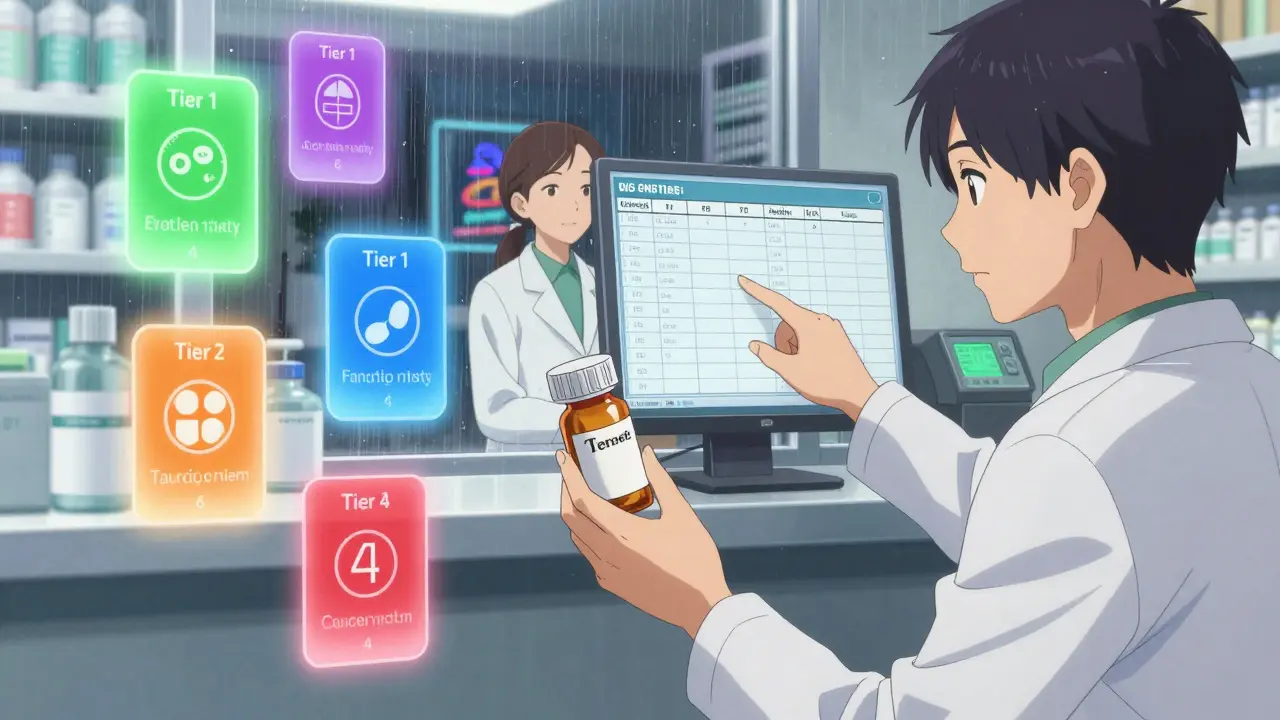
Most formularies use a tier system to show how much you’ll pay for each drug. The higher the tier, the more you pay. Here’s how it typically breaks down:- Tier 1: Generic drugs - These are the cheapest. They’re chemically identical to brand-name drugs but cost far less. Most plans charge $0-$10 for a 30-day supply. Examples include metformin for diabetes or lisinopril for high blood pressure.
- Tier 2: Preferred brand-name drugs - These are brand-name medications that your plan has negotiated lower prices for. You’ll usually pay $25-$50 per prescription, or 15-25% coinsurance.
- Tier 3: Non-preferred brand-name drugs - These are brand-name drugs your plan doesn’t strongly recommend. You’ll pay more-often $50-$100 or 25-35% coinsurance. This is where surprises happen. A drug your doctor prescribed might suddenly cost twice as much because it moved to this tier.
- Tier 4: Specialty drugs - These are high-cost medications for complex conditions like cancer, multiple sclerosis, or rheumatoid arthritis. Costs range from $100-$300 per month, or 30-50% coinsurance. Some plans even have a Tier 5 for the most expensive drugs, which can cost over $1,000 a month without coverage.
It’s important to know that the same drug can be on different tiers across different plans. For example, the diabetes drug glimepiride might be Tier 1 on one plan and Tier 3 on another. That’s why comparing formularies during open enrollment matters.
Why Your Medication Might Not Be Covered
Sometimes, a drug you need isn’t on the formulary at all. That’s called "non-formulary." It doesn’t mean the drug doesn’t work-it just means your plan hasn’t agreed to cover it. This often happens with newer brand-name drugs, off-label uses, or medications that haven’t gone through the P&T committee’s review. If your drug is non-formulary, you’ll pay full price unless you get an exception. You can ask your doctor to file a formulary exception request. They’ll need to explain why you can’t use a drug on the list-maybe you tried all the alternatives and had side effects, or the other drugs simply didn’t work. In urgent cases, approval can happen in 24 hours. For non-emergencies, it usually takes 72 hours. In 2023, about two out of three exception requests were approved in Medicare Part D plans.
Restrictions That Can Block Your Access
Even if a drug is on the formulary, your plan might still put limits on it. These are called utilization management tools. Three common ones:- Prior authorization - Your doctor must get approval before the plan will pay. This often happens with expensive drugs or those with high misuse potential, like opioids or certain antidepressants.
- Step therapy - You have to try cheaper drugs first. For example, if you have rheumatoid arthritis, your plan might make you try methotrexate before covering a biologic like Humira. If those don’t work, you can then request to move up.
- Quantity limits - You can only get a certain amount per month. For instance, your plan might allow only 30 pills of a painkiller per month, even if your doctor prescribes 60.
These rules are meant to prevent waste and overuse-but they can delay treatment. If you’re stuck in step therapy and your condition is worsening, ask your doctor to request an expedited review.
Formularies Change-All the Time
Many people assume their formulary stays the same all year. It doesn’t. Plans update their lists every January, but changes can happen anytime. A drug might be moved to a higher tier, removed entirely, or have new restrictions added. Your plan must give you 60 days’ notice before a change affects your current prescription. That’s why checking your formulary every year during open enrollment is critical. If you’re on Medicare, use the Medicare Plan Finder tool (updated every October) to compare plans. If you’re covered through an employer, log into your insurance portal and download the current formulary document. Don’t wait until you’re at the pharmacy counter.Real Stories: How Formularies Affect Lives
One woman in Ohio, who goes by "MedicareMom2023," shared on a patient forum that her diabetes medication moved from Tier 2 to Tier 3. Her monthly cost jumped from $35 to $85. She couldn’t afford it, so she switched to a generic alternative-her blood sugar stabilized, and she saved $600 a year. Another patient, "CancerSurvivor87," had immunotherapy for breast cancer. The drug cost $5,000 per dose off-formulary. But because it was on Tier 4 of her plan, she paid only $95 per dose. She called it a lifesaver-not just medically, but financially. A 2023 Kaiser Family Foundation survey found that 68% of insured adults check their formulary before filling prescriptions. Nearly half have switched medications because of formulary changes. That’s not a small number-it’s a major part of how people manage their health.
What You Can Do Right Now
You don’t have to guess or wait for surprises. Here’s what to do:- Find your formulary - Go to your insurance website or call customer service. Ask for the current “Drug List” or “Formulary Document.”
- Search your medications - Type in the exact name (brand and generic) to see which tier it’s on and if there are restrictions.
- Ask your pharmacist - They have access to real-time formulary data and can tell you if a drug is covered before you leave the store.
- Check during open enrollment - If you’re on Medicare, compare plans between October 15 and December 7. If you have employer coverage, review options when your plan renews.
- Know your rights - If a drug is denied, you can appeal. Your doctor can help you file a formulary exception. Don’t accept a "no" without asking.
What’s Changing in 2025
New rules are making formularies more patient-friendly. Starting January 1, 2025, Medicare Part D will cap out-of-pocket costs for all covered drugs at $2,000 a year. Insulin is already capped at $35 per month under the Inflation Reduction Act. Biosimilars-lower-cost versions of biologic drugs-are being added to more formularies. In 2024, the FDA approved 15 new biosimilars, bringing the total to 43. These are already cutting costs for patients with arthritis, cancer, and autoimmune diseases. By 2027, AI tools will help plans predict which drugs work best for individual patients based on their history, genetics, and response to past treatments. This could mean fewer step therapy delays and more personalized care.Final Thought
A drug formulary isn’t your enemy. It’s a system designed to help you get the right medication at a price you can afford. But it’s not perfect. It’s complex, it changes often, and it can leave gaps. The key is to stay informed. Know your plan. Know your drugs. Ask questions. And don’t be afraid to push back if your health depends on it.What happens if my drug isn’t on the formulary?
If your drug isn’t on the formulary, your insurance won’t cover it-or will charge you full price. You can ask your doctor to file a formulary exception request. They’ll need to explain why other covered drugs won’t work for you. If approved, your plan will cover it. About 67% of these requests are approved in Medicare plans.
Can my insurance change my formulary during the year?
Yes. Plans can update their formularies at any time, but if a change affects a drug you’re currently taking, they must notify you at least 60 days before the change takes effect. If your drug is removed entirely, you may be allowed to finish your current prescription or get a transition fill.
Why do some generic drugs cost more than others?
All generics are FDA-approved to be the same as brand-name drugs. But plans group them into tiers based on cost negotiations. One generic might be on Tier 1 (lowest cost) because the manufacturer gave the plan a big discount. Another generic might be on Tier 2 if it’s less commonly used or the manufacturer didn’t negotiate as well.
How do I know if my Medicare Part D plan covers my drugs?
Use the Medicare Plan Finder tool on Medicare.gov. Enter your medications, dosage, and pharmacy. It will show you which plans cover them, what tier they’re on, and your estimated monthly cost. Do this every year during open enrollment (October 15-December 7).
Are formularies the same across all insurance plans?
No. Each plan-whether it’s Medicare Part D, Medicaid, or private insurance-creates its own formulary. A drug on Tier 2 in one plan might be Tier 4 in another. Even the names of tiers can differ: one plan calls them "Preferred Generic," another uses "Tier 1." Always compare formularies when choosing a plan.
What’s the difference between a formulary and a drug list?
There’s no difference. "Drug list," "preferred drug list," and "formulary" all mean the same thing. These are just different terms used by different insurers. The structure and rules are identical.
Can I switch to a different drug if mine is on a high tier?
Yes, and many people do. If your drug is on Tier 3 or higher, ask your doctor if there’s a similar medication on a lower tier. Often, there’s a generic or preferred brand that works just as well. Switching can cut your monthly cost by 50% or more.