
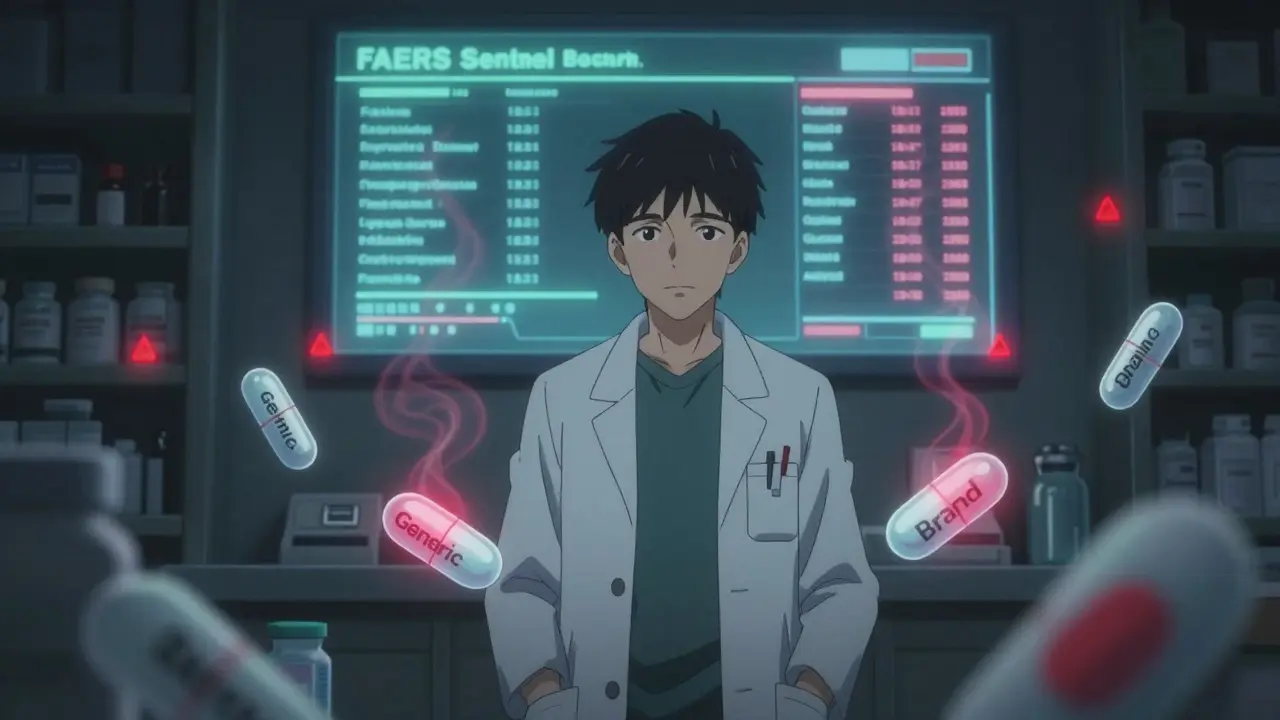
The FDA doesn’t stop checking on generic drugs once they’re approved. In fact, that’s when the real monitoring begins. Generic drugs make up 90% of all prescriptions filled in the U.S. today. That’s over 3 billion prescriptions a year. But unlike brand-name drugs, generics don’t go through large clinical trials to prove they work the same way. Instead, they only need to prove bioequivalence-meaning they deliver the same amount of active ingredient into the bloodstream at the same rate as the brand-name version. That’s efficient. But it also means some potential issues might not show up until thousands or millions of people start taking them. So how does the FDA catch problems after a generic drug hits the market?
How the FDA Tracks Problems After Approval
The FDA uses three main systems to watch what happens after generics are sold: FAERS, Sentinel, and MedWatch. These aren’t just databases-they’re active surveillance networks that collect real-world data from doctors, patients, pharmacies, and hospitals.
The FDA Adverse Event Reporting System (FAERS) is the backbone. It’s a computerized system that gathers reports of side effects, medication errors, and unexpected outcomes. Anyone can report: a patient who feels worse after switching to a generic, a pharmacist who notices a strange reaction, or a doctor who sees a pattern in their clinic. In 2023 alone, FAERS received over 1.2 million reports, nearly half of them involving generic drugs. The FDA’s Office of Surveillance and Epidemiology has a team of epidemiologists and safety scientists who sift through these reports looking for patterns. If a certain generic drug shows up repeatedly in reports of dizziness, rash, or low blood pressure-especially compared to the brand-name version-they flag it for deeper review.
The Sentinel Initiative is the FDA’s next-generation tool. Launched in 2008, Sentinel uses real-time data from electronic health records and insurance claims from over 200 million Americans. That’s more than half the U.S. population. Unlike FAERS, which waits for reports to come in, Sentinel actively scans for signals. It can detect if patients taking a specific generic drug are being hospitalized more often, or if they’re filling prescriptions for additional medications (like antacids or blood pressure pills) at higher rates than those taking the brand-name version. This system caught early warning signs in several complex generics, including extended-release pills and inhalers, before FAERS even had enough reports to notice.
MedWatch is the public-facing arm. It’s the portal where patients and providers report problems directly to the FDA. It’s simple: go to the website, fill out a form, and submit. No special training needed. The FDA reviews every MedWatch report related to generics. Sometimes, a single report can spark a full investigation-if enough people report the same issue, like a generic pill dissolving differently or causing nausea that the brand-name version never did.
Why Generics Need Extra Monitoring
Not all generics are created equal. Simple generics-like a 10mg tablet of atorvastatin-are straightforward. The active ingredient is the same, the dosage form is the same, and the body absorbs it the same way. But complex generics are a different story. These include inhalers, topical creams, injectables, and extended-release pills. For these, bioequivalence doesn’t always mean therapeutic equivalence.
Take an asthma inhaler. Two generics might have the same active drug, but different propellants or particle sizes. One might deliver the medicine deeper into the lungs than the other. A patient switching from brand to generic might not notice until they have an asthma attack. The FDA calls these “therapeutic equivalence gaps.” That’s why they created the Center for Research on Complex Generics (CRCG) in 2020, partnering with universities to study exactly how formulation differences affect real patients.
Another issue is the nocebo effect. That’s when a patient expects a generic to work worse-and then it does. A 2019 study in JAMA Internal Medicine found that 15% of adverse event reports for generics involved complaints about reduced effectiveness. But when researchers checked lab data, there was no difference in drug levels. The patient’s belief changed their perception, and sometimes even their body’s response. The FDA now trains its staff to look for patterns that separate true safety issues from psychological ones.
What Happens When Something Goes Wrong
When the FDA spots a potential problem, they don’t wait. They act fast.
- If a pattern emerges-say, three different manufacturers of a generic blood pressure pill show spikes in kidney-related hospitalizations-the FDA launches a targeted investigation. They might request data from the manufacturers, review production records, or even retest samples.
- If they find a manufacturing flaw, they can issue a voluntary recall. No court order needed. Companies usually comply within 48 hours.
- If the issue is labeling, they update the package insert. For example, a generic antidepressant might get a new warning about increased anxiety in the first week of use, even if the brand-name version doesn’t have it.
- In serious cases, they send out a “Dear Healthcare Provider” letter. These are official notices sent directly to doctors and pharmacists, warning them to monitor patients more closely.
In 2022, the FDA issued over 40 safety alerts related to generic drugs. Half of them were for complex generics. One alert led to the withdrawal of a generic extended-release metformin after reports of unexplained weight loss and low blood sugar. Another prompted a label change for a generic seizure medication after doctors reported breakthrough seizures in patients who had been stable on the brand.
The Future: AI and Real-World Data
The FDA is investing heavily in the future. In 2023, they allocated $5.2 million specifically to develop artificial intelligence tools for monitoring generics. Why? Because current systems are slow. FAERS reports take months to accumulate. Sentinel can detect trends faster, but it still relies on existing data.
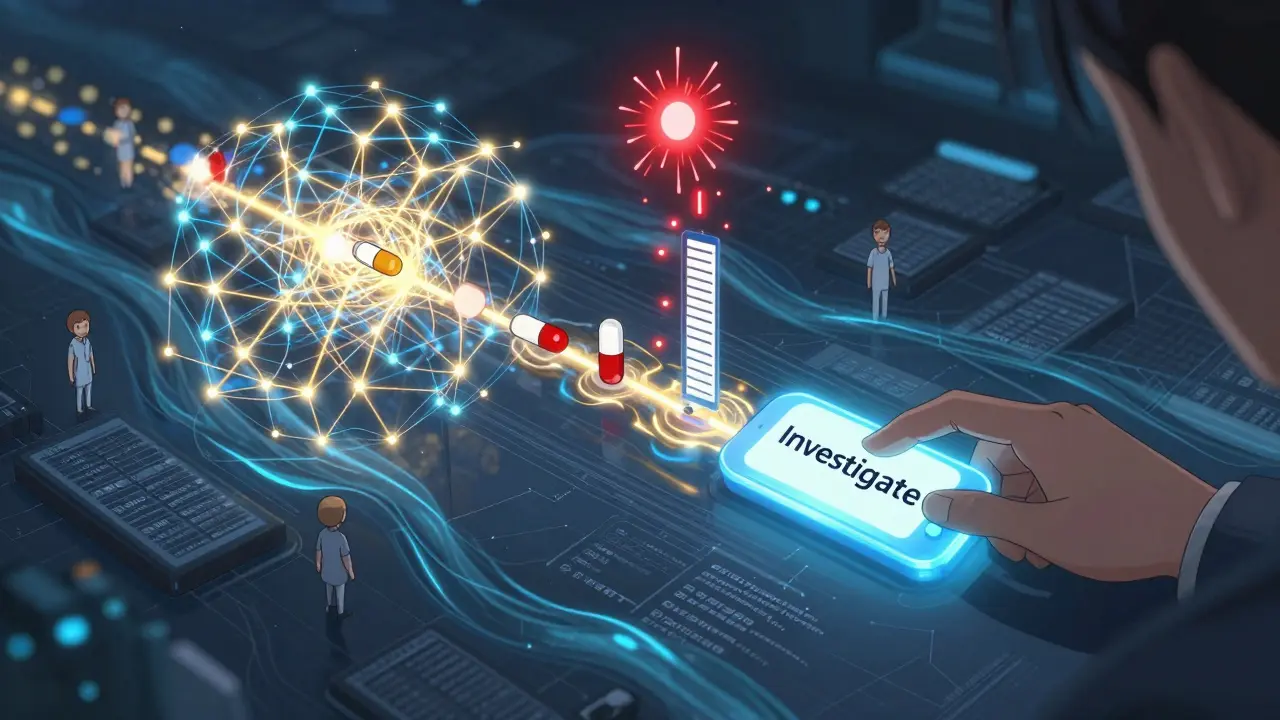
The goal is to build AI models that can predict problems before they become widespread. Imagine an algorithm that scans millions of insurance claims and EHRs in real time. It notices that patients on a certain generic insulin are being prescribed more glucose test strips than usual. That’s a red flag. The system flags it, the FDA investigates, and within weeks-before hundreds more patients are affected-they issue a warning.
By 2027, the FDA expects AI-driven systems to cut the time to detect safety signals for complex generics by 60-70%. That could mean the difference between a minor adjustment and a public health crisis.
Challenges and Criticisms
It’s not perfect. Critics say the FDA’s system still relies too much on voluntary reporting. Many doctors don’t report minor side effects. Patients don’t always know how to report. And with over 15,000 approved generics, resources are stretched thin.
Public Citizen, a consumer advocacy group, argues that the FDA doesn’t prioritize complex generics enough. They point out that while the agency has issued guidance on surveillance best practices, implementation is inconsistent. Some manufacturers are held to stricter standards than others.
And then there’s the question of transparency. The FDA doesn’t publicly name which generics are under review. That leaves patients and providers guessing. If your generic blood pressure pill suddenly has a new warning, how do you know if it’s the same one your neighbor switched to?
The FDA says they’re working on it. They’ve started publishing anonymized summaries of safety reviews and are exploring ways to let patients track the status of specific generic products.
What You Can Do
You don’t have to wait for the FDA to act. If you notice something off after switching to a generic:
- Write down the symptoms. When did they start? Did they get worse after the switch?
- Check the manufacturer. Is it the same one you used before? If not, that might be the issue.
- Report it. Go to MedWatch and file a report. It takes five minutes. Your report could help someone else.
- Talk to your pharmacist. They often know which generics have had issues in the past.
The FDA doesn’t have a crystal ball. But with millions of people taking generics every day, their surveillance systems are the closest thing we have to one. And they’re getting smarter.
Do generic drugs have the same side effects as brand-name drugs?
Generally, yes-because they contain the same active ingredient. But sometimes, differences in inactive ingredients (like fillers or coatings) can affect how the drug is absorbed, which may lead to different side effects in some people. The FDA investigates these cases when reports suggest a pattern.
Can I trust a generic drug if it’s much cheaper than the brand?
Yes. Price doesn’t reflect quality. Generic manufacturers must meet the same FDA standards as brand-name companies. The lower cost comes from not having to repeat expensive clinical trials. The FDA inspects manufacturing facilities regularly to ensure consistency.
What’s the difference between bioequivalence and therapeutic equivalence?
Bioequivalence means the generic delivers the same amount of drug into your bloodstream at the same rate as the brand. Therapeutic equivalence means it works the same way in your body-producing the same clinical effect. For simple pills, they’re the same. For complex drugs like inhalers or creams, they might not be. That’s why the FDA monitors these closely after approval.
How long does it take for the FDA to act on a safety concern with a generic drug?
It varies. For clear, urgent risks-like contamination or sudden spike in hospitalizations-the FDA can act within days. For subtle patterns, it may take months to gather enough data. Sentinel and AI tools are helping speed this up, but safety always comes before speed.
Are all generic manufacturers held to the same standards?
Yes. Every manufacturer, whether based in the U.S. or overseas, must pass FDA inspections and meet the same quality standards. But inspection frequency varies based on risk. A plant with past violations gets checked more often. The FDA doesn’t publicly rank manufacturers, but they track performance internally.

16 Comments
Lorna Brown
March 12, 2026 AT 17:59The FDA's surveillance systems are way more sophisticated than most people realize. FAERS, Sentinel, MedWatch-they're not just passive databases. They're living, breathing networks that connect real-world outcomes to drug performance. And yeah, generics make up 90% of prescriptions, but the system doesn't treat them like second-class citizens. It's actually the opposite: they're monitored harder because they're used more. That's smart public health.
People act like generics are some shady loophole, but the science is solid. Bioequivalence isn't a loophole-it's a validated metric. The real issue is complex generics: inhalers, injectables, topical creams. Those are where formulation differences matter. The FDA's Center for Research on Complex Generics? Brilliant move. They're finally treating these like the nuanced therapies they are.
And the nocebo effect? Understated but huge. I've seen patients swear a generic made them nauseous, then switch back to brand, feel better, and never realize their brain was the problem. The FDA knows this. They're training staff to filter out psychological noise. That's clinical wisdom, not bureaucracy.
Byron Boror
March 12, 2026 AT 23:23Let’s be real-this whole ‘generic drug surveillance’ thing is just corporate PR. The FDA lets Chinese and Indian factories churn out pills with dirt-cheap fillers, then pretends they’re ‘equivalent’ because the blood levels are within 10%. That’s not science, that’s compromise. And don’t get me started on how they ignore manufacturing quality differences. I’ve seen generics that crumble in your hand. You think they test every batch? Nah. They test one out of every 5000. That’s not oversight. That’s negligence.
And don’t even mention ‘Sentinel’ like it’s some magic bullet. It’s still just data mining. Real safety isn’t caught by algorithms-it’s caught by doctors who actually talk to their patients. But nope, the FDA outsources to tech firms and calls it innovation. Meanwhile, real people are getting sick because some factory in Mumbai skipped a quality check.
Rex Regum
March 13, 2026 AT 01:01Oh wow. So the FDA is now a superhero? 🦸♂️ With their fancy AI and ‘Sentinel’ and ‘CRCG’-all these acronyms like they’re NASA. Meanwhile, I’ve been taking a generic blood pressure med for 3 years and my doctor never once asked if I was okay. No one’s monitoring me. No one’s checking my kidneys. No one’s even looking. And now they want a medal for ‘proactive surveillance’? Please.
Here’s what actually happens: someone takes a generic, gets dizzy, goes to the ER, gets discharged, and forgets about it. Then 6 months later, they die of a stroke. Only then does the FDA get a report. That’s not surveillance. That’s autopsy.
And let’s talk about the nocebo effect. You mean people are too dumb to know the difference between a $3 pill and a $30 pill? That’s not psychology. That’s capitalism. We’ve trained patients to distrust anything cheap. And now we’re blaming them for it? Brilliant.
Also, why is the FDA’s budget for generic monitoring smaller than their coffee fund? 😂
Kelsey Vonk
March 14, 2026 AT 20:38Wow, this was actually really comforting to read. I’ve been scared to switch to generics because I thought they were ‘lesser’-but learning how much the FDA actually tracks them? 🤯
I didn’t know about Sentinel or how they use insurance claims. That’s wild. Like, they can see if people on a certain generic are filling more antacids? That’s next-level. And the fact they’re building AI to predict issues before they spread? That’s hope right there.
Also, the nocebo effect thing? So true. I had a friend who swore her generic antidepressant made her ‘numb,’ but when she switched back and forth in a controlled way? Totally placebo. Her brain just hated the packaging 😅
Thank you for explaining this so clearly. I feel way less anxious now. 💙
Emma Nicolls
March 15, 2026 AT 15:13i didnt know the fda even did this kind of stuff honestly i always thought once it was approved thats it but this makes me feel way better about taking generics i just switched to one for my cholesterol and was nervous but now i get it theyre watching
Jimmy V
March 17, 2026 AT 07:51Generic drugs are safe. Period. The FDA doesn’t cut corners. They inspect every facility-U.S. or overseas. Same standards. Same inspections. Same consequences if you fail.
Yes, some generics have formulation quirks. That’s why complex ones get extra scrutiny. But the system works. FAERS catches 1.2M reports a year. Sentinel spots trends before they explode. AI will make it faster.
Stop pretending this is a lottery. It’s science. And if you’re still scared? Talk to your pharmacist. They know which batches have had issues. They’re your frontline.
Trust the system. It’s not perfect. But it’s the best we’ve got.
Richard Harris
March 18, 2026 AT 05:03Interesting read. I’m from the UK and we have a similar system here-Yellow Card scheme, real-time EHR monitoring. It’s reassuring to see the FDA is moving in the same direction. The real challenge isn’t the tech-it’s the reporting culture. Doctors still don’t report minor side effects. Patients don’t know how. Maybe we need a simple app? One tap. ‘I feel weird after this pill.’ Done.
Also, the nocebo effect is real. I’ve seen it with statins. Patients swear they’re ‘tired’ on generics. But when you check their CPK levels? Normal. It’s all in the mind. Still matters though.
Kandace Bennett
March 19, 2026 AT 19:16Oh honey. 🤭 You think this is impressive? The FDA is barely keeping up. I’ve been following generic drug safety since 2018. And let me tell you-half the time, they don’t even know which manufacturer made the pill you took. How? Because labels don’t list it! So if you get sick, you’re SOL.
And AI? Please. They’re using models trained on 2019 data. That’s like using a flip phone to predict the future. Meanwhile, I’ve got a cousin who had a stroke after switching to a generic metformin. The FDA didn’t act until 8 other people died. Eight.
And don’t get me started on the ‘nocebo effect’ excuse. That’s just lazy science. If your drug causes nausea, it causes nausea. Stop blaming the patient.
Also, why isn’t this on the front page? 🤔
Tim Schulz
March 20, 2026 AT 14:34Oh wow. A whole article about how the FDA ‘monitors’ generics. 🤡
Let me guess: you think this is groundbreaking? Like, ‘Oh look, they’re using data!’
Newsflash: the FDA is a bureaucratic sausage factory. They don’t ‘catch problems’-they react to them. After the fact. After people are hospitalized. After lawsuits pile up.
And you call Sentinel ‘next-gen’? It’s a glorified spreadsheet with a fancy name. The real innovation? The fact that we’re still surprised the FDA does anything at all.
Also, ‘Dear Healthcare Provider’ letters? That’s not a safety alert. That’s a memo. Written in Times New Roman. Sent after the damage is done.
Stop patting yourselves on the back. This isn’t innovation. It’s damage control.
Jinesh Jain
March 21, 2026 AT 01:26This is actually very informative. I come from India where generics are the only option for most people. It's good to see the FDA has systems in place. I hope other countries adopt similar models. The nocebo effect part was eye-opening. People think cheaper = worse, but it's not always true.
douglas martinez
March 21, 2026 AT 13:09Thank you for this comprehensive overview. The FDA’s post-market surveillance infrastructure is one of the most robust in the world, and it deserves recognition. The integration of real-world data from electronic health records and insurance claims represents a paradigm shift in pharmacovigilance. This is not reactive-it’s predictive. And the move toward AI-driven signal detection is not merely aspirational; it is necessary.
For patients and providers alike, understanding the difference between bioequivalence and therapeutic equivalence is critical. This article bridges that gap with clarity and precision.
Let us not confuse public skepticism with systemic failure. The system works. It is imperfect, yes-but it is the most scientifically rigorous framework for drug safety in human history.
Sabrina Sanches
March 23, 2026 AT 08:56I love that theyre using AI now... its so cool that they can predict problems before they happen... like... imagine if your phone could warn you before you got sick from a pill... thats wild... i never thought about how much data they collect... but it makes sense... so smart...
Shruti Chaturvedi
March 23, 2026 AT 19:40This is so important for people in developing countries too. We rely on generics because we have no choice. If the FDA is doing this well, maybe other countries can learn from it. I hope more transparency comes soon so patients know which manufacturer made their medicine. That would help so much
Katherine Rodriguez
March 24, 2026 AT 08:24Why should I care about FDA surveillance? They’re just protecting Big Pharma. They let foreign manufacturers get away with everything. I took a generic and it made me sick. No one listened. No one cared. Now they want a medal for collecting reports? That’s not safety. That’s paperwork.
Devin Ersoy
March 25, 2026 AT 14:02Oh, so now we’re supposed to be impressed that the FDA uses a database? 🙄
Let me guess: the same FDA that approved Vioxx? The same FDA that ignored opioid warnings for years? The same FDA that lets manufacturers self-certify bioequivalence? Yeah. Trust them with your life.
And AI? Please. They’re using algorithms trained on biased data. What if the system only flags generics made in China? What if it ignores the ones made in Kentucky because they’re ‘American’? That’s not science. That’s nationalism.
Also, ‘Dear Healthcare Provider’ letters? That’s not a warning. That’s a footnote. Written in 8-point font. On page 17 of a PDF no one reads.
Do you know how many people die because of generic errors? We don’t track that. Because the FDA doesn’t want to know.
Lorna Brown
March 26, 2026 AT 05:01Re: @8044 and @8046 - you’re right that the system isn’t perfect. But the alternative is no oversight. You think we should go back to the 1990s, when generics had zero post-market tracking? When people just got sick and no one knew why?
The fact that we’re even having this conversation? That’s progress. Sentinel caught 17 potential signals last year that FAERS missed. That’s not luck. That’s innovation.
And yes, reporting is still underutilized. But that’s a cultural problem, not a systemic one. The tools are here. The data is there. Now we need patients to speak up.