

Every year, millions of people take generic medicines made in different countries. They expect those drugs to be safe. But what happens when someone has a bad reaction? Who tracks it? And how do regulators in the U.S., Europe, Japan, or Brazil know about it fast enough to act? That’s where pharmacovigilance harmonization comes in - the quiet, complex system trying to make global drug safety work as one.
Why harmonization matters more than ever
Before 1990, every country had its own rules for reporting side effects. A patient in Germany had a reaction to a drug. The company had to file a report in German, using German forms, to German regulators. Meanwhile, the same drug caused a similar reaction in Brazil - but the report had to go through a different system, in Portuguese, with different deadlines. The same drug, two reports, no connection. That’s not just inefficient. It’s dangerous. The International Council for Harmonisation (ICH) was created to fix that. Its goal? Make safety monitoring the same everywhere. Today, the ICH E2 series of guidelines sets the global standard for how adverse events are reported, analyzed, and shared. The result? Companies no longer need to rebuild their safety systems for every market. Regulators can see patterns across borders. And patients get faster warnings when something goes wrong. The FDA estimates that harmonization cuts time to market by 15-20%. That’s not just about profits - it’s about getting life-saving drugs to people faster. And it’s not just big pharma that benefits. Generic manufacturers, who make up over 80% of medicines taken worldwide, rely on these standards to enter global markets without getting lost in paperwork.The tools that make global safety possible
At the heart of this system is the ICH E2B(R3) format - a digital template for reporting adverse events. It’s not fancy. It doesn’t look like a smartphone app. But it’s the universal language of drug safety. Since 2020, 89% of the top 50 pharmaceutical companies have adopted it. That’s reduced transmission errors by 63%. But data alone isn’t enough. That’s where technology steps in. The EMA and FDA started using machine learning in 2022 to scan safety reports. These tools now find dangerous signals 30-40% faster than humans alone. Japan’s PMDA took it further in 2023 with AI models that cut false alarms by 25%. That means fewer wasted investigations and more focus on real threats. Then there’s real-world data. The EU now requires drug companies to pull safety signals from electronic health records. The FDA’s Sentinel Initiative tracks 300 million patient records. The EMA’s DARWIN EU network covers 100 million. These aren’t clinical trials. These are real people taking drugs in real life - and their data is becoming the new gold standard for spotting hidden risks.Where the world still doesn’t agree
Harmonization sounds perfect on paper. But in practice, differences still trip up even the biggest companies. Take reporting deadlines. In the U.S., serious unexpected side effects must be reported to the FDA within 15 days. In the EU, it depends on the drug. Some need reporting in 7 days. Others have up to 15. Canada? 30 days. Japan? 15 - but with different definitions of what counts as “unexpected.” Then there’s risk management. The EU requires every new drug to have a full Risk Management Plan (RMP). The U.S. only requires these for high-risk drugs - about 1.2% of approved medicines. That means a company might spend months building one RMP for Europe, then a simplified version for the U.S. - two separate teams, two separate systems. A 2023 survey of 152 pharmacovigilance managers found that 82% still spend significant time adapting reports for different regions. One professional on Reddit said they spend 35-40% of their week just formatting reports for different regulators. That’s not safety work. That’s paperwork. And it’s not just about rules. It’s about data. The WHO’s VigiBase holds over 35 million individual safety reports from 134 countries. But in low- and middle-income countries, only 31% have fully adopted the E2B(R3) standard. Many still rely on paper forms or outdated systems. That means a dangerous reaction in Nigeria or Bangladesh might never reach global databases - or might take months to get there.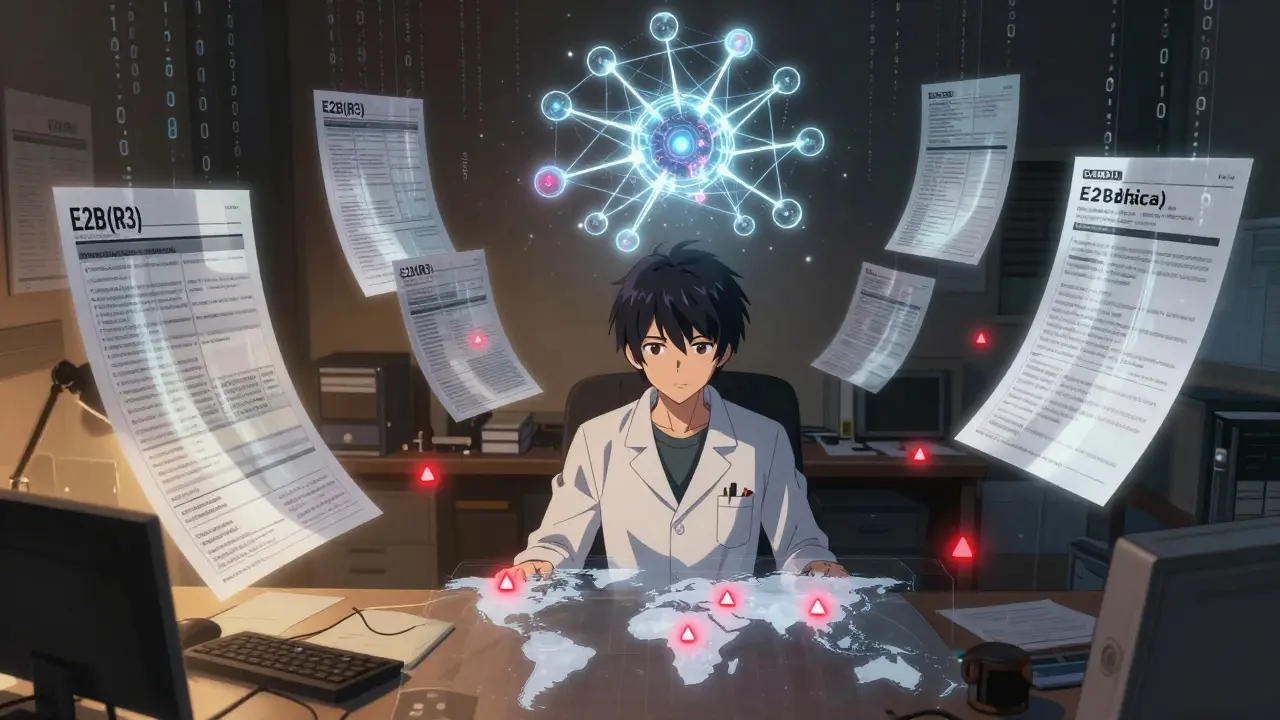
Who’s leading the charge - and who’s falling behind
The U.S., EU, and Japan are the three pillars of harmonization. They’ve aligned 78% of their requirements for new biologics since early 2024 through a joint task force. Their systems talk to each other. Their data formats match. Their timelines are close. But the rest of the world? It’s a patchwork. China’s NMPA requires local reporting within 15 days - even if the same case was already sent to the FDA. That creates double work. India’s system is improving, but lacks the infrastructure to process real-world data. Brazil and South Africa can’t use more than 15% of potential data sources because their health systems aren’t digitized. The Access to Medicine Foundation found that 74% of pharmacovigilance staff in low-income countries lack the resources to meet even basic ICH standards. Meanwhile, 95% of companies in the U.S. and EU are fully compliant. That gap isn’t just unfair - it’s a global health risk. The WHO’s new Global Smart Pharmacovigilance Strategy, under review since October 2024, aims to fix this. The goal? Common data standards across 150 member states by 2027. But it’ll take billions in funding. Deloitte estimates a $1.8 billion gap in infrastructure spending for emerging markets. Without that, harmonization will remain a club for wealthy nations.The human cost of misalignment
Harmonization isn’t just about efficiency. It’s about saving lives. In 2021, a drug used for migraines was linked to rare heart issues in Europe. Because of aligned reporting, the signal was detected across multiple countries within weeks. The FDA quickly reviewed the data and added a warning to U.S. labels - all within 40 days. Now imagine the same drug was only reported in one country. The signal might have taken six months to emerge. More people would have been exposed. More lives lost. Deloitte projects that full harmonization could prevent 1,200-1,500 drug-related deaths each year. That’s not a guess. It’s based on how long it takes to detect signals in fragmented systems versus integrated ones. But here’s the catch: the people who benefit most from harmonization - patients in low-income countries - are the ones least able to use it. Until their systems are upgraded, their voices stay silent.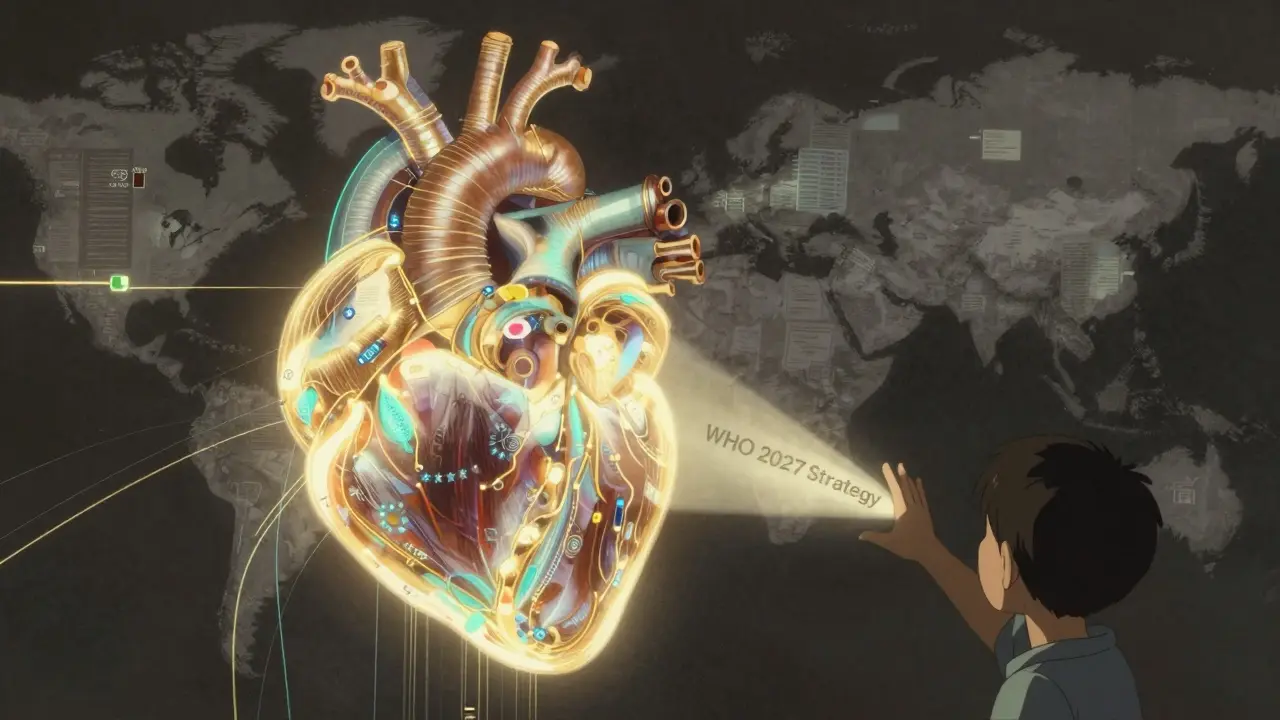
11 Comments
Bret Freeman
December 25, 2025 AT 09:53This system is a joke. Big Pharma writes the rules, regulators kiss their rings, and we’re supposed to believe this is about patient safety. The real goal is to cut costs and speed up approvals - not protect lives. If harmonization were truly about equity, why are low-income countries still using paper forms while CEOs get bonuses for hitting quarterly targets? This isn’t progress. It’s corporate theater dressed up in regulatory jargon.
And don’t get me started on AI. Machines can’t feel a patient’s pain. They can’t recognize when a culture of silence in a rural clinic means a death was never reported. You don’t fix systemic neglect with algorithms.
The only thing being harmonized here is the profit margin.
EMMANUEL EMEKAOGBOR
December 26, 2025 AT 17:22Thank you for this comprehensive overview. As a healthcare professional from Nigeria, I can attest that the challenges described are not theoretical - they are daily realities. Our pharmacovigilance unit operates with limited internet, outdated software, and no dedicated data entry staff. When a patient has an adverse reaction, we often rely on handwritten reports that take weeks to reach the national center.
While I appreciate the advances in E2B(R3) and AI-driven detection, these tools remain inaccessible to most of the world. The WHO’s strategy is a step in the right direction, but without immediate funding and infrastructure support, it risks becoming another well-intentioned document gathering dust on a shelf.
We do not need more guidelines. We need trained personnel, reliable electricity, and digital tools that work offline. Harmonization must include us - not just as data sources, but as equal partners.
Gray Dedoiko
December 28, 2025 AT 03:15I work in clinical trials and this is the most accurate thing I’ve read all year. The paperwork alone is insane. We had a case last month where the same adverse event got flagged in three different systems - EU, US, and Japan - and each one required a different format, even though the patient data was identical.
It’s not that people are lazy. It’s that the systems were never designed to talk to each other. The fact that we’ve gotten this far with E2B(R3) adoption is actually impressive. The real win is that signals are now detected faster - even if the process is still a mess.
Hope the WHO funding comes through. We’re one global pandemic away from another preventable disaster if this doesn’t improve.
Paula Villete
December 28, 2025 AT 18:26Oh wow. So now we’re supposed to be impressed that Big Pharma is finally doing the bare minimum to not kill people? Congratulations, we’ve reached ‘not actively harming patients’ tier. How about we stop calling this ‘harmonization’ and just call it ‘corporate damage control’?
And let’s not pretend AI is some magical fix. Those models are trained on data from rich countries. They don’t know what a rural clinic in Bangladesh looks like. They don’t know that ‘dizziness’ might be reported as ‘feeling like the world is spinning’ - and that’s not in MedDRA.
Also, 76% of companies now require data science skills? Cool. So now pharmacovigilance teams have to be pharmacists, data scientists, and IT specialists - all while being paid less than a Starbucks barista.
Progress? Or just more work for fewer people?
Georgia Brach
December 29, 2025 AT 12:21The premise of this article is fundamentally flawed. Harmonization is not a neutral or benevolent force - it is a mechanism of regulatory capture. The ICH is dominated by Western pharmaceutical interests. Their standards reflect their internal processes, not global medical needs.
Why should a Nigerian village clinic adopt E2B(R3) when they lack basic diagnostic tools? Why should India align with U.S. definitions of ‘unexpected’ when their population has different genetic profiles and comorbidities?
This isn’t safety. It’s standardization as a tool of cultural and economic imperialism. The real risk isn’t fragmented systems - it’s forcing one-size-fits-all protocols on diverse populations.
The data shows that 74% of LMIC staff lack resources. That’s not a gap to be filled - it’s a warning that this model is fundamentally incompatible with global equity.
Katie Taylor
December 30, 2025 AT 23:51Stop making excuses. This isn’t about funding or infrastructure - it’s about willpower. The U.S. and EU figured out how to make this work. Why can’t Brazil, India, or Nigeria? They have the technology. They have the talent. What they lack is the political courage to prioritize patient safety over bureaucratic inertia.
Every year we delay, people die. Not because of the drugs - because of the systems that refuse to change.
WHO’s $1.8 billion gap? That’s less than what the U.S. spends on military band uniforms in a month. This isn’t a funding problem. It’s a moral failure.
Stop talking about ‘support.’ Start demanding accountability. If you’re not part of the solution, you’re part of the problem.
siddharth tiwari
December 31, 2025 AT 01:43they told us this was for safety but i think its just a way to control what we can take. why do they need to track every little thing? what if its just a coincidence? i heard from a guy in delhi that the FDA hides side effects to protect big pharma. they dont want us to know how many people die from these pills. the real danger is not the drugs - its the surveillance.
they say ai finds signals faster - but what if the ai is trained to ignore the ones they dont want to see? i think the whole system is a lie. they just want to make us dependent on their drugs and then charge us more.
why dont they just let people decide for themselves? why do we need all this paperwork? its a trap.
Adarsh Dubey
December 31, 2025 AT 10:41I appreciate the depth of this post. As someone working in generic drug manufacturing in India, I’ve seen both sides - the chaos of unharmonized reporting and the slow, steady progress toward standardization.
The E2B(R3) adoption here is patchy, yes - but it’s improving. We’ve trained 12 staff members on digital reporting in the last year. It’s not perfect, but it’s a start.
I agree with the Nigerian commenter - infrastructure matters. But I also believe change starts small. One form at a time. One report. One hospital at a time.
Let’s not dismiss the progress because it’s incomplete. Let’s push harder to make sure the next person who gets a bad reaction doesn’t have to fight the system just to be heard.
Bartholomew Henry Allen
January 1, 2026 AT 19:08Harmonization is American leadership. The U.S. FDA set the standard. Europe followed. Japan adapted. The rest of the world is just catching up. If you can’t meet the standard, that’s not a failure of the system - it’s a failure of your country’s priorities.
Stop asking for handouts. Start building capacity. We didn’t get here by waiting for permission. We got here by demanding excellence.
There is no global safety without American standards. Period.
Andrea Di Candia
January 2, 2026 AT 07:07I think we’re missing the bigger picture. Harmonization isn’t just about reports and AI and deadlines. It’s about dignity.
Every time a patient in Ghana has a reaction and it never makes it to a global database, they’re being told their experience doesn’t matter. Their pain isn’t data. Their voice isn’t worth tracking.
That’s the real cost of the gap - not the deaths, not the delays, but the silence.
So yes, we need funding. We need infrastructure. But we also need to stop treating low-resource countries as problems to be solved - and start treating them as partners with lived experience that could teach us something.
Maybe the next breakthrough in signal detection won’t come from an AI model trained in Boston - but from a nurse in Kampala who noticed a pattern no algorithm could see.
bharath vinay
January 3, 2026 AT 18:48you think this is about safety? think again. this is a globalist plot to control medicine. the same people who made the vaccines also made these rules. they want you to believe that harmonization is good - but its just a way to lock out small manufacturers and force everyone to use their drugs. why do you think they’re pushing AI? so they can erase the truth. if a drug kills someone in india but the ai says its ‘not significant’ - who do you think decides what’s significant?
they’re not protecting you. they’re protecting their profits. and the people who believe this are the ones who will get hurt first.
wake up. this is not progress. this is control.