
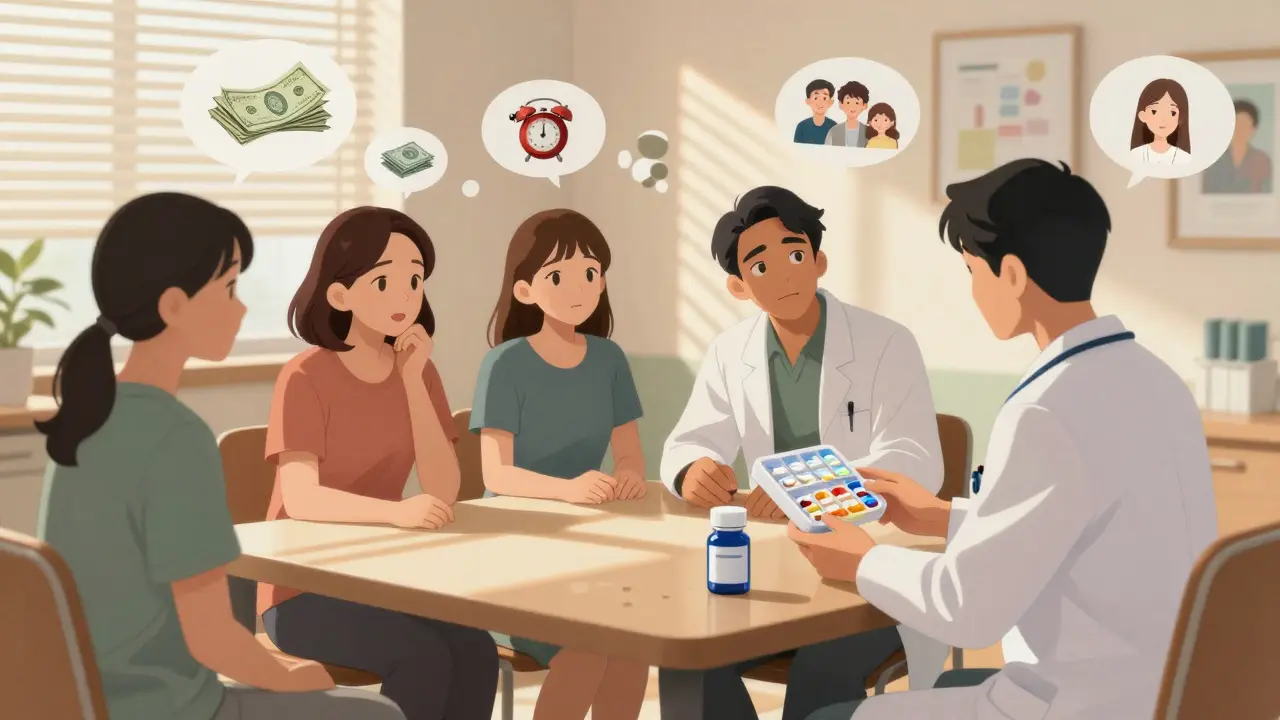
Have you ever been told to take a pill every day, only to skip it because it made you feel weird, or because you couldn’t afford it, or just because you forgot? You’re not alone. Nearly half of all people with long-term health conditions don’t take their meds as prescribed. But here’s the thing: the reason we talk about this isn’t because patients are lazy. It’s because the language we use to describe this problem has been wrong for decades.
Compliance Is Outdated - Adherence Is the New Standard
For years, doctors and nurses called it compliance. The idea was simple: you get a prescription, you follow the instructions exactly, or you’re not doing your part. It sounded fair. But it ignored everything real patients actually deal with - the cost of pills, the nausea from side effects, the fear of long-term use, the confusion about why they’re taking five different pills at different times.
By the early 2000s, the medical world started changing its mind. Organizations like the American Medical Association and the World Health Organization began replacing the word "compliance" with "adherence." Why? Because adherence doesn’t assume patients are disobedient. It assumes they’re human.
Medication adherence is defined by the American Pharmacists Association as "the extent to which a patient’s behavior - taking medications at the right time, in the right dose, and with the right frequency - matches what was agreed upon with their provider." Notice the word "agreed upon." That’s the whole difference.
Adherence means you and your doctor sat down, talked about your life, your schedule, your budget, your fears - and together, you figured out a plan that actually works for you. Maybe you switch from three daily pills to one combo pill. Maybe you get your meds delivered. Maybe you use a pillbox with alarms. The goal isn’t obedience - it’s sustainability.
What Does Adherence Actually Look Like?
Adherence isn’t just about taking pills. It’s a three-step journey:
- Initiation: Did you start the medicine at all? Many people never fill their first prescription - especially if it’s expensive or they don’t understand why they need it.
- Implementation: Once you start, do you take it correctly? Not just "sometimes" - but every day, at the right time, in the right amount?
- Discontinuation: When do you stop? And why? Did you feel better and quit on your own? Did side effects scare you off? Or did you run out of money?
The American Medical Association says a patient is considered adherent if they take at least 80% of their prescribed doses over time. That’s not perfection - it’s realistic. Life happens. You forget. You travel. You feel fine and think you don’t need it anymore. Adherence allows for that.
Compliance, on the other hand, only checks one thing: Did you take the pill today? It doesn’t ask why you didn’t take it yesterday. It doesn’t care if you’re scared of the side effects. It just counts.
Why This Distinction Changes Everything
Think about it this way: if your doctor says, "You’re non-compliant," what do you hear? "I failed." "I’m bad at this." "I’m the problem."
But if your doctor says, "I notice you’ve missed a few doses - what’s getting in the way?" - now you’re having a conversation. Maybe you’re working two jobs and can’t remember to take your blood pressure pill at 7 a.m. Maybe your insurance won’t cover the generic version. Maybe your culture tells you that pills are for weak people.
Adherence asks questions. Compliance assigns blame.
This isn’t just about feelings. It’s about outcomes. Studies show that when patients are treated as partners - not rule-breakers - their adherence rates jump by up to 37.6%. That means fewer hospital trips, fewer emergency rooms, fewer deaths.
The World Health Organization estimates that poor adherence causes over 125,000 preventable deaths each year in high-income countries alone. In places with less access to care, the number is far higher. But when providers shift from compliance to adherence, those numbers drop. Fast.
How Healthcare Is Changing - And Why You Should Care
The shift isn’t just theoretical. It’s happening in real time.
In January 2024, Medicare started tying 8% of hospital payments to how well patients stick to their meds. Hospitals now have a financial reason to help you take your pills - not just punish you for not taking them.
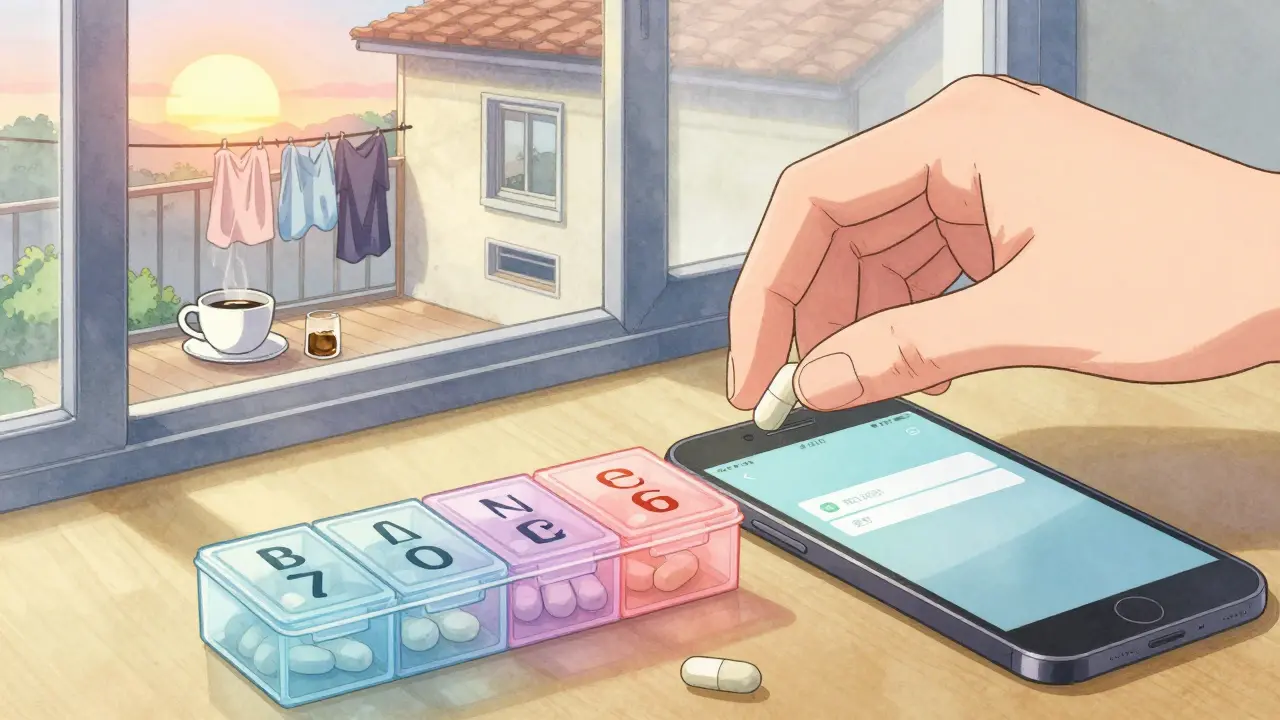
Pharmacies are using smart pill bottles that text you when you miss a dose. Apps like Hero Health and Dose Packer track your habits and adjust reminders based on your schedule. In one Kaiser Permanente trial, a smart pill dispenser cut missed doses by 42%.
Even the FDA and European Medicines Agency now require drug companies to measure adherence in clinical trials - not just whether a drug works, but whether real people can actually use it.
And in 2025, the American Medical Association introduced new billing codes (99487-99489) specifically for adherence counseling. That means doctors can now get paid for sitting down with you, listening to your concerns, and helping you build a plan that lasts.
What’s Still Holding Us Back?
Despite all this progress, old habits die hard.
Some doctors still say "compliance" without thinking. Some clinics still use forms that ask, "Did you take your meds?" instead of, "What’s making it hard to take your meds?"
And in places like prisons and nursing homes, compliance is still the norm - because it’s easier to control than to collaborate.
But the data doesn’t lie. Patients who feel heard are more likely to stick with treatment. Those who feel judged are more likely to quit.
A 2024 study by the AARDEx Group found that intentional non-adherence - where patients consciously decide not to take meds because of cost, fear, or mistrust - is far more common than accidental forgetfulness. And guess what? You can’t fix intentional non-adherence with a pill reminder app. You need a conversation.

What You Can Do Right Now
If you’re managing a chronic condition:
- Ask your doctor: "What’s the most important thing about this medicine?"
- Speak up about cost. There are often generics, coupons, or patient assistance programs.
- Try a pillbox with alarms. Even a simple one works better than trying to remember.
- Don’t stop meds because you feel fine. Talk to your provider first.
- Bring a friend or family member to appointments. They might hear something you miss.
If you’re a caregiver or a health worker:
- Stop asking, "Are you taking your meds?" Ask, "What’s making it hard?"
- Don’t assume forgetfulness is laziness. It might be depression, confusion, or transportation issues.
- Use technology - but don’t rely on it alone. A text reminder won’t help if the pill costs $200 a month.
- Track adherence, not just refills. A refill doesn’t mean the pills were taken.
The Bigger Picture
This isn’t just about pills. It’s about dignity.
For too long, healthcare treated patients like machines: input the prescription, output the result. But people aren’t machines. We have lives. We have fears. We have bills. We have days when we just can’t.
Adherence says: "I see you. I know this is hard. Let’s make it work."
Compliance says: "Do as you’re told."
The world is moving toward adherence. And it’s not just better - it’s more human.
Is medication adherence the same as compliance?
No. Compliance means following instructions without question - like a robot. Adherence means working with your provider to create a realistic, personalized plan that fits your life. Adherence recognizes that people have reasons for not taking meds - and seeks to solve them, not blame them.
What percentage of people are truly adherent to their meds?
About 50% of people with chronic conditions like high blood pressure, diabetes, or cholesterol take their meds as prescribed. That means half of all patients stop or skip doses within the first year. The good news? When providers use adherence-focused strategies - like shared decision-making and personalized support - adherence rates can rise by 30% or more.
How do doctors measure medication adherence?
They use a mix of methods: pill counts, pharmacy refill records, electronic caps that track when bottles are opened, and patient self-reports. The gold standard is the Medication Possession Ratio (MPR). If you have enough pills to cover 80% or more of the days you should be taking them, you’re considered adherent. It’s not about perfection - it’s about consistency over time.
Why is adherence better for chronic diseases than compliance?
Chronic conditions require long-term habits. Compliance doesn’t help you build those habits - it just punishes you for breaking them. Adherence works with your daily life. It asks: What’s stopping you? Is it cost? Side effects? Confusion? Then it helps you fix it. That’s why adherence improves outcomes by 20-50% compared to compliance-focused care.
Can technology help improve adherence?
Yes - but not alone. Smart pill dispensers, reminder apps, and automated texts can reduce missed doses by 30-40%. However, if the real barrier is cost or fear, tech won’t fix it. The best solutions combine tech with human support - like a pharmacist calling to check in, or a provider adjusting your plan after you say you can’t afford your meds.
Is adherence only for people with chronic illnesses?
No. Adherence matters for any medication - whether it’s antibiotics for an infection, a daily aspirin, or a vaccine booster. Even short-term meds can fail if people don’t understand why they’re needed. Adherence helps everyone - not just those with long-term conditions.

15 Comments
Prathamesh Ghodke
March 15, 2026 AT 18:41Finally, someone said it out loud. Compliance is a buzzword from the 1950s. We’re not robots. I’ve had patients cry because they chose between insulin and rent. No one needs a lecture-they need a partner.
Srividhya Srinivasan
March 15, 2026 AT 19:43Oh, here we go again-another woke medical jargon parade! 'Adherence'? Sounds like they're trying to make lazy people feel better about skipping meds. And don't get me started on 'shared decision-making'-like, sure, let’s vote on whether to take blood pressure pills? Next thing you know, we’ll be asking the patient if they'd prefer to die slowly or quickly!
Also, who approved this? The WHO? The AMA? Please. They're all just corporate shills pushing pharma profits. You think smart pill bottles are helping? Nah. They're tracking you. They know when you skip. They're building profiles. They're selling data. I'm not surprised.
And why is everyone suddenly acting like this is new? My grandmother took her pills every day, no alarms, no apps, no 'agreements.' She had discipline. Now we're turning medicine into a therapy session with a side of guilt-tripping.
Also, Medicare paying hospitals for 'adherence counseling'? That's just another way to inflate billing codes. You think a 20-minute chat with a nurse is worth $200? Please. They're gaming the system. And you're all eating it up like it's enlightenment.
Adherence? More like 'permission to be irresponsible.' I've seen people stop antibiotics because they 'felt better.' Then they end up in ICU. And now we're supposed to pat them on the head and say, 'It's okay, honey, we'll adjust your plan.' No. No, we won't.
Compliance isn't about control. It's about survival. And if you think your 'personalized plan' is going to stop a heart attack, you're delusional.
Also, who funded this article? A pharma lobby? Because this reads like a PR campaign disguised as a public health manifesto.
And don't even get me started on 'cultural reasons' for non-adherence. My culture taught me to take medicine when it's prescribed. Not to negotiate with a 30-year-old in a hoodie who says, 'Let's explore your relationship with your medication.'
Wake up. This isn't progress. It's surrender.
Stephen Habegger
March 17, 2026 AT 09:00This is so refreshing to read. I’ve worked in clinics for 12 years, and I’ve seen how compliance language shuts people down. Adherence? It’s not just a word change-it’s a mindset shift. And it works.
One patient, 72, diabetic, worked two jobs. We switched her from 5 pills to one combo. She cried. Said no one had ever asked how her schedule worked. Now she’s been adherent for 18 months.
Simple. Human. Effective.
Justin Archuletta
March 17, 2026 AT 10:04YES. Finally! Someone gets it! 🙌
I used to be the 'compliance cop' until my grandma died from a heart attack because she stopped her meds after her husband passed. She said, 'Why take it if I don't have anyone to take it with?'
That broke me. Now I ask, 'What’s stopping you?' instead of 'Did you take it?'
Game. Changer.
Sanjana Rajan
March 17, 2026 AT 10:16Ugh. This is so performative. 'Adherence' is just compliance with a spa day. You think a pillbox with alarms is going to fix systemic poverty? Please. Half these people can’t afford food, let alone insulin. And now we're giving doctors billing codes to chat? That's not healthcare-that's customer service with a stethoscope.
Also, 'agreed upon'? Who agreed? The doctor? The patient? Or the insurance company that denied the generic? Nobody agreed. They just got handed a script and told to figure it out.
This whole thing is a distraction. Fix the prices. Fix the access. Stop pretending semantics will save lives.
Kyle Young
March 18, 2026 AT 14:29It's interesting how language shapes behavior, but I wonder if the shift from compliance to adherence is merely semantic-or if it fundamentally alters the power dynamic in the patient-provider relationship. Is adherence truly a collaborative model, or is it just compliance repackaged with more empathy? If the goal remains 'optimal dosing,' then are we not still enforcing a normative standard, just with softer language? Perhaps the deeper issue is not the terminology, but the structure of care itself-where autonomy is performative, not substantive.
Aileen Nasywa Shabira
March 18, 2026 AT 17:39Oh, so now we're blaming the system instead of the patient? Brilliant. Let's make it all about 'cost' and 'fear' and 'culture.' What about personal responsibility? Where's the accountability? You can't hand out pills like candy and then act shocked when people don't take them. This isn't psychology-it's enabling.
And let's not forget: if you're skipping meds because you 'feel fine,' you're not a victim-you're an idiot. No one's asking you to be perfect. But you're not entitled to a 'personalized plan' when you're putting yourself and others at risk.
Also, who the hell decided 'adherence' was better? Did they poll the people who actually have to clean up the mess? ER nurses? Paramedics? No. They polled therapists. Because of course they did.
Kendrick Heyward
March 19, 2026 AT 01:52I’m so tired of this. 😔
I lost my brother because he stopped his meds. He said he ‘felt better.’ He didn’t get a ‘personalized plan.’ He got a funeral.
Compliance isn’t cruel. It’s the only thing that keeps people alive when they’re too sick to care.
Adherence sounds nice. But it doesn’t work when you’re in the ICU because someone decided their feelings mattered more than their science.
I’m sorry. I just… I’m so tired. 😔
lawanna major
March 19, 2026 AT 11:07The distinction between compliance and adherence is not merely lexical-it is epistemological. Compliance assumes a unilateral, hierarchical relationship between provider and patient, wherein the patient's agency is subordinated to clinical authority. Adherence, by contrast, implies a dialogic, negotiated space in which treatment is co-constructed. This is not semantic indulgence; it is a philosophical recalibration of care.
Moreover, the 37.6% increase in adherence rates under this model is not anecdotal-it is empirically validated across multiple longitudinal studies, including those from the Journal of General Internal Medicine and The Lancet. The shift is not trendy; it is evidence-based.
And yes, technology helps-but only as a scaffold. The real intervention is relational: a clinician who listens, who asks, 'What’s getting in the way?' instead of 'Why didn’t you take it?'
This isn't about making patients feel good. It's about making treatment effective.
Ryan Voeltner
March 21, 2026 AT 06:14The shift from compliance to adherence reflects a broader evolution in medical ethics from paternalism to partnership. This is not merely a change in terminology but a recognition of patient autonomy as a foundational principle of care. When treatment plans are co-designed with lived experience, outcomes improve not because patients are 'nicer' but because they are empowered. The data is clear. The moral imperative is undeniable. The time for compliance has passed.
Linda Olsson
March 22, 2026 AT 22:59Let’s be honest-this whole 'adherence' movement is just the medical-industrial complex trying to make patients feel guilty without calling them lazy. 'Oh, we don’t blame you, we just want to understand your barriers!' Translation: we’re going to spend $300 on a pill dispenser and then bill you for a 15-minute 'consultation' that could’ve been done over the phone.
And don’t even get me started on 'cultural factors.' Are we now diagnosing non-adherence as a cultural identity crisis? Next, they’ll be offering meditation sessions before prescribing statins.
Meanwhile, the real issue-pharmaceutical pricing, insurance loopholes, and lack of primary care access-is being drowned out by buzzwords.
It’s not about the word. It’s about the dollars.
Ayan Khan
March 24, 2026 AT 08:26In India, we have a phrase: 'Dawa le lo, par samajh ke.' Take the medicine, but understand why. That’s adherence in one line.
My uncle had diabetes. He didn’t take his pills because he thought they were 'foreign chemicals.' We didn’t yell. We didn’t shame. We sat with him. We showed him the science. We got him a pillbox. We asked him: 'What would make this easier?'
He’s been stable for six years now.
It wasn’t about obedience. It was about respect.
Emily Hager
March 24, 2026 AT 12:00How convenient. Now we're supposed to feel bad for people who don't take their meds? What about the people who do? The ones who work three jobs, pay $800 a month for insulin, and still take it every single day? They're the ones getting punished by the system. And now we're going to reward the ones who skip doses with 'personalized plans'?
This isn't compassion. It's a moral hazard.
And why are we pretending this is new? I've been in healthcare since 2005. We've been trying to move away from compliance since the 90s. It didn't work then. It won't work now.
People who don't take their meds are making a choice. Let them live with the consequences.
Melissa Starks
March 24, 2026 AT 18:46Okay I just had to say this because I’m literally crying rn 😭
I’m a single mom. I have asthma. My inhaler costs $400. I’ve skipped doses because I had to choose between food and breathing. I’ve felt like trash. Like I’m failing. Like I’m a burden.
Then one day, my nurse didn’t ask if I took it. She asked, 'What do you need to make this work?'
We got me a coupon. We got me a free delivery. We got me a buddy system with another mom in the program.
I haven’t missed a dose in 11 months.
This isn’t about jargon. This is about someone seeing you.
And if you think that’s weak… I’m sorry. But I’m alive because someone didn’t judge me.
Lauren Volpi
March 25, 2026 AT 04:07Adherence? Sounds like a fancy way to say 'we’re too lazy to make people obey.'
My dad had a stroke. He was told to take blood thinners. He didn’t. Said 'I don’t trust doctors.'
He died.
Now you want to sit down and 'explore his fears'? What good did that do him?
Some people are just dumb. Or stubborn. Or both.
And now we’re gonna spend millions on apps and 'counseling' instead of just saying: 'Take the pill or you die.'
That’s not cruel. That’s honesty.