
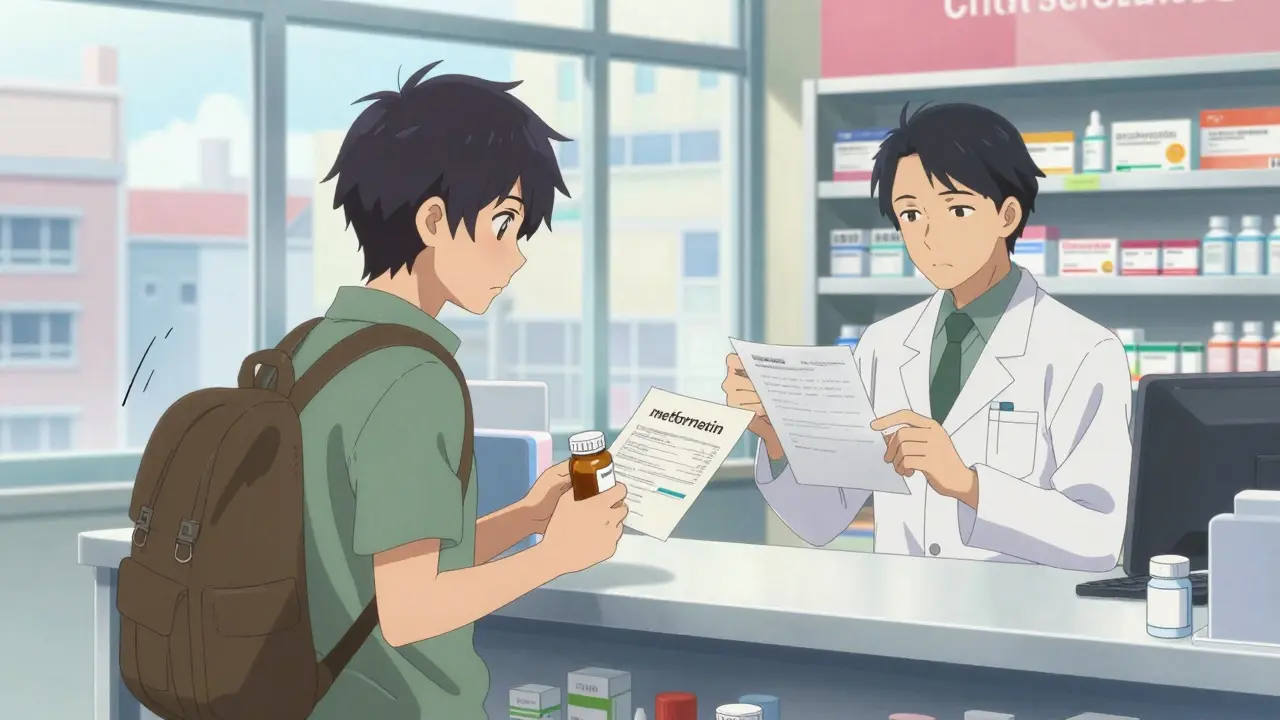
Trying to refill your prescription while traveling abroad isn’t as simple as walking into a local pharmacy. Even if you have the same medication in your hand, the rules change completely when you cross a border. You might think your U.S. prescription works in Canada, the EU, or Japan - but it doesn’t. Not without preparation. What works in one country is often illegal, unrecognized, or simply unprocessable in another.
Why You Can’t Just Walk In and Ask for a Transfer
Most people assume pharmacies can just email or fax a prescription from one country to another. That’s not how it works. Each country has its own drug laws, licensing rules, and pharmacy regulations. In the U.S., the DEA controls controlled substances like opioids, ADHD meds, and sleep aids - and they don’t recognize foreign prescriptions. The FDA bans personal importation of prescription drugs, even if they’re legal in the country you’re visiting. Canada requires every U.S. prescription to be reviewed and reissued by a Canadian doctor. The EU allows cross-border prescriptions within its 27 members - but only if the drug is available and the prescription includes the generic name, not the brand.There’s no global system. No central database. No universal form. Every transfer attempt is a custom process shaped by local laws, not patient convenience.
What Works: The EU’s Cross-Border System
If you’re traveling within the European Union, you’re in the best position. Since 2012, the EU has allowed prescriptions issued in one member state to be filled in another. You don’t need a new doctor. You don’t need a cosign. You just need the right paperwork.Your prescription must include:
- The generic (common) name of the medication - not the brand name (e.g., “metformin” not “Glucophage”)
- Strength and dosage instructions
- Quantity and number of refills
- Prescriber’s name, signature, and license number
Pharmacies across the EU are trained to recognize these. A German pharmacy can fill a French prescription. A Spanish pharmacist can refill an Italian one. Success rates are high - over 87% according to European Commission data.
But here’s the catch: the drug might not be available. Your U.S. brand might not exist in Poland. Your asthma inhaler might be sold under a different name in Italy. Always check the generic name first. Bring the original packaging. And call ahead - don’t assume.
What Doesn’t Work: U.S. to Canada Transfers
If you’re a U.S. resident planning to refill your prescription in Canada, forget direct transfer. U.S. pharmacies are legally barred from sending prescriptions to Canadian ones. It’s not a policy - it’s federal law. The DEA doesn’t regulate international transfers. The FDA doesn’t allow personal importation. And Canadian provinces require prescriptions to come from Canadian-licensed practitioners.So how do people do it? They use the “cosigning” process.
Here’s how it works:
- Get a signed letter from your U.S. doctor stating your diagnosis, medication, dosage, and that you’re traveling or living abroad.
- Bring your original prescription bottle with the pharmacy label.
- Find a Canadian pharmacy that offers cosigning services (PharmacyChecker lists verified ones).
- Submit your documents and health history form.
- A Canadian pharmacist reviews your case and contacts a local doctor to issue a new, valid Canadian prescription.
- You pay for the new prescription - not a transfer fee.
This isn’t a transfer. It’s a restart. You’re getting a new prescription based on your old one. Expect to pay $50-$100 for this service. And it takes 3-7 days. Don’t wait until you’re out of pills.

Other High-Risk Destinations: China, Middle East, and Beyond
Traveling to China, Saudi Arabia, the UAE, or other countries with strict drug controls? You’re entering a minefield. Many medications that are legal in the U.S. - including common ADHD drugs, painkillers, and even some cold medicines - are classified as controlled substances or banned entirely.Here’s what you need before you fly:
- Original prescription with the doctor’s signature
- Letter on letterhead explaining your medical condition and why you need the medication
- Proof of legal purchase in the U.S. (receipt or pharmacy label)
- Carry no more than a 90-day supply
Some countries require the letter to be notarized or translated into the local language. Others require prior approval from their health ministry. In the UAE, you must register your medication with the Ministry of Health and Prevention before arrival. In China, even over-the-counter medications like pseudoephedrine are restricted.
MedAire’s 2022 report found that 43% of travelers to these regions faced medication access issues - not because they were denied, but because they didn’t bring the right documents.
The U.S. Rule That Doesn’t Help You Abroad
In August 2023, the DEA rolled out a new rule allowing one-time electronic transfers of controlled substance prescriptions between U.S. pharmacies. Sounds useful, right? But it only applies within the U.S. It doesn’t extend to Canada, Mexico, the UK, or anywhere else. The DEA explicitly excluded international transfers, citing security risks and lack of international reciprocity.This means if you’re moving from New York to London, your U.S. pharmacy can’t transfer your Adderall prescription. You must return to your prescriber, get a new one, and carry it with you - or risk being turned away at customs.
How to Prepare: A 14-Day Checklist
If you’re traveling with prescriptions, start planning at least two weeks before you leave. Here’s your step-by-step:- Identify your destination’s rules - Check the U.S. State Department’s travel site or the country’s health ministry website for medication restrictions.
- Get your doctor’s letter - On letterhead, signed, dated, and listing your diagnosis, medication name (generic), dosage, and reason for travel.
- Bring original prescriptions and bottles - Never rely on digital copies. Physical labels prove legal purchase.
- Carry only a 90-day supply - This is the FDA’s unofficial limit for personal use. More than that raises red flags at customs.
- Call your destination pharmacy ahead - Ask if they accept foreign prescriptions. For Canada, ask about cosigning. For China, ask about registration.
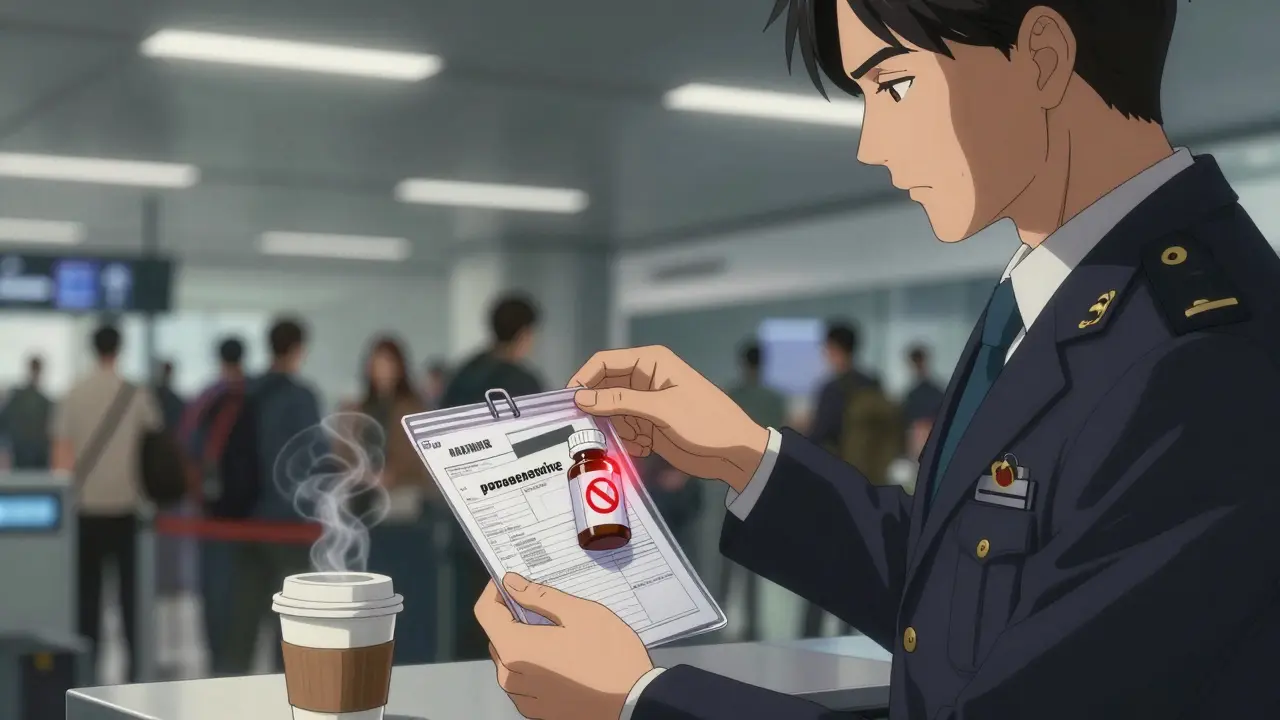
- Know your rights at customs - U.S. Customs and Border Protection says you must carry medication as prescribed. Don’t pack it in checked luggage. Keep it in your carry-on.
What to Do If You’re Turned Away
If a pharmacy refuses to fill your prescription abroad, don’t panic. Here’s what to try:- Visit a hospital clinic - Many countries have international clinics that can write new prescriptions for travelers.
- Use a medical travel service - Companies like MedAire or International Medical Group offer on-call doctors and prescription coordination for a fee (around $150 per consultation).
- Reach out to your embassy - They often have lists of local doctors and pharmacies familiar with foreign prescriptions.
- Don’t buy from unlicensed online pharmacies - They’re illegal, unsafe, and may be counterfeit.
And never, ever try to mail medication to yourself from another country. The FDA will seize it. Customs will fine you. And you’ll be out of your medicine anyway.
Why This System Is Broken - And Who It Hurts Most
The current system isn’t just inconvenient - it’s unfair. It hits frequent travelers, military families, retirees living abroad, and expats the hardest. A Canadian living in Florida can’t refill their diabetes medication without flying home. A U.S. nurse stationed in Germany can’t get her antidepressant refilled without a new prescription from a German doctor.There’s no political will to fix it. The U.S. Congress has tried - bills like H.R. 3 in 2021 aimed to allow safe importation - but they died in committee. The FDA and DEA say safety is the priority. But safety shouldn’t mean denial of care.
Meanwhile, the EU keeps improving its internal system. Other regions are watching. But for now, if you’re crossing borders with prescriptions, you’re on your own.
Bottom Line: Plan Ahead, Carry Proof, Don’t Guess
There’s no shortcut. No magic trick. No app that transfers your prescription globally. What works is preparation. Know your medication’s generic name. Get your doctor’s letter. Bring your original bottles. Call ahead. Don’t assume. Don’t wait until you’re out of pills.Traveling with medication isn’t about rights - it’s about documentation. And the more you prepare, the less stress you’ll have when you land.

12 Comments
Louis Paré
December 31, 2025 AT 06:13Let’s be real - this whole system is a dumpster fire designed by bureaucrats who’ve never had to refill insulin while stranded in Prague. The EU’s system works? Sure. But only if you’re lucky enough to be in a country that speaks English and doesn’t think your Adderall is a narcotic. Meanwhile, I’m over here in Canada paying $80 just to get a Canadian doctor to stare at my U.S. script and say ‘yeah, this looks like metformin.’ No thanks, I’ll just fly home every 90 days.
Marie-Pierre Gonzalez
January 1, 2026 AT 05:20Thank you for this guide! 😊 I just moved from Toronto to Vancouver with my thyroid med and was terrified I’d be left without it. The cosigning process worked perfectly - took 5 days, but I had my script before my last pill was gone. Always call ahead! The pharmacy on 4th Ave was so helpful. 🙏
Janette Martens
January 3, 2026 AT 02:19U.S. meds are overrated anyway. Canada’s healthcare is better. Why do you even need to bring your own pills? Just get a real prescription here. Stop expecting the world to bend for American entitlement. We don’t need your Glucophage - we’ve got metformin. End of story.
Manan Pandya
January 3, 2026 AT 08:21This is incredibly useful. I’ve traveled to Dubai twice with my diabetes meds and was shocked at how strict they are. The letter from my doctor on official letterhead, notarized and translated into Arabic, saved me. I’d add one thing: always carry a copy of the WHO’s list of controlled substances - it’s on their website. Helps when you’re talking to customs officers who don’t speak English.
Aliza Efraimov
January 5, 2026 AT 05:30OH MY GOD I’VE BEEN THERE. Last year I was in Berlin and my anxiety meds were flagged because the brand name didn’t match the generic. I cried in a pharmacy in Neukölln. Then this sweet German pharmacist called her cousin who’s a doctor and got me a new script in 4 hours. I still think about her. If you’re traveling - DO NOT SKIP THE DOCTOR’S LETTER. It’s not paperwork, it’s your lifeline.
Paige Shipe
January 5, 2026 AT 07:12Actually, the FDA doesn’t ban personal importation - they just don’t prioritize enforcement unless it’s large-scale or dangerous. Most people bring a 3-month supply without issue. The real problem is people who try to mail pills or order from sketchy websites. This guide overcomplicates it. Just carry your script, your bottle, and don’t be a dumbass.
Tamar Dunlop
January 6, 2026 AT 02:19As someone who moved from Montreal to Tokyo with a chronic illness, I want to emphasize: cultural respect matters. In Japan, even aspirin requires a prescription. The staff at the international clinic in Shinjuku were incredibly kind. They didn’t just refill my meds - they sat with me for 45 minutes explaining the cultural context of medication use here. It wasn’t just medical care - it was human care. Please, when you travel, remember that.
Emma Duquemin
January 7, 2026 AT 15:07Y’all are making this sound like a spy mission. It’s not. You’re not smuggling contraband - you’re carrying medicine. Bring your prescription, your bottle, your doctor’s note, and your chill. I’ve done this in 14 countries. The worst I got was a confused pharmacist asking, ‘Is this for your cat?’ (Long story.) Bottom line: if you’re not trying to sell it, you’re probably fine. But yeah, call ahead. And for the love of God, don’t pack it in your checked bag. I once had my antidepressants disappear for 3 days. Never again.
Kevin Lopez
January 9, 2026 AT 08:33Non-compliance risk: high. DEA non-recognition: absolute. FDA importation policy: de facto prohibition. Cross-border transfer: legally infeasible. Cosigning: administrative workaround. Pharmacies: not obligated. Patients: responsible for compliance. End of story.
Samar Khan
January 10, 2026 AT 02:29Ugh. I just spent 3 hours trying to get my ADHD med in Thailand. They said it was ‘a controlled substance under the Narcotics Act.’ I had the letter, the bottle, the receipt - nada. Then some random guy in the clinic offered me ‘Thai version’ from his pocket. I said NO. But I’m crying now. 😭💊
Russell Thomas
January 10, 2026 AT 14:19So you’re telling me a Canadian can’t get their U.S. prescription filled without paying a doctor to pretend they’re their doctor? And this is the ‘advanced’ system? Wow. I guess the U.S. is just too lazy to build a global database. Or maybe we’re too scared to let foreigners touch our drugs. Either way - pathetically inefficient. Also, your checklist? Cute. But what if you’re homeless and on Medicaid? You’re screwed. Just sayin’.
Joe Kwon
January 10, 2026 AT 14:35Really appreciate this breakdown. I’m a veteran stationed in Germany and this is my third deployment with meds. The EU system is a godsend - but I’ve seen too many soldiers panic because they didn’t know to bring the generic name. One tip: download the EMA’s EudraVigilance database. It’s clunky, but it tells you if your med’s approved in any EU country. And yes - call the pharmacy. I once showed up with a 6-month supply. They laughed, gave me 30 days, and sent me to the base clinic. We’re all just trying to stay alive out here.