
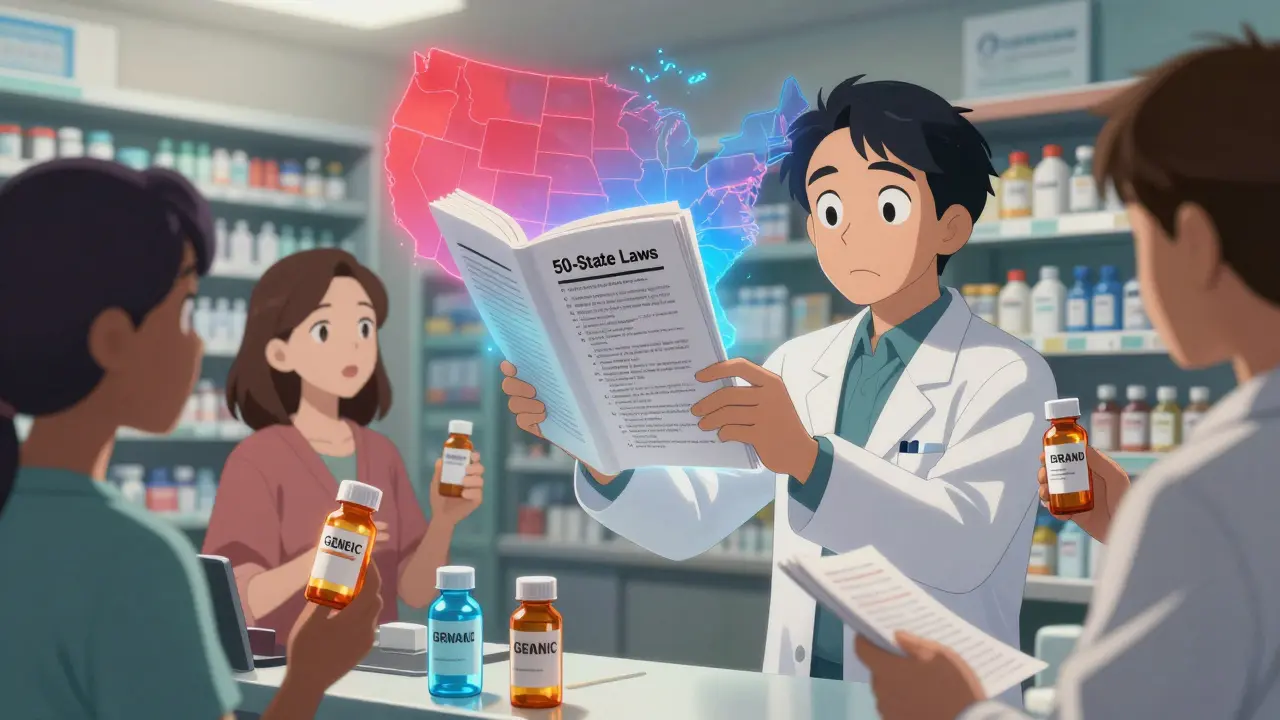
Every time you pick up a prescription, there’s a good chance the pharmacist gave you a generic version instead of the brand-name drug you expected. That’s not random-it’s governed by state laws that vary wildly across the U.S. Some states force pharmacists to swap in generics. Others require your permission first. A few don’t even tell you it happened. If you’ve ever been confused about why your medication changed-or didn’t change-this is why.
How Generic Substitution Works (And Why It Matters)
Generic drugs are chemically identical to their brand-name counterparts. They work the same way, have the same side effects, and are held to the same FDA standards. The only real difference? Price. Generics cost 80% to 85% less. That’s why they make up 90% of all prescriptions filled in the U.S. But even though they’re safe and effective, pharmacists can’t just swap them in without following state rules. The federal government created the modern generic approval system in 1984 with the Hatch-Waxman Act. But it left the actual substitution rules to each state. That’s why a pharmacist in California handles substitutions completely differently than one in Oklahoma. And that confusion doesn’t just affect patients-it weighs heavily on pharmacists. One pharmacist in Texas told a 2023 survey they spend 15 to 20 minutes a day just checking which state’s rules apply when filling telepharmacy prescriptions.Mandatory vs. Permissive Substitution: The Big Divide
There are two main types of state laws: mandatory and permissive. Mandatory substitution means the pharmacist must substitute a generic unless the prescriber says “do not substitute” or the patient refuses. Nineteen states have this rule. That includes New York, Florida, and Illinois. In these states, the default is generic unless someone actively blocks it. The other 31 states (plus Washington, D.C.) use permissive substitution. Here, pharmacists can substitute, but they’re not required to. Many choose to, especially if the patient is paying out-of-pocket. But they could legally give you the brand name every time-even if the generic is cheaper and equally effective. This split has real financial consequences. States with mandatory substitution see generic use rates of 85.3%. In permissive states? Only 76.6%. That gap adds up. According to CMS data, patients in mandatory states pay about $55 less per year on prescriptions.Consent: Do You Get to Say No?
Even in mandatory states, patients usually have a voice. But how much of a voice? That depends. Seven states and D.C. require explicit patient consent before a substitution can happen. That means the pharmacist has to ask you, “Do you want the generic?” and get a yes. Those states include New Jersey, Rhode Island, and Massachusetts. In those places, 68% of patients say they feel more informed about their meds, according to a 2023 University of Michigan poll. In the other 43 states, consent isn’t required. The pharmacist can swap the drug without asking. That’s efficient-but it leaves some patients feeling blindsided. One patient in Ohio told a pharmacy newsletter: “I didn’t know they switched my blood pressure pill until I read the label. I thought something was wrong with me.”Notification: Are You Told When It Happens?
Some states require pharmacists to notify you when a substitution occurs. Others don’t. And some require notification only for certain drugs. Thirty-one states and D.C. require patient notification-usually through a printed label, a phone call, or a note in the prescription packet. California even requires electronic notification to the prescriber within five days of substituting a biologic. But 20 states have no notification requirement at all. That means you might never know your drug changed. That’s not just inconvenient-it’s risky. A 2021 study by the Institute for Safe Medication Practices found that 22% of substitution-related medication errors happened in states without clear notification rules.
Liability: Who Gets Blamed If Something Goes Wrong?
If a substituted drug causes an adverse reaction, who’s on the hook? The pharmacist? The prescriber? The manufacturer? Twenty-four states offer no explicit liability protection to pharmacists who substitute generics. That means if something goes wrong, the pharmacist could be sued-even if they followed all state rules. Connecticut pharmacist Sarah Jennings said in a 2024 interview that she’s refused to substitute warfarin (a blood thinner) in some cases, not because it wasn’t appropriate, but because she didn’t want to risk legal exposure. The other 26 states have laws that shield pharmacists from liability as long as they follow substitution rules. That gives pharmacists more confidence to make substitutions that save money and reduce waste.Small-Molecule vs. Biosimilar Substitution: A Whole Different Ballgame
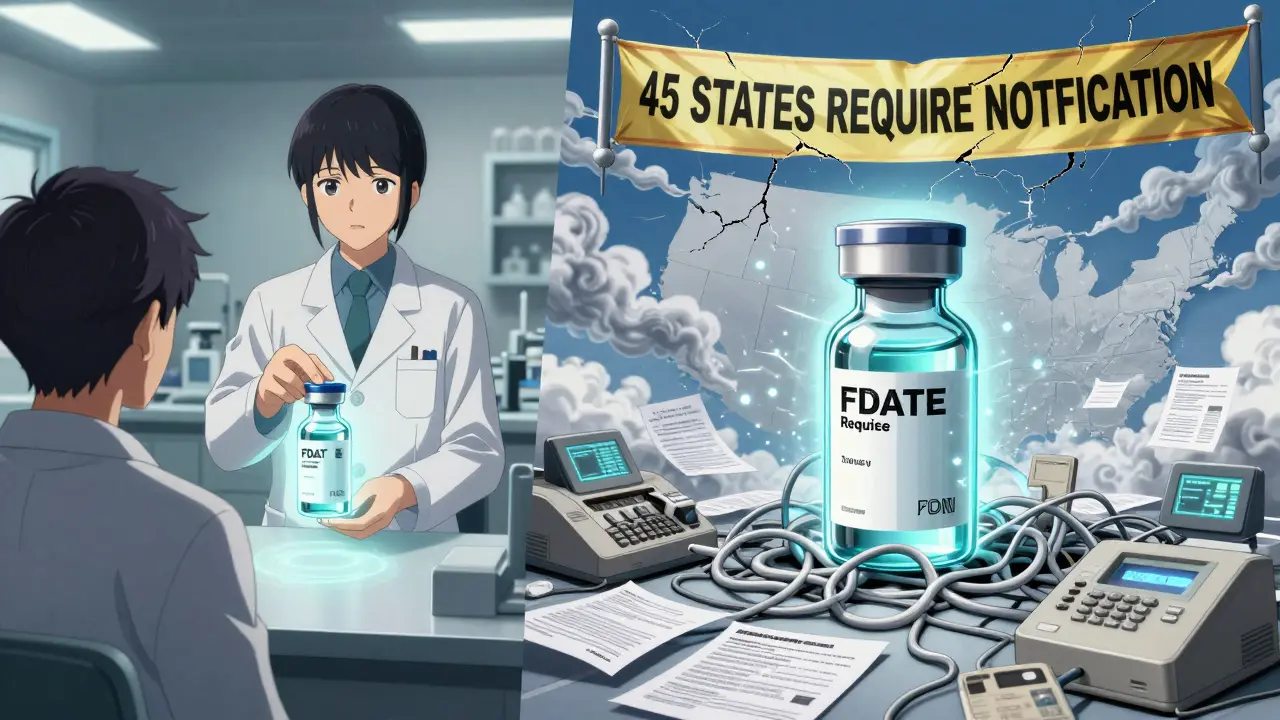
Not all generics are created equal. Most are small-molecule drugs-pills like metformin or lisinopril. But now there are biologics: complex, injectable drugs used for cancer, arthritis, and autoimmune diseases. Their generic versions are called biosimilars. Biosimilars aren’t exact copies. They’re highly similar, but not identical. Because of that, states treat them differently. Forty-five states (including D.C.) have stricter rules for biosimilars than for regular generics. Forty-five states require the prescriber to be notified after a biosimilar is given. Thirty-eight require patient notification. And 48 states let doctors write “dispense as written” on prescriptions to block substitution entirely. Only one state-California-requires electronic notification to the prescriber for biosimilars. Most still rely on paper or fax. That delays care and creates confusion. The FDA says inconsistent state rules are the biggest reason biosimilars make up only 14% of eligible prescriptions, even though 32 are approved.Formularies: What’s Allowed and What’s Not
States use two systems to control which generics can be swapped:- Positive formulary: Lists only the generics that are approved for substitution.
- Negative formulary: Lists drugs where substitution is banned.
What Pharmacists Actually Deal With
The average pharmacist spends 8.2 hours a month just keeping up with state substitution laws. That’s nearly a full workday every month. New pharmacists need 4 to 6 weeks of training before they can confidently handle substitutions across multiple states. Electronic health records (EHRs) make this easier-but only in 28 states. In the other 23, pharmacists have to manually check each state’s rules. That’s where errors creep in. In 2023, 41% of pharmacists reported at least one substitution-related error in the past year. Independent pharmacies are hit hardest. A 2023 survey found 68% of independent pharmacists had substitution errors, compared to 42% at chain pharmacies. Why? Chains have legal teams and software systems. Independents often don’t.What’s Changing in 2025 and Beyond
There’s movement toward change. In 2024, the National Association of Boards of Pharmacy launched a project to reduce 51 different state rules down to just three regional models by 2027. The FDA is pushing for alignment too. Commissioner Robert Califf called state fragmentation “the single greatest barrier to biosimilar adoption.” Nine states passed new laws in 2023-2024 to make biosimilar rules match small-molecule rules. Texas, Illinois, and Pennsylvania are leading the way. But change is slow. Industry analysts predict biosimilar substitution rates won’t hit 35% until 2030-far below the 90%+ rate for regular generics.What You Can Do
You don’t need to memorize 50 state laws. But you can take control:- Ask your pharmacist: “Is this a generic? Was it substituted?”
- Check your prescription label. It should say if it’s a generic.
- If you’re on a high-risk drug (like warfarin, seizure meds, or thyroid pills), ask your doctor to write “dispense as written” on the prescription.
- Use apps or tools from the National Association of Boards of Pharmacy-they update quarterly and show your state’s rules.
Final Thought: It’s Not Just About Cost
Generic substitution saves the U.S. healthcare system billions every year. But if the rules are confusing, inconsistent, or hidden, people lose trust. Patients don’t want to feel like they’re being swapped out for cheaper pills. They want to know what’s in their body-and why. The system works best when transparency, safety, and savings go hand in hand. Right now, we’re still far from that balance. But awareness is the first step toward change.Can a pharmacist substitute my brand-name drug without telling me?
Yes-in 20 states, pharmacists are not required to notify you when they substitute a generic drug. In the other 31 states and D.C., they must inform you, either on the label, through a note, or by phone. If you’re unsure, always ask.
Do I have to accept a generic drug?
Yes, you always have the right to refuse a generic substitution-even in mandatory states. You can ask for the brand name, though you may pay more. Some states require you to give explicit consent before substitution; others don’t. Either way, your consent matters.
Why are biosimilars harder to substitute than regular generics?
Biosimilars are complex biological drugs-like those for rheumatoid arthritis or cancer. They’re not exact copies of the brand name, so regulators treat them more carefully. Forty-five states require prescriber notification after substitution, and many require patient consent. That’s because small changes can affect how the drug works in your body.
What does “dispense as written” mean?
It means the prescriber has specifically asked the pharmacist not to substitute the brand-name drug with a generic. This can be written on the prescription or entered electronically. If it’s there, the pharmacist must fill it as written-no substitutions allowed.
Are generic drugs really as safe as brand names?
Yes. The FDA requires generics to have the same active ingredient, strength, dosage form, and route of administration as the brand. They must also meet the same strict manufacturing standards. The only differences are in inactive ingredients or packaging-which rarely affect safety or effectiveness.
Which states have the strictest generic substitution laws?
Oklahoma is the strictest: substitution requires written authorization from either the prescriber or the payer. Other states with tight rules include New Jersey and Rhode Island, which require explicit patient consent. States like California and New York have detailed notification and formulary rules that add layers of complexity.
How do I find out my state’s substitution rules?
The National Association of Boards of Pharmacy offers a free, updated online resource that maps all 50 state laws. You can also ask your pharmacist or check your state’s board of pharmacy website. For biosimilars, the FDA and Avalere Health publish state-by-state summaries.
Pharmacists are the front line in making generics accessible. But they can’t do it right if the rules keep changing. If you want to save money without risking your health, know your rights-and ask questions.

8 Comments
Christina Bilotti
January 17, 2026 AT 07:18Oh wow, another 12-page essay on how pharmacies are basically running a state-by-state legal obstacle course. And let me guess-this is supposed to be ‘eye-opening’? Newsflash: if you’re shocked that pharmacists are drowning in paperwork while you’re just trying to get your blood pressure pills, you’ve never actually worked in healthcare. The real tragedy? People still think generics are ‘inferior.’ I’ve seen patients cry because their Lexapro was switched. Same molecule. Same effect. Just cheaper. But sure, let’s keep pretending this is about safety and not corporate greed disguised as regulation.
kanchan tiwari
January 17, 2026 AT 10:40THEY’RE HIDING THINGS FROM US. I KNOW IT. I’VE BEEN SICK FOR MONTHS. I SWORE I WAS ON THE SAME MEDS. THEN I SAW THE LABEL-DIFFERENT NAME. DIFFERENT COLOR. DIFFERENT MANUFACTURER. THEY’RE TESTING US. ON PURPOSE. THE PHARMACIES, THE GOVERNMENT, THE BIG PHARMA-THEY’RE ALL IN IT TOGETHER. YOU THINK IT’S ABOUT COST? NO. IT’S ABOUT CONTROL. THEY WANT YOU TO FEEL CONFUSED. TO DOUBT YOURSELF. TO STOP ASKING QUESTIONS. I’M NOT TAKING ANOTHER PILLS UNTIL I GET THE BRAND. I’M SENDING A LETTER TO THE FDA. THEY NEED TO KNOW.
Bobbi-Marie Nova
January 18, 2026 AT 06:39Okay but honestly? This is the most useful thing I’ve read all week. I used to just grab whatever the pharmacist handed me and assume it was fine. Then my mom had a weird reaction to her thyroid med and we found out it had been swapped without a word. Now I ask every time. ‘Is this generic? Was it substituted?’ Sounds awkward, but it’s worth it. Also-yes, biosimilars are weird. I didn’t even know they existed until last month. Thanks for not making this sound like a law textbook. Also, independent pharmacies deserve way more love. They’re doing this with no support. 🙏
Chelsea Harton
January 19, 2026 AT 10:12state laws are a mess. pharmacists are stuck. patients are confused. generics are fine. biosimilars are complicated. consent matters. notification should be mandatory. liability should be clear. stop making it harder than it is. just fix it. please.
Bianca Leonhardt
January 20, 2026 AT 08:05So let me get this straight-you’re telling me in 20 states, you can be handed a completely different drug and never know? And the only reason this isn’t a national scandal is because people don’t read labels? That’s not negligence. That’s criminal. And the fact that pharmacists are being sued for doing what the law says? That’s a system designed to fail. Someone should sue the entire patchwork of state boards. This isn’t healthcare. It’s a bureaucratic horror show.
brooke wright
January 21, 2026 AT 02:22Wait, so if I’m in Texas and my doctor writes ‘dispense as written,’ but I move to Florida next month, does that follow me? Or do I have to re-ask every time? And what if I’m on Medicare? Does the plan override the doctor’s note? I just want to know if my meds are the same, not become a legal scholar. Can someone just make a simple app? Like a barcode scanner that says ‘this is a generic, you’re good’ or ‘this is a biosimilar, call your doctor’? Why is this so hard? I’m not asking for much.
Nick Cole
January 22, 2026 AT 13:13I’ve been a pharmacist for 17 years. I’ve seen people cry because they couldn’t afford their brand name. I’ve also seen people panic because their pill looked different-even though it was 100% identical. The system isn’t broken because generics are unsafe. It’s broken because we don’t talk to each other. Patients don’t know their rights. Pharmacists are overwhelmed. Doctors don’t understand the rules either. We’re all trying. But we need better tools, not more laws. And we need to stop treating patients like they’re too dumb to understand ‘generic’ means the same thing. It’s not magic. It’s science. And it’s saving lives every day.
Riya Katyal
January 23, 2026 AT 12:58Oh so now we’re supposed to be grateful that generics save money? Cool. But while you’re saving $55 a year, I’m paying $200 for my insulin because my state doesn’t cover biosimilars and my insurance says ‘too risky.’ And guess what? The pharmacist didn’t tell me they switched. So now I’m paranoid every time I take it. Thanks for the transparency, America. You’re doing great.