
When you find an old pill bottle in the back of your medicine cabinet, the expiration date staring back at you isn’t just a suggestion-it’s a legal and scientific boundary set by the manufacturer. But what does that date actually mean for your health? Many people assume expired medications are dangerous or toxic. Others think they’re still perfectly fine. The truth is more complicated-and far more important to understand.
Expiration Dates Are About Potency, Not Poison
The expiration date on your medicine isn’t a ‘use-by’ label like on milk. It’s the final day the manufacturer guarantees the drug will work as intended. That means it still has at least 90% of its labeled strength. This standard comes from U.S. Food and Drug Administration (FDA) rules, which require companies to test how long their drugs stay effective under controlled conditions-usually 25°C and 60% humidity.
That doesn’t mean the drug turns harmful the next day. Most medications don’t suddenly become poisonous after their expiration date. Instead, they slowly lose strength. A 2012 study by the NIH found that 88% of 122 different drugs tested-some stored for over 15 years past their expiration-still had enough active ingredient to work. Ciprofloxacin, for example, kept 97% potency 12 years after its printed date. Amoxicillin? Still 94% effective eight years later.
So why do manufacturers put expiration dates so early? Two reasons: legal protection and conservative testing. Companies test under ideal conditions, but real life isn’t ideal. Heat, moisture, and light break down drugs faster. To cover every possible scenario, they set dates well before the drug might actually fail. Think of it like a car’s warranty-it doesn’t mean the engine dies the day after it expires.
When Expired Medications Can Be Dangerous
Just because most pills are still safe doesn’t mean all are. Some medications degrade in ways that make them ineffective-or even risky. These are the exceptions you can’t afford to ignore.
Nitroglycerin, used for chest pain, loses half its strength within months after opening the bottle-even before expiration. If you take expired nitroglycerin during a heart attack, you might not get enough to save your life.
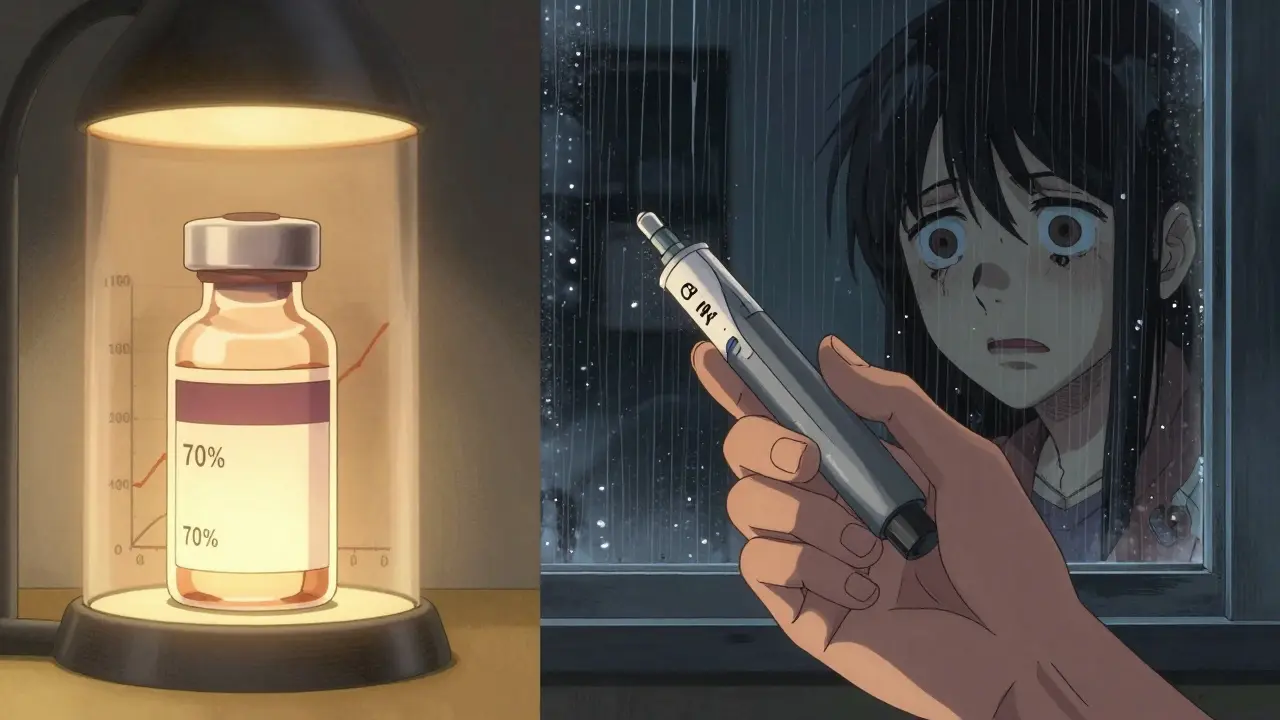
Insulin breaks down quickly if it’s been exposed to heat. A vial stored above 8°C can lose 1.5-2.5% of potency per month. For someone with Type 1 diabetes, that means blood sugar control slips, leading to dangerous highs or lows.
Liquid antibiotics like amoxicillin-clavulanate suspension become useless after 14 days, no matter what the bottle says. Bacteria can grow in the liquid, and the active ingredients break down into compounds that won’t fight infection.
Epinephrine auto-injectors (EpiPens) are another critical case. Each year after expiration, they lose 15-20% of their potency. In a severe allergic reaction, that could mean the difference between stopping anaphylaxis and needing emergency help.
Warfarin, a blood thinner, is unpredictable when expired. Its effect can fluctuate wildly, increasing your risk of dangerous bleeding or clots. No doctor would recommend using it past its date.
These aren’t hypothetical risks. They’re documented in peer-reviewed journals and emergency medicine reports. If you rely on any of these for life-sustaining treatment, never use them past expiration.
What About Common Medications? Statins, Antidepressants, Painkillers
For most people, the real question is about everyday drugs: your blood pressure pill, your antidepressant, your ibuprofen. Are these safe to use if they’re a year or two past expiration?
According to the Institute for Safe Medication Practices, these fall into Category 3: low risk. Solid tablets and capsules-especially those kept dry and cool-lose potency slowly and predictably. A 2022 study at Johns Hopkins found that expired ACE inhibitors for high blood pressure still worked well enough for short-term use during drug shortages, as long as they were stored properly.
That doesn’t mean you should stockpile them. But if you’re out of refills, and you have a bottle of atorvastatin that expired six months ago, it’s unlikely to hurt you. You might not get the full benefit, but you won’t get poisoned.
The key here is storage. A pill kept in a bathroom cabinet-where humidity hits 80%-will degrade faster than one in a cool, dark drawer. If your pills look discolored, smell weird, or crumble when you touch them, toss them. Those are signs of chemical breakdown.
How Storage Changes Everything
Your medicine’s real shelf life isn’t on the label-it’s in your home. Heat and moisture are the biggest enemies.
Studies from the European Medicines Agency show that storing drugs at 30°C instead of 25°C speeds up degradation by 40-60%. That’s why pharmacies keep medications in climate-controlled back rooms. Your bathroom? Not ideal. Showers raise humidity to 75-85%. That’s like putting your pills in a steam room every morning.
Best practice? Keep meds in their original bottles, with the child-resistant cap tight. Store them in a bedroom drawer, a kitchen cabinet away from the stove, or a cool closet. Avoid direct sunlight. Don’t transfer pills to pill organizers unless you’re using them within a week-those containers don’t protect from moisture.
Some pharmacies now use temperature loggers to track storage conditions. If you’re worried about your meds, ask your pharmacist if they monitor this. It’s becoming standard for high-risk drugs like insulin and biologics.
What Should You Do With Expired Medicine?
Throwing pills in the trash or flushing them isn’t ideal-but it’s better than keeping them around. The FDA recommends using drug take-back programs. In 2023, over 900,000 pounds of unused medications were collected at more than 5,800 sites across the U.S. during National Prescription Drug Take-Back Days.
If no take-back event is nearby, mix pills with coffee grounds or cat litter, seal them in a bag, and throw them in the trash. This prevents kids or pets from getting into them.
Only flush medications if they’re on the FDA’s Flush List-like fentanyl patches or oxycodone tablets. These are so dangerous if misused that flushing is the safest option.
Pharmacists are your best resource. Most community pharmacies set their own “beyond-use” dates after dispensing. For solid pills, that’s usually one year. For eye drops, it’s 30 days. For reconstituted antibiotics, it’s just 14 days. These dates are stricter than the manufacturer’s-and they’re based on real-world conditions.
The Bigger Picture: Waste vs. Risk
Every year, Americans throw away $765 billion worth of medication because of expiration dates. That’s 13-15% of all drug spending. The U.S. military, through its Shelf Life Extension Program, has saved $1.2 billion annually by testing and extending the life of stockpiled drugs. Many of those same pills are still safe and effective years after their printed dates.
So why don’t we do this for everyone? Because regulation moves slowly. The FDA still warns against using expired drugs, even though their own data shows most are fine. A 2024 pilot program is testing smart packaging with sensors that track temperature and update expiration dates in real time. Early results show a 22% drop in unnecessary waste for insulin.
By 2030, experts predict we could extend average drug shelf lives by nearly half-saving billions and reducing environmental waste. But until those systems are widely available, you’re left making decisions based on what you know: the drug type, how it was stored, and how critical it is.
Bottom Line: Use Your Judgment
Expired medication isn’t automatically dangerous. But it’s not automatically safe either.
For life-saving drugs like epinephrine, insulin, nitroglycerin, or warfarin: never use them past expiration.
For chronic condition meds like statins, blood pressure pills, or antidepressants: if they’ve been stored well and show no physical changes, they’re likely still effective. Don’t panic, but don’t rely on them long-term either.
For antibiotics, painkillers, or allergy meds: if they’re more than a year past expiration, replace them. You don’t want to risk treatment failure.
When in doubt, talk to your pharmacist. They know your meds, your history, and your storage habits. And if you’re ever unsure-replace it. Your health isn’t worth the gamble.

8 Comments
jay patel
February 2, 2026 AT 11:16man i just found a bottle of amoxicillin from 2018 in my bathroom cabinet after my kid got sick again and i was too lazy to drive to the pharmacy. i took one pill just to see if it’d help, and honestly? it worked. not as fast as fresh stuff, but the fever went down. i know i shouldn’t have, but hey, we’ve all been there. the bottle looked fine, no weird smell, no crumbly powder. still, i’m gonna toss the rest after this. not worth the risk. also, why is my bathroom so humid??
Ansley Mayson
February 3, 2026 AT 19:48the fda says dont do it so dont do it. if you cant afford meds then get on assistance programs. your laziness is not a public health policy. also why are you keeping meds in the bathroom? that’s like storing batteries in a sauna. fix your life before you fix your pills.
Bob Hynes
February 4, 2026 AT 18:22okay but imagine if we treated all medicine like we treat wine. you wouldn’t throw out a 10-year-old cabernet just because the label says 2021, right? same logic. the real issue is corporate greed and lazy regulation. the military’s been extending drug shelf lives for decades and saving billions. why can’t we? also, i once took expired ibuprofen during a backpacking trip in the canadian Rockies and it saved my life. the pill tasted like chalk but the headache vanished. i’m not saying it’s ideal, but we’re not robots. we’re humans with cabinets full of nostalgia and half-used meds.
Marc Durocher
February 4, 2026 AT 23:42lol so basically the government is telling us to throw away perfectly good pills because the drug companies don’t want us to stockpile their products? genius. i’ve got a 3-year-old bottle of lisinopril that looks fine, stored in a drawer, no moisture, no sun. i’m not gonna toss it just because a label says so. also, anyone else notice how every single warning comes from a company that profits off you buying new ones? 🤔
larry keenan
February 5, 2026 AT 06:19the pharmacokinetic stability of solid oral dosage forms under ambient storage conditions is generally well-documented in peer-reviewed literature. degradation kinetics follow first-order reaction models, with activation energies varying by compound class. while the manufacturer’s expiration date reflects guaranteed potency under accelerated aging protocols, real-world stability data from the Shelf Life Extension Program demonstrates extended viability for many pharmaceuticals. however, the risk-benefit calculus for life-sustaining agents remains non-negotiable. storage environment, particularly humidity and thermal exposure, is a critical confounding variable. consult your pharmacist for beyond-use dating based on dispensing conditions.
Nick Flake
February 6, 2026 AT 05:17soooo… we’re all basically playing russian roulette with our meds? 🤯 i mean, i get it-nitroglycerin? nope. insulin? hell no. but my antidepressant that’s 14 months expired? i’m not throwing it out. i’ve got a drawer full of these things. i keep them in a sealed container in my bedroom. no heat, no steam, no chaos. and honestly? i feel fine. maybe we need smart labels. maybe we need a ‘meds are alive’ app that tracks temp and tells you when it’s actually dead. 🤖💊 maybe the system is broken and we’re just stuck in the middle. i’m not mad, i’m just… disappointed. 😔
Gary Mitts
February 7, 2026 AT 08:00just replace it. it’s cheaper than your life.
clarissa sulio
February 8, 2026 AT 17:20i work at a pharmacy and we give out beyond-use dates that are way stricter than the manufacturer’s. for example, we label antibiotics as expired after 14 days even if the bottle says 2 years. why? because people store them wrong. we’ve seen mold grow in liquid suspensions. we’ve seen pills turn yellow. we’ve seen people take expired epinephrine and end up in the ER. i’m not scared of expiration dates. i’m scared of people ignoring them. please just ask your pharmacist. we’re here to help, not judge.