
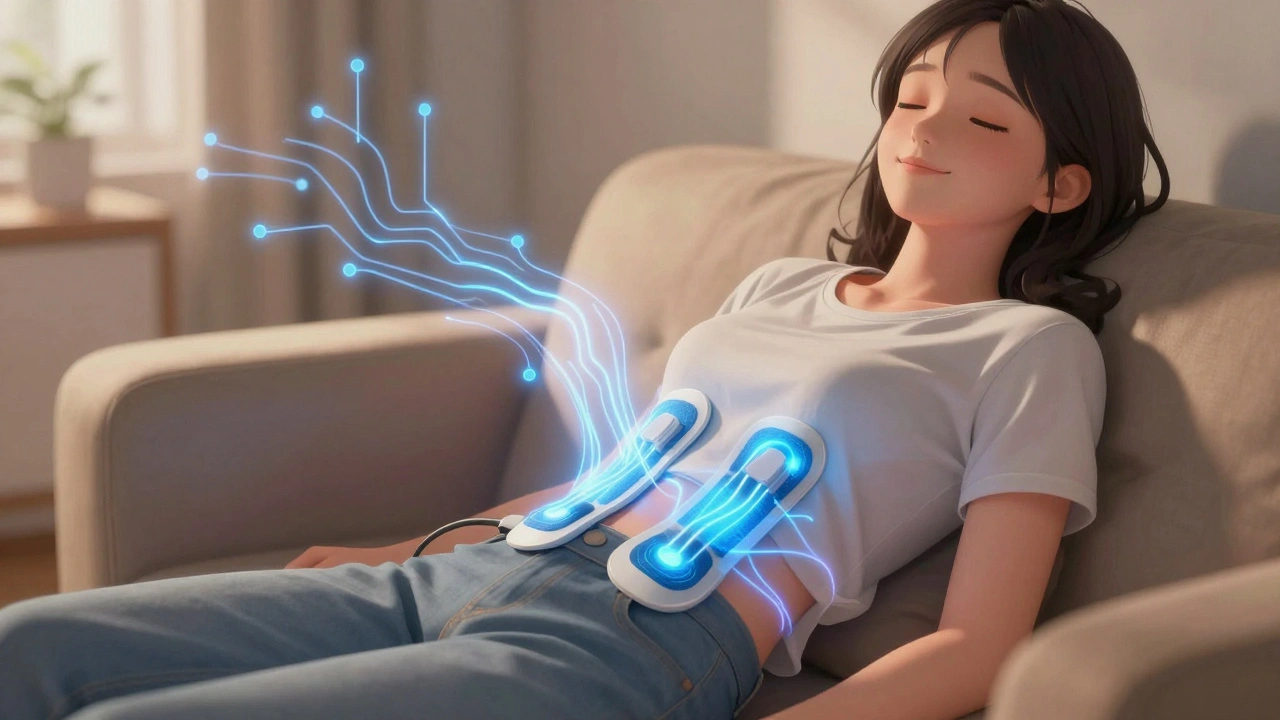
When your back flares up, your knees ache, or labor contractions hit hard, reaching for pills isn’t always the best or safest option. That’s where TENS therapy comes in - a simple, non-drug way to ease pain using mild electrical pulses. No prescriptions. No opioids. Just a small device, some sticky pads, and a few minutes of your time. It’s been used for decades, and today, millions of people rely on it to get through the day without relying on medication.
How TENS Therapy Actually Stops Pain
TENS stands for Transcutaneous Electrical Nerve Stimulation. That’s a mouthful, but it’s simpler than it sounds. The device sends tiny electrical currents through your skin to your nerves. These pulses don’t heal anything - they interrupt the pain signals before they reach your brain.
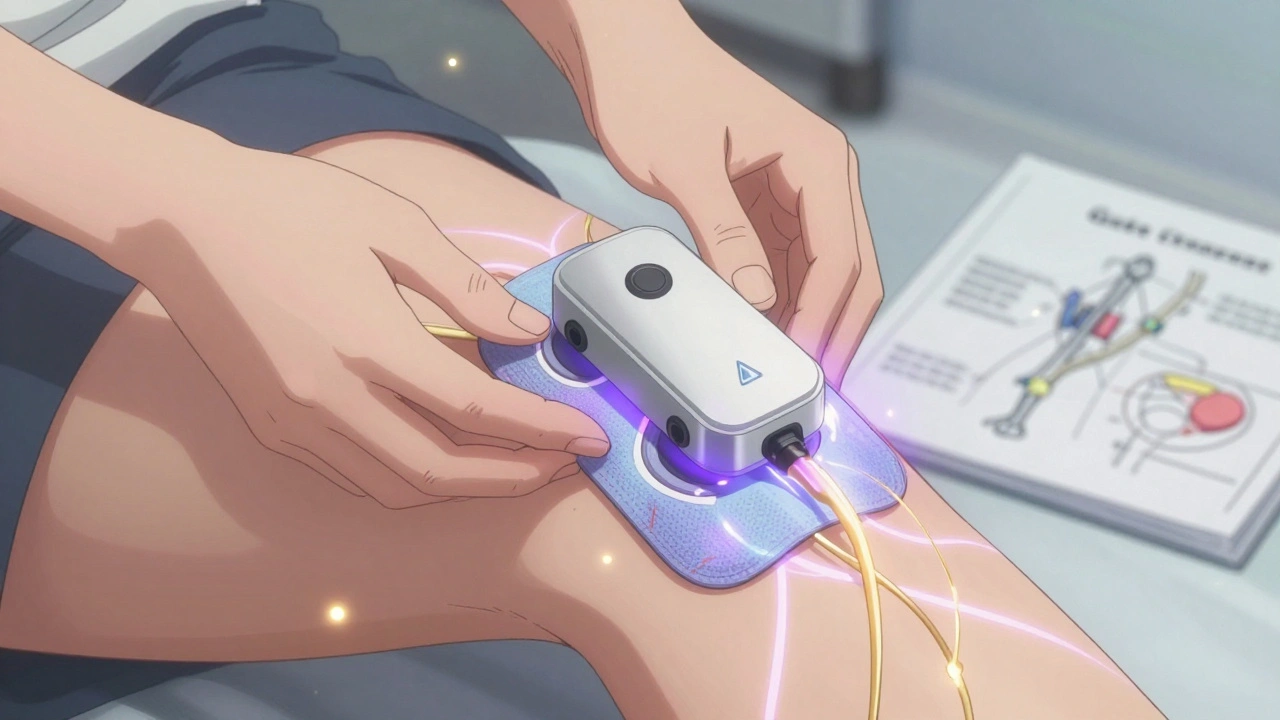
The science behind it goes back to 1965, when researchers Melzack and Wall came up with the Gate Control Theory. Think of your nerves like a highway. Pain signals are cars trying to get to your brain. TENS floods that highway with non-pain signals - a tingling, buzzing feeling - and those signals block the pain ones from getting through. It’s like turning up the volume on music so you don’t hear the sirens outside.
There are different ways to use TENS, depending on what kind of pain you have. High-frequency TENS (50-100 Hz) gives you that strong tingling feeling. It’s great for sudden pain - like after surgery or during labor. Low-frequency TENS (2-5 Hz) feels more like a deep muscle throb. It doesn’t just block pain; it tricks your body into releasing natural painkillers called endorphins. This works better for long-term pain like arthritis or chronic back pain.
What Conditions Does TENS Help With?
TENS isn’t a cure-all, but it’s been shown to help with several common pain problems:
- Lower back pain - Especially when it’s due to muscle strain or degenerative disc issues. One study showed a 35% drop in pain after using TENS for osteoarthritis-related back pain.
- Knee osteoarthritis - Many users report being able to walk farther and stand longer without pain.
- Post-surgical pain - Hospitals use TENS to reduce opioid use after operations. One study found patients needed 27% fewer painkillers.
- Labor pain - A Cochrane Review found women using TENS during childbirth reported 31% more pain relief than those using a placebo.
- Neuropathic pain - Nerve pain from diabetes or shingles can respond well, though results vary.
- Shoulder, neck, and wrist pain - Common for desk workers or people with repetitive strain injuries.
It’s less effective for widespread pain like fibromyalgia. Only about 38% of those users get meaningful relief. That’s why it’s best used as part of a bigger plan - not your only tool.
Setting Up Your TENS Unit Right
Most people buy TENS units online or at pharmacies. But here’s the catch: if you set it up wrong, it won’t work. And that’s why so many people give up on it.
First, placement matters. Electrodes need to go within 2-3 centimeters of where you feel the pain. For lower back pain, place them on either side of your spine, just above your hips. For knee pain, put one above and one below the kneecap. Don’t put them directly over broken skin, open wounds, or your neck or chest if you have a pacemaker.
Intensity is the biggest mistake. Too low? You’ll feel nothing. Too high? It hurts. The sweet spot is when you feel a strong, comfortable tingling - not painful, not tickly. A 2009 study found that 68% of failed TENS treatments happened because people didn’t turn the intensity up enough.
Start with 20-30 minutes per session, 2-3 times a day. Use high frequency (80-100 Hz) for acute pain. Use low frequency (2-5 Hz) for dull, aching pain. Some modern units have preset modes for back pain, arthritis, or labor - use those if you’re unsure.
Real People, Real Results
On Amazon, over 1,200 users rated TENS units an average of 4.3 out of 5. The most common praise? “I felt relief within minutes.” “No drowsiness like with pills.” “I can finally sleep.”
One user on Reddit, u/BackPainWarrior, said: “TENS works great for my sciatica flare-ups but only if I crank it to 85% intensity - anything less just tickles. Problem is, the battery dies in 90 minutes at that setting.” That’s a real trade-off. High intensity gives better pain relief but drains batteries fast. Some newer models have rechargeable batteries that last 8-10 hours at moderate settings.
Another user, a 54-year-old woman from Cleveland, reduced her pain score from 7.8 to 3.2 on a 10-point scale after just 20 minutes of proper TENS use. She cut her oxycodone use by 60%. That’s not magic - it’s smart pain management.
But it’s not perfect. About 34% of negative reviews mention skin irritation. That’s usually from cheap electrodes or leaving them on too long. Use conductive gel if your skin gets red. Replace pads every 10-15 uses. And if you feel a burning sensation, turn it off - that’s not normal.
How TENS Compares to Other Options
Let’s say you’re choosing between TENS, physical therapy, and painkillers.
| Method | Speed of Relief | Duration | Side Effects | Cost (per month) |
|---|---|---|---|---|
| TENS Therapy | Immediate | While in use, up to 4 hours after | Minimal (skin irritation possible) | $20-$150 (one-time device cost) |
| Physical Therapy | Days to weeks | Weeks to months (if exercises continued) | None | $50-$150 per session |
| NSAIDs (e.g., ibuprofen) | 30-60 minutes | 4-6 hours | Stomach upset, kidney strain, high blood pressure | $5-$20 |
| Opioids | 15-30 minutes | 4-6 hours | Drowsiness, constipation, addiction risk | $10-$50 (with insurance) |
TENS wins on safety and cost over time. A one-time purchase of $80 lasts years. Physical therapy is more effective long-term but requires commitment. Pills work fast but come with risks. TENS gives you control - you decide when, how long, and how strong.
What’s New in TENS Technology
It’s not just the same old box anymore. In May 2023, the FDA cleared the first AI-powered TENS device: NeuroLoop AI. It uses sensors to read your body’s response in real time and adjusts the settings automatically. In trials, it delivered 44% more pain relief than standard units.
Smart electrodes are coming too - pads with built-in sensors that detect if your skin is dry or the pad is lifting, then boost the current to keep the signal strong. These are still rare and expensive, but they’re the future.
Companies like Omron and Chattanooga now offer Bluetooth-enabled units that connect to apps. You can track your pain levels, see which settings worked best, and even share reports with your physical therapist.
The CDC now recommends TENS as a first-line treatment for chronic pain - part of a broader push to reduce opioid use. By 2025, they predict a 35% increase in TENS use among primary care doctors.
Who Should Avoid TENS?
TENS is safe for most people. But don’t use it if:
- You have a pacemaker or other implanted electronic device
- You’re pregnant (unless under medical supervision - especially avoid the abdomen or lower back)
- You have open wounds, infections, or skin conditions where the pads go
- You have epilepsy or a history of seizures
- You’re using it on your head, neck, or chest (unless directed by a professional)
If you’re on opioid medication, TENS might not work as well. Studies show opioids can block the body’s natural endorphin response, which reduces the effect of low-frequency TENS.
Getting Started: What to Buy
You don’t need a hospital-grade machine. For most people, a $60-$100 consumer unit works fine. Look for:
- Dual channels (lets you treat two areas at once)
- Adjustable frequency and intensity
- Pre-set programs for back, knee, or labor pain
- Rechargeable battery
- Clear instructions
Brands like Omron, TechCare, and iReliev are reliable. Avoid ultra-cheap units under $30 - they often lack proper safety controls and don’t deliver enough power.
If you’re unsure, ask your physical therapist. Many clinics offer TENS units for rent or trial use. Some even include a 10-minute training session to show you where to place the pads.
Final Thoughts
TENS therapy isn’t a miracle. But for millions of people, it’s the difference between managing pain and being controlled by it. It’s not for everyone, but if you’ve tried pills and they left you feeling foggy, or if you want to avoid them altogether, it’s worth a shot.
Start with a good unit. Place the pads correctly. Turn the intensity up until you feel a strong buzz - not pain, not tickles. Use it for 20-30 minutes, 2-3 times a day. Track how you feel. Give it two weeks. If it helps, keep going. If not, you’ve lost little time and no money.
In a world where pain meds come with risks, TENS is one of the few tools that lets you take control - safely, quietly, and without a prescription.
Can TENS therapy cure chronic pain?
No, TENS doesn’t cure pain. It doesn’t repair damaged tissue or reverse arthritis. What it does is block pain signals and trigger your body’s natural painkillers. It’s a tool for managing symptoms, not fixing the root cause. For lasting relief, combine it with movement, strength training, and professional care.
How long does TENS pain relief last?
Relief usually lasts while you’re using the device and for up to 4 hours afterward. With low-frequency TENS, some people report pain relief lasting 8-12 hours after a session, especially if endorphins are released. But it’s not permanent. Regular use helps maintain the effect, but you’ll need to keep using it.
Can I use TENS while sleeping?
It’s not recommended. You can’t monitor the intensity while asleep, and there’s a risk of skin irritation or burns if the pads shift. Also, the tingling sensation can wake you up. Use TENS during the day or before bed, but turn it off before falling asleep.
Is TENS covered by insurance?
In the U.S., Medicare and some private insurers cover TENS units under code E0720 if prescribed by a doctor for specific conditions like chronic low back pain. Coverage varies - you’ll need a prescription and documentation of failed conservative treatments. Most consumer units aren’t covered unless prescribed. Check with your insurer before buying.
Do TENS units have side effects?
Side effects are rare and mild. The most common is skin redness or irritation under the electrodes, usually from leaving pads on too long or using low-quality adhesive. Some people feel a slight muscle twitch. Serious side effects like burns or nerve damage are extremely rare and usually happen only with misuse or faulty equipment. Always follow the manufacturer’s instructions.
Can I use TENS with other pain treatments?
Yes, TENS works well alongside physical therapy, stretching, heat packs, and even some medications. It’s designed to be part of a multimodal approach. Just avoid using it on the same area as a heating pad at the same time - that can cause burns. Always check with your doctor if you’re combining TENS with opioids or nerve-blocking medications.
How do I know if my TENS unit is working?
You should feel a clear, tingling or buzzing sensation under the electrodes - strong enough to notice, but not painful. If you feel nothing, the pads may be dry, the battery is low, or the intensity is too low. If it hurts, turn it down. The goal is comfort, not discomfort. Keep a pain journal: rate your pain before and after each session. If you see a drop of 2 points or more on a 10-point scale, it’s working for you.

15 Comments
Evelyn Pastrana
December 8, 2025 AT 00:43So I tried this TENS thing after my knee surgery and honestly? It was the first thing that didn’t make me feel like a zombie. No drowsiness, no stomach issues, just a weird buzz that made my pain go from ‘I can’t stand’ to ‘I can stand, barely, but I’m alive.’
Worth every penny. My dog even stopped staring at me like I was dying.
Also, cranking it to 85% like that Reddit guy? Genius. I wish I’d known that sooner.
Maria Elisha
December 8, 2025 AT 21:26Ugh I bought one of those $30 units from Amazon. Lasted two days. The pads fell off mid-session. My cat sat on it. I gave up. Why do people act like this is magic? It’s just a fancy vibrating sticker.
Raja Herbal
December 10, 2025 AT 17:44My uncle in Delhi uses this for his arthritis. He says it works better than the pills the doctor gave him. But he also thinks it’s because the electricity is ‘purifying his karma.’
He won’t stop talking about it. I just nod and hand him more gel pads.
At least he’s not on opioids anymore. I’ll take karma over side effects any day.
Asset Finance Komrade
December 11, 2025 AT 14:47Interesting how we’ve reduced pain to a binary optimization problem: intensity vs battery life.
Yet we still haven’t solved the existential discomfort of being human.
Perhaps TENS is just a metaphor for distraction - we numb the signal, not the source.
Also, I used mine once. It tingled. I cried. It was beautiful.
😂
Carina M
December 12, 2025 AT 19:16While I appreciate the anecdotal enthusiasm, this article reads like a promotional brochure for consumer electronics. There is no rigorous longitudinal data supporting TENS as a first-line treatment. The FDA clearance of NeuroLoop AI, while noteworthy, was granted under the 510(k) pathway - meaning it was deemed substantially equivalent to existing devices, not clinically superior.
One must exercise caution before embracing technological placebo as medical innovation.
Jennifer Blandford
December 13, 2025 AT 15:17OMG I just used mine during my period and I’m crying. Not from pain. From relief. Like… actual tears.
My husband walked in and asked if I was okay. I said ‘I’m fine, I just finally feel human again.’
He didn’t get it. But I did.
Also, I bought the Omron one. The app is cute. I named it Gary.
❤️
Ronald Ezamaru
December 14, 2025 AT 16:21For anyone new to TENS: placement is everything. If you’re treating lower back pain, don’t put the pads on your hips - put them on the paraspinal muscles, about two fingers’ width from the spine. High frequency for sharp pain, low for deep ache.
And yes - turn it up. If you’re not feeling a strong buzz, you’re wasting your time. Most people underuse it.
Also, replace the pads when they lose stickiness. Don’t be cheap. Your nerves deserve better.
Suzanne Johnston
December 15, 2025 AT 02:26I’ve been using TENS for ten years. I had a spinal fusion. I still have nerve pain. It doesn’t fix me. But it lets me sit through a movie without screaming.
It’s not a cure. It’s a companion.
Like a quiet friend who doesn’t ask questions, just sits there and hums.
And sometimes that’s enough.
Shubham Mathur
December 15, 2025 AT 19:32People think TENS is for weaklings but no it’s for smart people who refuse to let Big Pharma control their pain
My mom used it after her hip replacement and cut her oxycodone in half in two weeks
She’s 72 and now walks three miles a day
Stop doubting the science
And buy a decent unit
Not that cheap junk
Also electrodes need gel
Stop being lazy
And yes I used it during labor
Best decision ever
My baby didn’t cry as much because I didn’t scream as much
And yes I named my TENS unit Steve
Angela R. Cartes
December 17, 2025 AT 11:57Ugh I bought one because everyone was posting about it. It made my skin itch. The app was glitchy. I used it once. Now it’s in a drawer next to my yoga mat that I’ve never used.
It’s not that it doesn’t work… it’s just… too much effort?
Also I think it’s weird that people name their TENS units.
Gary? Really?
😂
om guru
December 19, 2025 AT 11:18TENS therapy is a scientifically validated modality for pain modulation. It operates on the gate control theory and endorphin release mechanisms. For chronic pain patients, it offers a non-pharmacological alternative with minimal systemic risk. Proper electrode placement and intensity calibration are critical. I recommend supervised initiation under physiotherapist guidance. Consistency yields results. Do not expect miracles. Expect relief.
Andrea Beilstein
December 21, 2025 AT 07:04What if pain is just the body screaming to be listened to
And we just keep turning up the noise
Instead of asking why it’s screaming
Maybe TENS doesn’t fix the problem
Maybe it just lets us pretend we’re not broken
And that’s okay
For now
But someday
We’ll have to face the silence
Without the buzz
Graham Abbas
December 22, 2025 AT 19:46My grandfather used to say the best medicine is movement. TENS is a bandage. But sometimes a bandage is all you need to get to the gym.
So I’ll take it.
And I’ll move after.
That’s the real trick.
Not the machine.
The will.
Stacy Tolbert
December 24, 2025 AT 04:21I used TENS after my divorce. It didn’t fix my heart. But it made my back stop aching. And for a while, that was enough. I’d sit on the couch, tingling, pretending I wasn’t alone. It didn’t heal me. But it held me. I still use it sometimes. Just because it reminds me I’m still here.
And I still breathe.
Ryan Brady
December 26, 2025 AT 02:29USA invented this. China copies it. Now everyone’s buying it. But guess what? We’re still the best at pain management. No other country has the freedom to buy a $80 device and fix their back without asking a bureaucrat.
God bless TENS.
God bless America.
👍