
Drug Interaction Checker
Check Your Medications
Enter medications you're currently taking to identify potentially dangerous combinations. Based on real-world cases from the article.
Critical Interaction Warnings
Every year, tens of thousands of Americans are hospitalized or worse because of drug interactions that should have been caught. Not because the medicines are bad, but because the system failed to see the danger. You might think your pharmacist checks every combination you’re taking. But the truth? In more than half of cases, they don’t.
Why Some Drug Combos Are Silent Killers
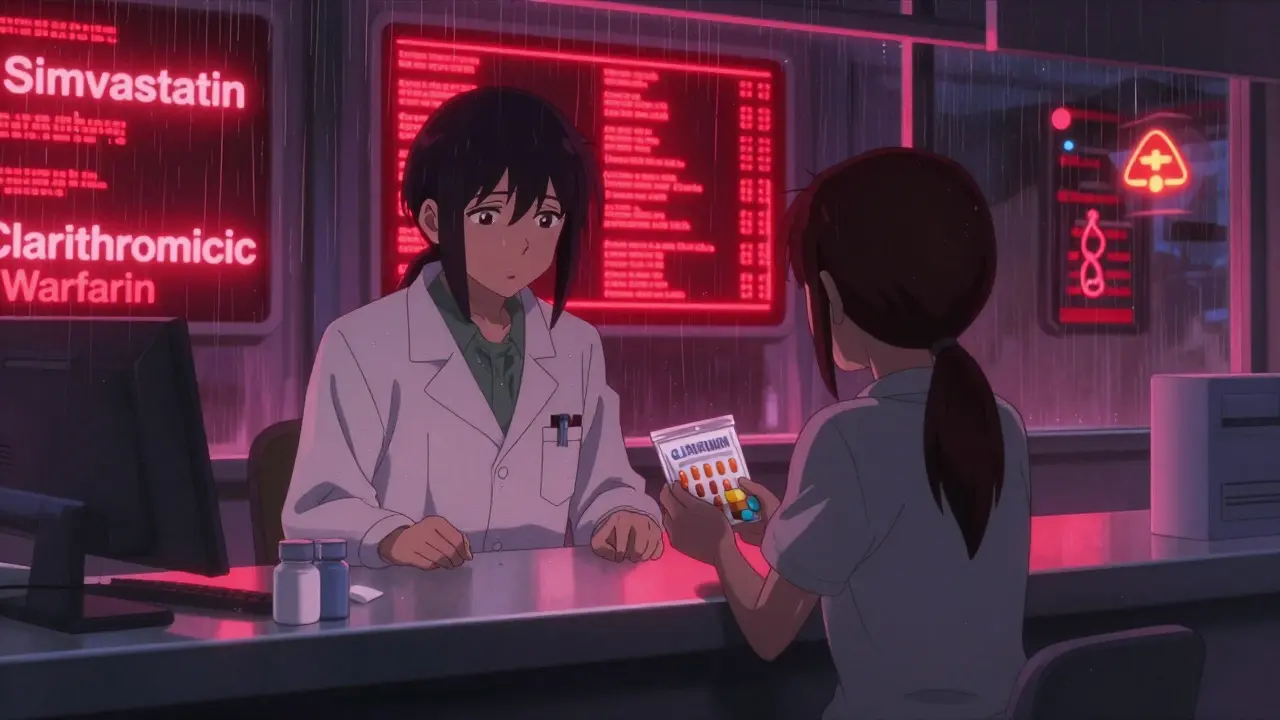
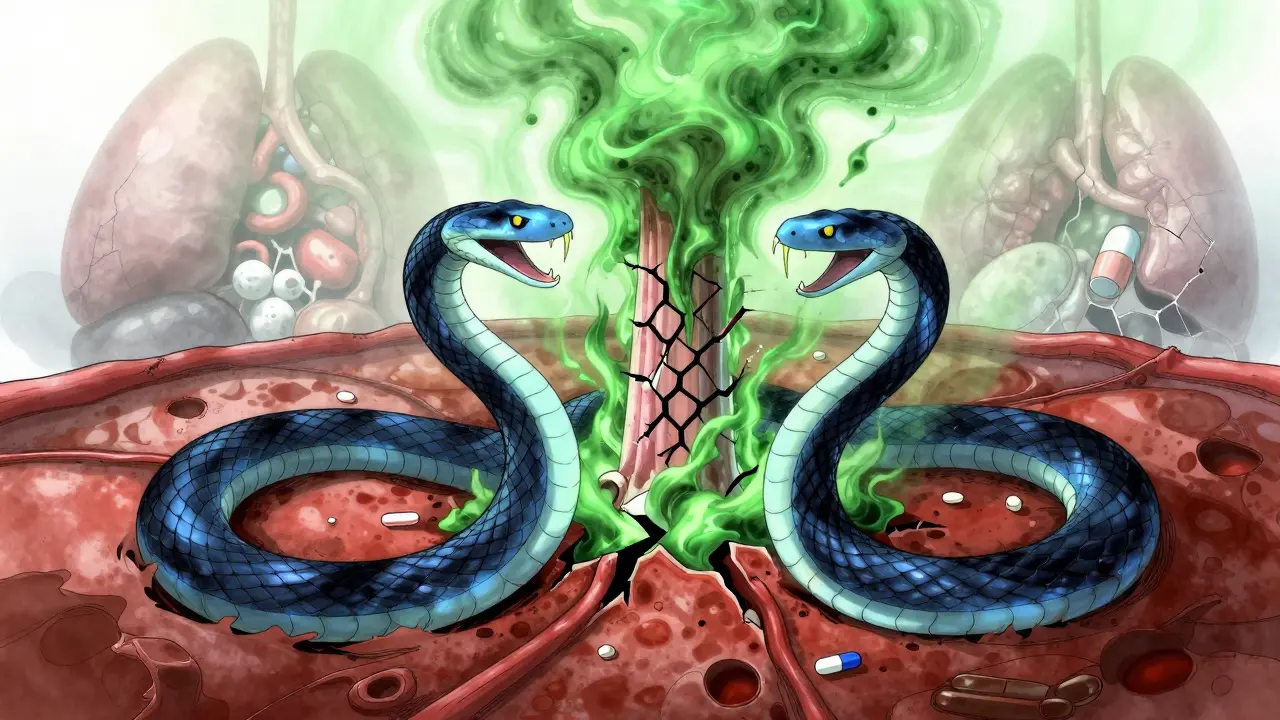
It’s not just about taking two pills together. Some combinations trigger chemical explosions inside your body. One drug blocks the enzyme that breaks down another, causing it to build up like a clogged drain. Another might speed up how fast a drug is cleared, making it useless. These aren’t theoretical risks. They’re real, deadly, and well-documented.Take simvastatin and clarithromycin. Simvastatin lowers cholesterol. Clarithromycin fights infections. Together, they can cause rhabdomyolysis - a condition where muscle tissue breaks down and floods your kidneys with toxic proteins. In severe cases, creatine kinase levels spike to over 10,000 U/L. Normal is under 200. This isn’t rare. It’s a known, preventable disaster. Yet, in the 2016 Chicago Tribune investigation, a CVS pharmacist in Evanston dispensed this exact combo without warning. The patient didn’t know. The system didn’t stop it.
Another deadly pair: tizanidine (a muscle relaxer) and ciprofloxacin (an antibiotic). Tizanidine is cleared by the CYP1A2 enzyme. Ciprofloxacin shuts that enzyme down. The result? Tizanidine builds up to dangerous levels. Patients pass out. Some never wake up. This combo should never be prescribed together - not even for a day.
The Warfarin Trap
Warfarin is a blood thinner. It’s been used for decades. But it’s like walking a tightrope. Too little, and you clot. Too much, and you bleed internally. Now add amiodarone, a heart rhythm drug. Amiodarone doesn’t just interact with warfarin - it hijacks it. It blocks three different enzymes (CYP2C9, 1A2, 3A4) that break down warfarin. That means warfarin sticks around much longer. The risk of bleeding skyrockets.The American Academy of Family Physicians says: if you start amiodarone while on warfarin, cut the warfarin dose by 30-50% immediately. Then check your INR every week for at least a month. Most pharmacies don’t have that protocol built in. Most pharmacists are rushing through 2.3 minutes per prescription. They don’t have time to dig into complex interactions like this - unless the system forces them to.
Even statins aren’t all safe with warfarin. Fluvastatin, lovastatin, rosuvastatin, and simvastatin all interfere with warfarin metabolism. Atorvastatin and pravastatin? Much safer. But unless your pharmacist knows the difference - and your doctor does too - you’re rolling the dice.
Birth Control in Danger
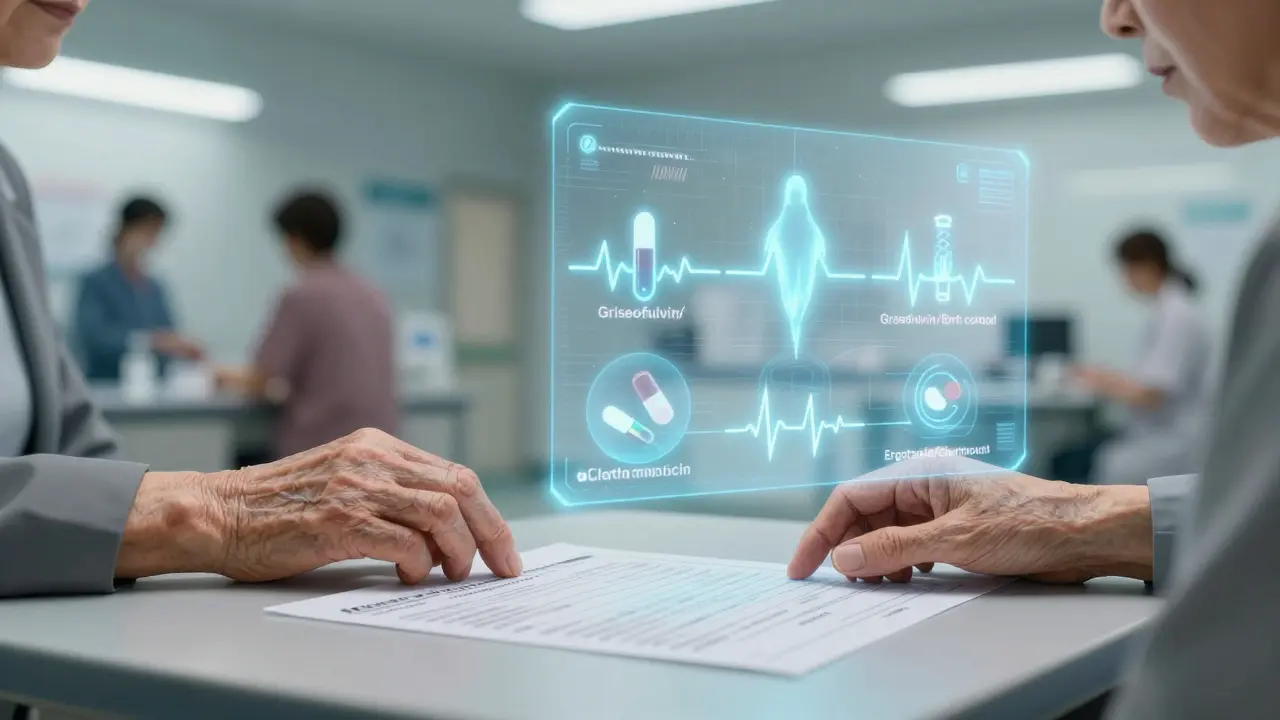
It’s not just about bleeding or kidney failure. Some interactions are quietly life-altering. Griseofulvin, an antifungal used for nail infections, can make birth control fail. How? It turns on the CYP3A4 enzyme, which speeds up the breakdown of estrogen. Studies show pregnancy rates jump above 30% when this combo is taken. And if you get pregnant while on griseofulvin? The risk of birth defects increases. Yet, many patients don’t even know they’re on this combo. The pharmacist might not catch it either - especially if the antifungal was bought over the counter.Same goes for ergotamine, used for migraines, and clarithromycin. Ergotamine causes blood vessels to narrow. Clarithromycin blocks its breakdown. The result? Ergotism - a condition that can lead to gangrene in fingers and toes, seizures, or heart attack. This isn’t a mild side effect. It’s a medical emergency. And it’s been happening for decades.
The System Is Broken - And It’s Getting Worse
You’d think computers would catch this. But they don’t. Not really. Pharmacy systems flood pharmacists with alerts - dozens, sometimes hundreds - for every prescription. Most are for low-risk interactions: “This drug might cause mild nausea.” “This combo might slightly increase dizziness.” After a while, the brain learns to ignore them. This is called alert fatigue.A 2016 study by the University of Washington School of Pharmacy found that 52% of pharmacies failed to warn patients about five known deadly combinations. That’s more than half. Even after the report, major chains like Walgreens and CVS promised to fix it. But progress is slow. Thirty percent of community pharmacies still don’t have smart systems that filter alerts by severity. They just get bombarded with noise.
Professor John Horn, who helped lead the Tribune investigation, worked with 12 major health systems to redesign their alert systems. He cut irrelevant warnings by 78%. And guess what? The number of high-risk interactions caught jumped from 48% to 89%. The system wasn’t broken - it was overloaded. Fixing the noise fixed the safety.
Who’s Most at Risk?
You might think this only affects the elderly. And yes - people over 65 are the most vulnerable. They take an average of 4.5 prescription drugs a day. That’s a lot of chances for something to go wrong. The FDA says older adults have seven times the rate of adverse drug events compared to younger people.But it’s not just seniors. Pregnant women on birth control. Kids on multiple medications. People with kidney or liver disease. Anyone on opioids and benzodiazepines. The FDA warned in 2016 that combining these two can cause fatal breathing problems. Between 2011 and 2016, prescriptions for both drugs together went up 500%. And people kept dying.
One doctor, Dr. Joe Graedon, lost his mother to serotonin syndrome after she was given Demerol (meperidine) with another medication. He had warned the hospital. They didn’t listen. She suffered violent muscle spasms, then internal bleeding after angioplasty. It was preventable. It was ignored.
What You Can Do Right Now
You can’t fix the system alone. But you can protect yourself.- Always tell your pharmacist every medication you take - including supplements, OTC painkillers, and herbal products.
- Ask: “Is this safe with everything else I’m taking?” Don’t wait for them to ask you.
- If you’re on warfarin, ask if your new drug affects INR. If you’re on statins, ask which one is safest with your other meds.
- Keep a printed list of all your medications and bring it to every appointment.
- If you’re prescribed a new drug and feel dizzy, weak, or confused within a few days - call your pharmacist. Don’t wait.
Pharmacists want to help. But they’re drowning in alerts, time pressure, and outdated systems. You’re the missing link. You’re the one who knows your body best. Speak up. Ask questions. Don’t assume someone else is watching.
What’s Changing - And What’s Not
The FDA’s 2023-2025 Digital Health Plan includes funding for AI tools that predict interactions based on your full medical history - not just two drugs. That’s promising. But AI won’t fix the problem if pharmacists still have no time to review the results.The CDC recommends mandatory counseling for all new prescriptions involving high-risk drugs. That could prevent 150,000 adverse events a year. But only 12% of pharmacies currently do this consistently.
The real solution? Reduce the noise. Train pharmacists on the top 10 deadliest interactions. Build systems that only scream when it matters. And give pharmacists the time to listen.
Until then, you’re your own best safety net. Know your meds. Ask the hard questions. And if something feels off - trust your gut. It might just save your life.
12 Comments
Diksha Srivastava
January 31, 2026 AT 04:57Thank you for writing this. I’ve been scared to take new meds since my aunt had a bad reaction, and this makes me feel less alone. Small acts of awareness save lives.
Melissa Cogswell
February 1, 2026 AT 17:54As a pharmacist with 12 years in community practice, I can confirm: alert fatigue is real. We get 80+ alerts per script sometimes. Half are ‘possible mild drowsiness.’ The system doesn’t prioritize. We’re trained to catch deadly combos, but we’re not given the tools. I keep a printed cheat sheet on my desk for top 10 lethal interactions. It’s the only thing that saves me.
Blair Kelly
February 3, 2026 AT 15:27This article is not just informative-it’s a national scandal. The FDA has known about these interactions for decades. The pharmacy chains have known. The EHR vendors have known. And yet, they continue to profit off of algorithmic negligence. This isn’t incompetence-it’s systemic malfeasance disguised as efficiency. Someone needs to be sued. And the families of the dead deserve restitution, not another PowerPoint slide.
Rohit Kumar
February 5, 2026 AT 10:34In India, we don’t have the same infrastructure, but we have something else: community trust. My grandmother takes six meds. She doesn’t know their names, but she knows the color, the shape, and who gave them to her. She brings her pills to every visit. No app, no alert system-just human memory and ritual. Maybe the solution isn’t more tech, but more presence.
Lily Steele
February 6, 2026 AT 15:36I just started warfarin last month. My pharmacist didn’t mention anything about amiodarone-I’m on it for AFib. I’m going back tomorrow with this article. Thank you for naming the risks. I feel less stupid for not knowing.
Marc Bains
February 8, 2026 AT 02:29My brother died at 42 from rhabdomyolysis after being prescribed simvastatin and clarithromycin for a sinus infection. He was healthy. He didn’t know. The pharmacy didn’t warn him. The doctor didn’t flag it. This isn’t a ‘risk’-it’s a preventable murder by bureaucracy. If you’re reading this and take statins, ask your pharmacist: ‘Which one is safest with my other meds?’ Don’t wait for them to ask you.
Amy Insalaco
February 8, 2026 AT 19:55While the article correctly identifies pharmacovigilance gaps, it fundamentally misattributes causality. The issue is not ‘alert fatigue’ per se-it’s the ontological misalignment between pharmacokinetic modeling and clinical decision-making frameworks. The CYP450 enzyme inhibition cascades are non-linear, context-dependent, and epigenetically modulated, yet current EHR systems treat them as binary Boolean triggers. Until we implement Bayesian risk-prediction architectures calibrated to individual metabolic phenotypes-rather than population-based heuristics-we’re merely rearranging deck chairs on the Titanic.
Natasha Plebani
February 8, 2026 AT 20:31The real tragedy isn’t the interaction-it’s the assumption that patients are passive recipients. We’ve been conditioned to believe that if it’s on a label, it’s safe. But the body doesn’t read labels. It responds to chemistry. And chemistry doesn’t care about your insurance plan. We need to teach pharmacology as a living science, not a checklist. Until then, every pill is a gamble.
Sidhanth SY
February 9, 2026 AT 16:01My uncle took tizanidine and cipro together for back pain and a UTI. He passed out in the shower. Woke up in ICU. No one told him it was dangerous. He’s fine now, but he won’t take anything without checking with me first. I’m not a doctor-I just read. We all need to be a little more like that.
Bobbi Van Riet
February 11, 2026 AT 07:39I’m a nurse, and I’ve seen this too many times. A patient comes in with a new script, says they’re on five meds, but forgets the turmeric capsules, the CBD oil, the St. John’s Wort for ‘anxiety.’ Then they get dizzy, fall, and end up in the ER. And everyone’s like, ‘Oh, it was the meds.’ But we didn’t ask. We didn’t dig. We assumed. I keep a little card in my pocket: ‘Ask about everything-even the stuff you think doesn’t count.’ It’s saved lives. Seriously. Even the gummy vitamins.
Katie and Nathan Milburn
February 13, 2026 AT 06:03It is deeply concerning that systemic failures in pharmaceutical safety continue to persist despite the availability of robust clinical evidence and technological infrastructure. One must question the ethical implications of permitting such preventable morbidity and mortality to occur under the guise of operational efficiency. The burden of vigilance should not be placed solely upon the patient, who, by virtue of their medical vulnerability, is already operating under significant cognitive and emotional strain. A more equitable and efficacious approach would necessitate mandatory, time-reserved clinical review for polypharmacy patients-a structural intervention, not an individualized one.
Kelly Weinhold
February 14, 2026 AT 10:13I just told my mom to stop taking griseofulvin for her toenail fungus. She was on birth control and didn’t even know it could cause pregnancy. She cried because she didn’t want to be a grandma yet. I’m glad I found this. We’re all just trying to survive this mess. You’re not alone. Keep speaking up.