

Every year, millions of people lose their hearing-not from aging, not from illness, but from something completely preventable: too much noise. Whether you’re working on a factory floor, using power tools in your garage, or standing front row at a concert, the sound around you can be quietly damaging your ears. The good news? We know exactly how much noise is safe, and how to protect yourself. The bad news? Many people still don’t know the rules-or they ignore them.
What Are Noise Exposure Limits?
Noise exposure limits are science-based thresholds that tell you how loud is too loud, and for how long. These aren’t guesses. They come from decades of research by organizations like the National Institute for Occupational Safety and Health (NIOSH) a U.S. federal agency that researches workplace safety and health, including noise-induced hearing loss and the Occupational Safety and Health Administration (OSHA) the U.S. agency that enforces workplace safety regulations, including noise standards.
NIOSH says any noise at or above 85 decibels (dBA) averaged over 8 hours is hazardous. That’s about the sound of heavy city traffic or a lawnmower. OSHA’s legal limit is higher-at 90 dBA-but even OSHA requires employers to start protecting workers once noise hits 85 dBA. Why the difference? Because NIOSH’s standard is designed to keep nearly everyone safe over a lifetime. OSHA’s allows more risk.
The math behind this is simple: every time the noise level goes up by 3 dB, your safe exposure time cuts in half. So if 85 dBA is safe for 8 hours, then:
- 88 dBA? Only 4 hours
- 91 dBA? Just 2 hours
- 94 dBA? 1 hour
- 100 dBA? Only 15 minutes
This is called the 3-dB exchange rate. NIOSH, the American Conference of Governmental Industrial Hygienists (ACGIH) a professional organization that sets science-based exposure guidelines for occupational hazards, and most health experts agree this is the right way to measure risk. OSHA still uses a 5-dB rate-which means it lets you stay longer in louder noise. That’s why NIOSH calls OSHA’s standard outdated.
How Loud Is Too Loud at Work?
Manufacturing, construction, mining, and music industries have the highest rates of noise-induced hearing loss. In 2022, the Bureau of Labor Statistics a U.S. government agency that collects labor data, including workplace injury statistics recorded over 15,500 cases of hearing loss on the job. That’s not counting the thousands more who don’t report it.
Here’s what you might hear in common jobs:
- Jackhammer: 130 dBA
- Chain saw: 110 dBA
- Power drill: 100 dBA
- Factory assembly line: 90-95 dBA
- Truck cab: 85-90 dBA
At 90 dBA, OSHA says you can work 8 hours without protection. But NIOSH says you’re already at risk after 1 hour at 95 dBA. That’s why many workplaces now follow NIOSH’s stricter standard-even if they’re not legally required to.
Employers must follow a hierarchy of controls:
- Eliminate or replace noisy machines with quieter ones (e.g., switching from a pneumatic hammer to an electric one).
- Engineer the noise out-install sound barriers, enclosures, or vibration dampeners.
- Change work schedules-rotate workers so no one is exposed for too long.
- Provide hearing protection-earplugs or earmuffs.
But here’s the catch: most hearing protection only works if it’s worn correctly. NIOSH studies show that without hands-on training, only 40% of workers use their earplugs right. With training? That jumps to 85%.
Concerts, Festivals, and Your Ears
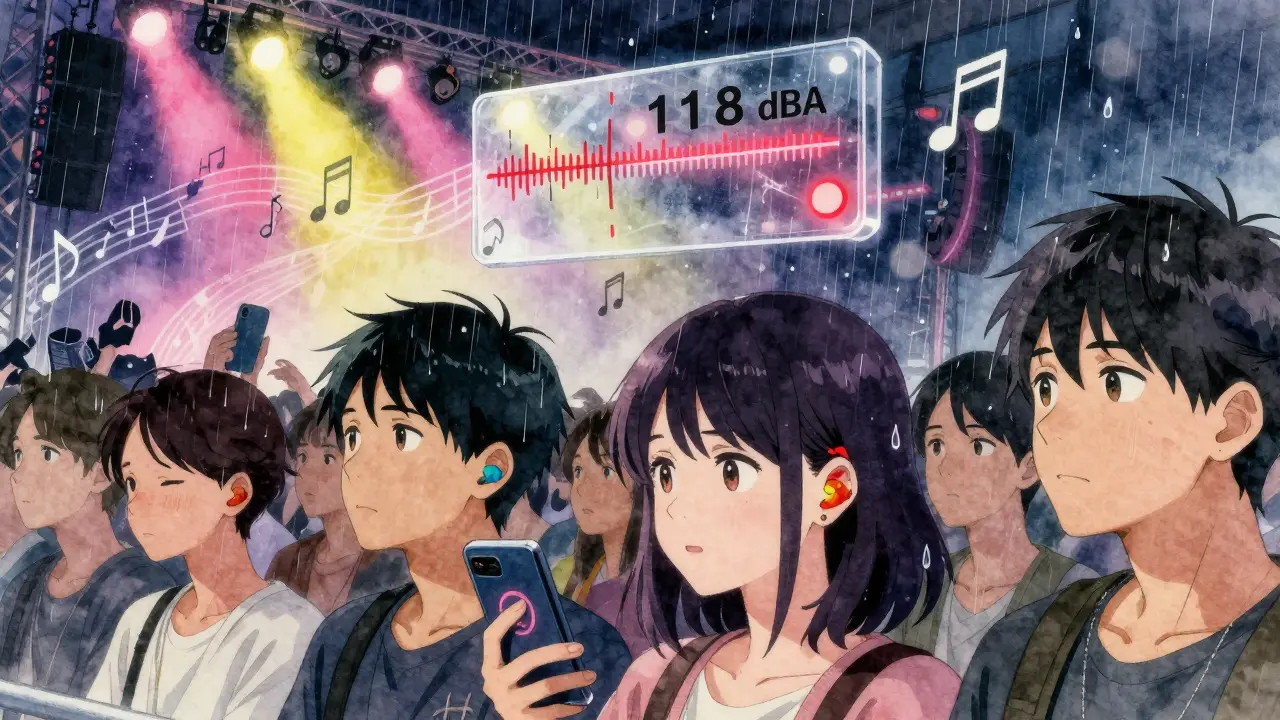
Concerts aren’t workplaces-but that doesn’t mean your ears are safe. A typical rock concert hits 110-120 dBA. At that level, damage can happen in under 15 minutes. A 2022 survey by the International Music Managers Forum a global organization representing music industry professionals found that 63% of professional musicians already have some hearing loss. And it’s not just performers. Fans are at risk too.
Here’s what’s changing:
- Free earplugs: Festivals like Lifehouse now hand out earplugs at the gate-and 75% of attendees take them.
- Quiet zones: Some venues now offer areas with ambient noise around 70-75 dBA, where you can rest your ears between songs.
- Real-time sound displays: A few venues now show live decibel readings on screens so you know how loud it is.
The World Health Organization (WHO) a global public health agency that promotes safe listening practices recommends limiting personal audio device use to 40 hours per week at 80 dBA. That’s roughly one hour a day. Most people blast their headphones way louder than that.
And here’s something new: apps on your smartphone can now measure noise levels with 92% accuracy, compared to professional meters. You can check if your headphones are too loud or if the bar you’re at is risking your hearing.
Why the Rules Are Different Around the World
Not every country agrees on the limits:
| Region | 8-Hour Limit (dBA) | Exchange Rate | Peak Limit |
|---|---|---|---|
| NIOSH (U.S. Recommendation) | 85 | 3-dB | 140 dB(C) |
| OSHA (U.S. Law) | 90 | 5-dB | 140 dB(C) |
| European Union | 85 (action), 87 (limit) | 3-dB | 137 dB(A) |
| UK | 80 (lower), 85 (upper), 87 (limit) | 3-dB | 135 dB(C) |
| Australia (Safe Work Australia) | 85 | 3-dB | 140 dB(C) |
| China (GBZ 2.2-2007) | 85 | 3-dB | 140 dB(C) |
Canada, Australia, and most of Europe follow NIOSH’s lead. The U.S. is the outlier-its legal standard is older and less protective. But change is coming. California already uses the 85 dBA limit and 3-dB rate. The European Commission is pushing to extend these rules to concert staff and venues. And WHO is working with Spotify and Apple Music to warn users when their volume hits unsafe levels.
What You Can Do Today
You don’t need to wait for regulations to protect your hearing. Here’s what works:
- At work: If you’re exposed to noise above 85 dBA, ask your employer about a hearing conservation program. Demand training. Wear your earplugs-even if you think you’re fine. Hearing loss is silent until it’s permanent.
- At concerts: Grab free earplugs. Sit farther back. Take breaks in quiet zones. Don’t assume “it’s just one night.” Temporary ringing? That’s your body warning you.
- With headphones: Use volume-limiting settings. Set a max volume at 60% or below. Use noise-canceling headphones so you don’t turn it up to drown out background noise.
- At home: If you use power tools, wear protection. If your vacuum cleaner or lawnmower sounds loud, it probably is. Measure it with your phone app.
The CDC says 24% of hearing loss in the U.S. is caused by noise-and it’s 100% preventable. You don’t need fancy gear. You don’t need a law to change. You just need to know the numbers and act on them.
Why This Matters More Than You Think
Hearing loss doesn’t just mean you miss a song or a joke. It means you stop connecting. You withdraw from conversations. You feel isolated. It’s linked to depression, anxiety, and even cognitive decline. The National Institute on Deafness and Other Communication Disorders a U.S. government research institute focused on hearing, balance, and communication disorders projects that if we fully adopt 85 dBA limits across all sectors, we could prevent 240,000 cases of hearing loss every year in the U.S. alone by 2040.
That’s not a statistic. That’s 240,000 people who can still hear their kids laugh, their partner say “I love you,” or the birds outside their window.
Is 85 decibels really that loud?
Yes. 85 dBA is about the sound of heavy city traffic, a lawnmower, or a blender running. It’s not ear-splitting, but if you’re exposed to it for 8 hours straight, day after day, your hearing will start to decline. That’s why it’s the international benchmark for safe exposure.
Can I rely on earplugs alone to protect me?
No. Earplugs are the last line of defense. The best protection comes from reducing noise at the source-quieter machines, barriers, or limiting time near loud sounds. Earplugs help, but only if they’re fitted properly. Studies show that even high-quality plugs can lose up to 50% of their protection if not inserted correctly.
Do concerts have legal noise limits?
In most places, no-not for the audience. But in the EU and parts of Canada, venues are required to protect staff if they’re exposed to more than 80 dBA for long shifts. The U.S. has no federal rule for concertgoers, but some cities and festivals are adopting voluntary limits. The trend is moving toward mandatory monitoring.
How do I know if my headphones are too loud?
If someone next to you can hear your music, it’s too loud. Use your phone’s sound meter app to check. Most apps show you the equivalent dBA level. If it’s above 80 dBA for more than an hour a day, you’re at risk. Apple and Spotify now warn you when your volume hits unsafe levels-turn those alerts on.
Is hearing loss from noise reversible?
No. Once the hair cells in your inner ear are damaged, they don’t grow back. What you might think is temporary ringing (tinnitus) after a concert could be the first sign of permanent damage. The damage builds slowly over years. You won’t notice until it’s too late.
What’s the best type of earplug for concerts?
Musician’s earplugs. These are custom-molded or high-fidelity filters that reduce volume evenly across frequencies so music still sounds natural. Regular foam plugs make everything muffled. You want to hear the music, not lose your hearing.
What’s Next?
The future of hearing protection is simple: awareness, tools, and action. More venues will install real-time noise displays. More apps will track your daily exposure. More employers will follow NIOSH’s lead. But none of that matters if you don’t act.
Protecting your hearing isn’t about being cautious. It’s about being smart. It’s about knowing that the next time you go to a concert, or start your car, or turn on the lawn mower-you have power. You can choose to protect yourself. And once you do, you’re not just saving your hearing. You’re saving your connection to the world around you.

13 Comments
Bhaskar Anand
February 23, 2026 AT 17:23This post is pure propaganda. 85 dB? That's laughable. In India, we work in factories where the noise is 100 dB for 12 hours straight. No one wears earplugs. No one cares. You think a government guideline changes reality? It doesn't. People adapt. Or they don't. And if they don't? Too bad. This whole thing is a Western luxury. We need jobs, not decibel charts.
William James
February 24, 2026 AT 03:12i just wanted to say… thank you for writing this. i’ve been working in construction for 18 years and started losing hearing in my 30s. i didn’t know it was preventable. i wish someone had told me this when i was 20. i use custom musician’s plugs now. they’re expensive but worth it. you can still hear your buddy joke about the boss… just without the ringing after. please, if you’re reading this… don’t wait until it’s too late. it’s not dramatic. it’s just… quiet. and then it’s gone.
David McKie
February 25, 2026 AT 20:28Let me be brutally honest: this entire article is a feel-good fantasy. You talk about 'hearing conservation programs' like they're a magic solution. They're not. In the real world, employers cut corners. Workers are paid by the hour, not by decibels. And guess what? No one's going to 'rotate shifts' when there's a deadline. Earplugs? Most workers shove them in like cotton balls and forget they're there. This isn't a public health crisis-it's a human behavior crisis. And we're all too lazy to fix it.
Southern Indiana Paleontology Institute
February 26, 2026 AT 00:15i dont get why people are so scared of loud stuff. my grandad worked on a drill rig for 40 years and never wore earplugs. he still hears just fine. you think the government is trying to control us? maybe. but i say: if you can't handle noise, get a different job. also, 85 db? that's like a blender. i had a lawnmower that was louder. and i used it every weekend. no damage. just saying.
Anil bhardwaj
February 27, 2026 AT 03:52i work in a textile factory in Mumbai. our machines hit 90 dB. we get earplugs once a year. no training. no checks. i just use whatever i can find. sometimes cotton. sometimes paper. i don’t think about it. i just work. but i did notice last month-my left ear doesn’t hear my phone ring anymore. weird. i guess i should do something. but honestly? i’m tired.
lela izzani
February 28, 2026 AT 22:29I just wanted to add something practical: if you're using noise-canceling headphones and you're cranking them up to drown out your environment, you're already doing damage. The solution isn't just volume control-it's environment control. Get a quiet space. Or use passive noise isolation. I started using these over-ear earmuffs for commuting, and my daily exposure dropped by 60%. No app needed. Just awareness. Small changes, big impact.
Joanna Reyes
March 1, 2026 AT 02:25I’ve been reading through this and it’s making me reflect on how we normalize sensory overload in modern life. We don’t just tolerate noise-we celebrate it. Concerts are about intensity. Workplaces are about output. Even our homes are filled with the hum of appliances, notifications, and streaming. We’ve created a world where silence feels unnatural. And now we’re surprised when our bodies start to break down from the constant assault? The real tragedy isn’t the decibel level-it’s the fact that we’ve stopped noticing the cost. We traded hearing for convenience, and we didn’t even realize we were making the trade.
Stephen Archbold
March 1, 2026 AT 18:58so i went to a metal concert last month and got the free earplugs. at first i thought they’d ruin the music. but honestly? it was better. i could hear the bass still, the drums, the vocals-all clear. no ringing afterward. i told my friends. they thought i was weird. now two of them bought their own. it’s weird how something so simple can feel revolutionary. also, my phone app says my vacuum is 87 dB. who knew? i’m gonna get a quieter one. small wins, right?
Nerina Devi
March 2, 2026 AT 19:54In India, we don’t have the luxury of choosing quiet. But we do have something better: community. When I worked in a factory, we’d take turns reminding each other to wear earplugs. No one wanted to be the one who couldn’t hear their child’s first words. We didn’t need posters or laws. We just cared. Maybe the real solution isn’t technology or policy-it’s human connection. We protect each other when we remember we’re not alone.
Dinesh Dawn
March 3, 2026 AT 19:15i used to think hearing loss was something old people got. then i started noticing my own ears ringing after the gym. now i keep earplugs in my bag. i use them when i mow the lawn, when i clean, even when i go to the movies. no one’s impressed. but i don’t care. better to be quiet now than deaf later. simple.
Vanessa Drummond
March 3, 2026 AT 20:49This is such a scam. They say 85 dB is dangerous, but then you look at the data-most people who lose hearing have pre-existing conditions, or they’re just old. This whole thing is fear-mongering disguised as science. And don’t get me started on those 'musician earplugs'-they cost $150. Meanwhile, my $5 foam plugs work fine. This isn’t about health. It’s about profit. Companies sell you solutions to problems they invented.
Nick Hamby
March 4, 2026 AT 17:25I find it profoundly interesting how we have established scientifically rigorous thresholds for noise exposure, yet societal compliance remains abysmally low. This disconnect suggests not a failure of knowledge, but a failure of cultural prioritization. We have metrics, regulations, and tools-but we lack a collective ethos that values sensory longevity. The question is not whether we can protect hearing, but whether we as a society are willing to redefine what we consider 'normal' in terms of environmental stimulation. Perhaps the next frontier in public health is not the decibel, but the decision.
kirti juneja
March 4, 2026 AT 17:56i just tried those app-based sound meters and holy wow. my blender is 92 dB. my coffee maker? 88. my kid’s toy that screams 'i love you' every 10 seconds? 95. i thought i was being quiet. turns out i’m basically living in a rock concert. i’m gonna start using my earplugs at home too. not for work. just… for me. i want to hear my grandma’s voice when she’s 90. and i want to hear my own laughter too. not the echo. the real one.