
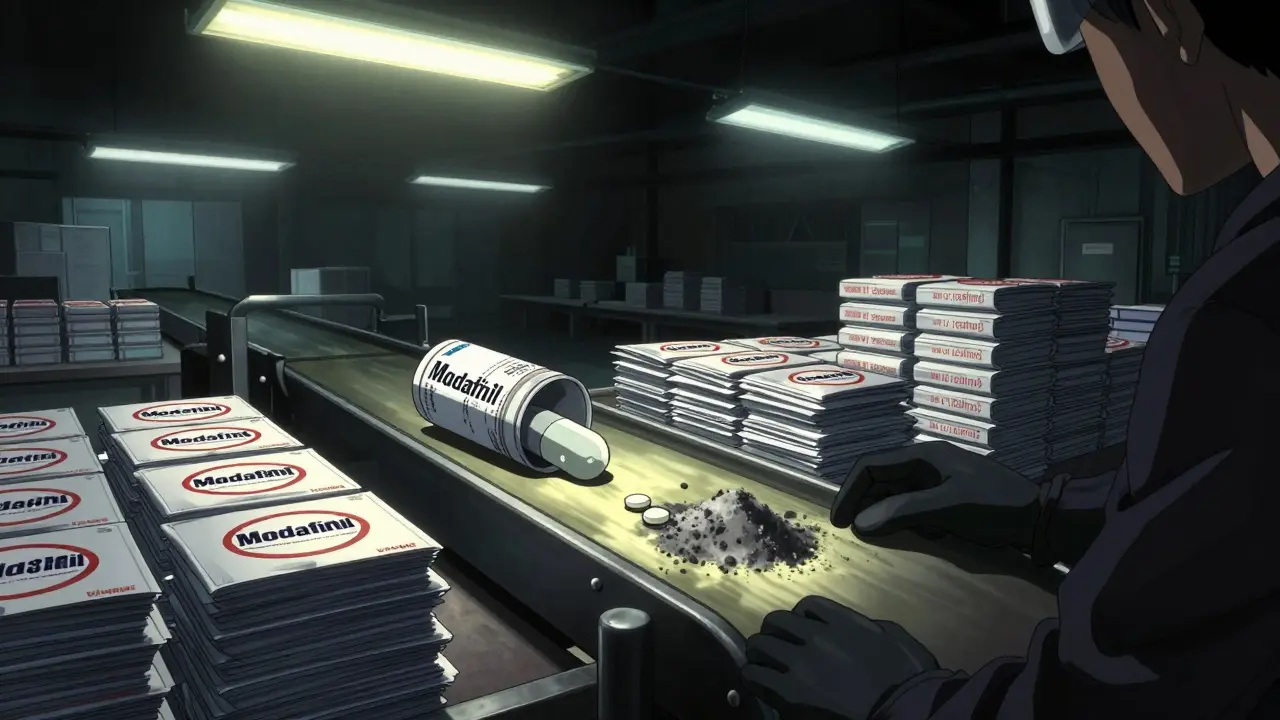
Every year, millions of people around the world order prescription drugs online from foreign pharmacies hoping to save money. What they don’t realize is that nearly one in ten of these medications could be fake - and some of them could kill you.
The problem isn’t just happening in distant countries. In 2025, Australian border officials seized over 5.2 million units of illegal drugs shipped from overseas. Most of them? Pills sold as modafinil, erectile dysfunction meds, or smoking cessation products. They looked real. They came in branded packaging. But inside? Sometimes no active ingredient at all. Sometimes twice the dose. Sometimes toxic chemicals like rat poison or industrial dyes.
What Exactly Is a Counterfeit Drug?
A counterfeit drug isn’t just a knockoff like a fake Rolex. It’s a medical product that deliberately misrepresents itself. The World Health Organization breaks this down into two categories:
- Substandard: Made properly but failed quality checks - maybe expired, improperly stored, or diluted.
- Falsified: Deliberately fake - wrong ingredients, no active drug, or harmful additives.
These aren’t rare edge cases. In 2024, global authorities recorded over 6,400 incidents of pharmaceutical counterfeiting across 136 countries. That’s not just pills with wrong labels - it’s cancer drugs with no active ingredient, antibiotics with 14% of the needed dose, or diabetes meds laced with sugar and chalk.
Why does this happen? Because the profit margins are insane. A legitimate insulin pen might cost $100. A counterfeit version costs $2 to make. Sell it for $30? That’s a 1,400% profit. For some cancer biologics, the margin jumps to over 9,000%. Criminal gangs don’t care if you live or die - they only care about the bank transfer.
Where Are These Fake Drugs Coming From?
You won’t find counterfeit drugs on Amazon or Walmart. They’re sold through websites that look like real pharmacies. They use logos, fake certifications, and even professional-looking videos of pharmacists explaining dosage. Many of them operate out of unregulated regions - mostly Southeast Asia, parts of Eastern Europe, and Latin America.
During INTERPOL’s 2025 crackdown (Operation Pangea XVI), authorities shut down 13,000 websites, social media accounts, and online marketplaces selling fake meds. The same operation led to 769 arrests across 90 countries. The U.S., Canada, Australia, and the UK led in seizures - not because they’re the source, but because so many of their citizens are ordering from these sites.
Here’s the scary part: 93% of the drugs seized during that operation had no approval from any national health authority. That means no safety testing. No quality control. No traceability. Just a warehouse, a printer, and a courier service.
What Happens When You Take a Fake Drug?
Most people assume the worst-case scenario is getting no effect. But the real danger is worse:
- Treatment failure: If your blood pressure pills have no active ingredient, your heart could stop. If your malaria drug has only 14% of the needed dose, you won’t recover - and you’ll spread drug-resistant strains.
- Toxic reactions: Counterfeit antibiotics have been found to contain lead, arsenic, and industrial solvents. One study found counterfeit erectile dysfunction pills with 198% of the labeled sildenafil - causing permanent vision damage and priapism (a painful, hours-long erection that can destroy tissue).
- Antimicrobial resistance: Taking weak antibiotics doesn’t kill bacteria - it trains them to survive. The WHO estimates counterfeit anti-malarial drugs alone cause 116,000 deaths per year. Counterfeit antibiotics contribute to over 72,000 child deaths from pneumonia annually.
There’s no warning label. No recall notice. No way to know until it’s too late.
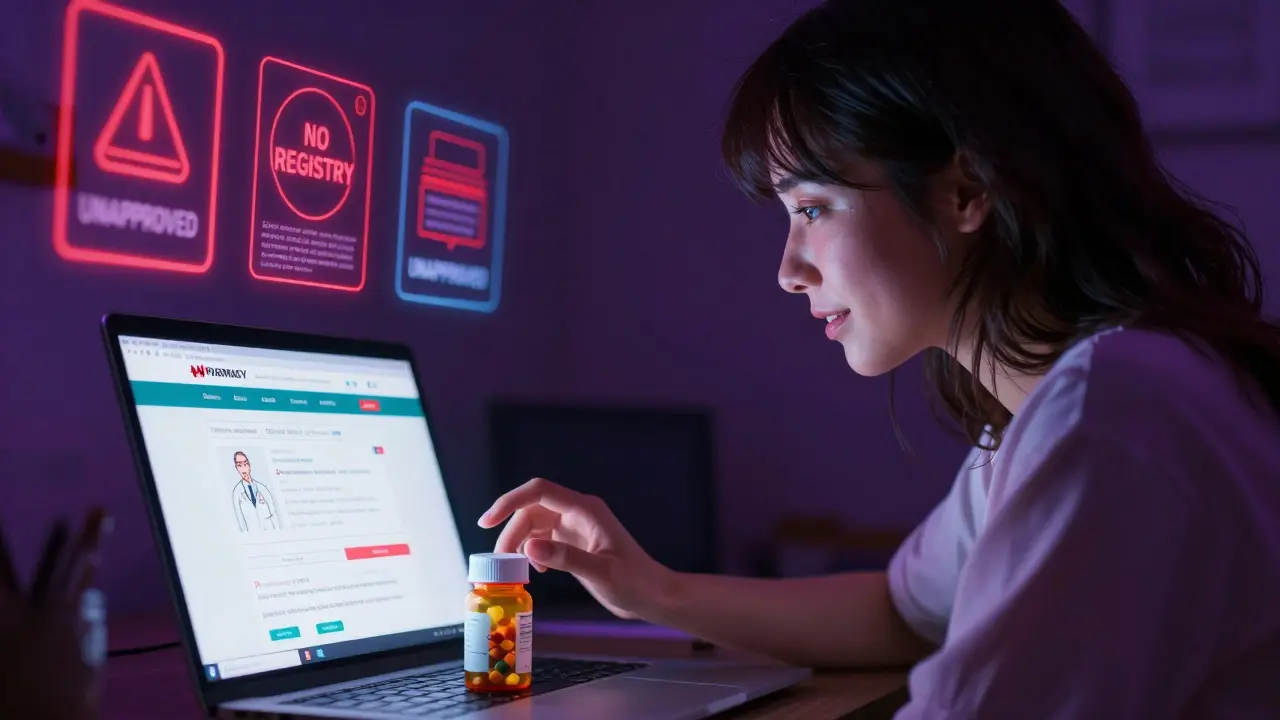
How Do You Even Tell If a Pharmacy Is Legit?
Most people don’t check. A 2024 survey found that 72% of Americans who ordered drugs from abroad never verified the pharmacy’s credentials. That’s because fake sites are terrifyingly convincing.
Here’s how to spot the real ones:
- Require a prescription: Legitimate pharmacies won’t sell controlled meds without one.
- Have a licensed pharmacist on staff: They should be available for phone or chat consultation.
- Display a physical address and phone number: Not just a PO box. Look it up on Google Maps.
- Check for official seals: In the U.S., look for VIPPS (Verified Internet Pharmacy Practice Sites). In Canada, check the Canadian International Pharmacy Association (CIPA). In Australia, verify through the Therapeutic Goods Administration (TGA).
- Don’t trust logos: Fake sites copy real logos. Always click through to the regulator’s official site to verify.
Here’s the kicker: A 2024 study found that only 3% of online pharmacies meet all safety standards. That means 97% are risky - even if they look perfect.
Why Do People Still Order From These Sites?
Price. Convenience. Lack of awareness.
A 2024 Kaiser Family Foundation survey showed that 18% of Americans have ordered prescription drugs from overseas - mostly because they’re cheaper. A $500 insulin pen in the U.S. might cost $80 in Canada. But if you don’t know whether the Canadian pharmacy is real, you’re gambling with your life.
People also assume that if a site has good reviews, it’s safe. But Trustpilot data shows unverified international pharmacies average a 2.1/5 rating. The most common complaints? “The pills looked different” (37%) and “It didn’t work at all” (42%).
And here’s the cruel twist: Even if the drug works, you have no recourse. No insurance covers foreign purchases. No doctor can help if you get sick from something bought online. No police will track down the seller if they’re in a country with no extradition treaty.
What’s Being Done About It?
There are global efforts. INTERPOL’s Operation Pangea is now in its 16th year. The EU requires every prescription medicine to have a unique identifier and tamper-proof seal. Pfizer has blocked over 302 million counterfeit doses since 2004. The WHO is building a global tracking system that’s already logged over 1,500 quality alerts from 124 countries.
But progress is slow. Only 60 out of 194 countries have fully functional drug regulation systems. Criminal networks adapt faster than regulators. They use cryptocurrency, encrypted messaging, and fake domains that change every week.
The most dangerous trend? Counterfeiters are now targeting biologics - expensive, complex drugs used for cancer, rheumatoid arthritis, and autoimmune diseases. These aren’t pills you can copy. They’re living molecules. Fake versions? They’re not just ineffective. They can trigger deadly immune reactions.
What Should You Do?
If you need medication, here’s your action plan:
- Never order from a website you found via Google ads or pop-ups. Legit pharmacies don’t buy ads that way.
- Use your country’s official drug regulator. In Australia, go to TGA’s website. In the U.S., use the FDA’s BeSafeRx tool. In Canada, use Health Canada’s database.
- Ask your doctor. Many doctors know of licensed international pharmacies that ship legally. They can give you a verified name.
- Check packaging. Real meds have batch numbers, expiry dates, and consistent color/shape. If it looks off - even slightly - don’t take it.
- Report suspicious sites. Most countries have a portal to report fake pharmacies. Your report could save someone else’s life.
There’s no shortcut. No hack. No secret trick. The only way to be safe is to verify - every single time.
Final Warning
Buying medicine online from abroad isn’t like ordering shoes. You can’t return a dead kidney. You can’t exchange a failed stroke treatment. One pill can change your life - or end it.
The criminals behind these operations don’t care about your health. They care about your payment. And they’re counting on you not checking.
Can I trust international pharmacies that offer discounts?
No. Discounted prices are one of the biggest red flags. Legitimate pharmacies rarely offer deep discounts on prescription drugs because of strict pricing regulations. If a site offers 80% off insulin or Viagra, it’s almost certainly selling counterfeit or diverted products. Real international pharmacies charge slightly less than domestic ones - not a fraction of the price.
Is it illegal to order drugs from another country?
In most countries, including Australia, the U.S., and Canada, it’s technically illegal to import prescription drugs not approved by national regulators. But enforcement usually targets large-scale operations, not individual buyers. That doesn’t mean it’s safe. Even if you’re not prosecuted, you risk getting sick from fake medicine. Customs agencies seize millions of packages each year - and they don’t notify you if they do.
How can I verify a pharmacy’s license?
Go directly to your country’s drug regulator website - don’t click links on the pharmacy’s site. In Australia, use the TGA’s online register. In the U.S., use the NABP’s VIPPS verification tool. In Canada, check the CIPA directory. Enter the pharmacy’s exact name and address. If it doesn’t appear, it’s not licensed. Never trust logos, seals, or “certified” badges on the pharmacy’s own site - they’re easy to fake.
What should I do if I already took a fake drug?
Stop taking it immediately. Contact your doctor or go to the nearest emergency room. Bring the packaging and any remaining pills. Report the pharmacy to your national health regulator - Australia’s TGA, the U.S. FDA, or Health Canada. Even if you feel fine, some counterfeit drugs cause delayed damage. Blood tests or liver function scans may be needed. Don’t wait for symptoms - act fast.
Are there any safe ways to buy drugs from abroad?
Yes - but only through verified channels. If you’re in Australia and want to buy from Canada or the U.S., use a pharmacy certified by the Therapeutic Goods Administration (TGA) or one that’s part of the Verified Internet Pharmacy Practice Sites (VIPPS) program. These pharmacies are audited, require prescriptions, and follow strict import rules. Even then, always check the product’s approval status with your local regulator before ordering.
8 Comments
Tasha Lake
February 8, 2026 AT 16:53Okay, so let’s break this down: falsified meds aren’t just ‘bad batches’-they’re *engineered deception*. We’re talking about biologics with zero active moiety, laced with heavy metals, and sold under FDA-looking logos. The real kicker? The supply chain is so fragmented that even the courier doesn’t know what’s in the box. It’s like ordering a Tesla and getting a lawn mower with a Tesla sticker.
And don’t get me started on the regulatory arbitrage. Countries with weak pharmacovigilance systems are basically becoming open-air labs for pharmaceutical crime. We need blockchain traceability, not just ‘verify this link’-because 97% of sites fake the verification seal anyway.
Also, why is no one talking about the AI-generated pharmacy sites? I saw one last week with a live video feed of a ‘pharmacist’-turns out it was a deepfake looping footage from a legit Canadian clinic. Scary stuff.
Simon Critchley
February 9, 2026 AT 06:51Bro, this is peak 21st century capitalism. 🤡
Counterfeit insulin? 1400% margins? That’s not crime-that’s venture capital with a side of manslaughter. These gangs aren’t just selling pills-they’re running a black-market IPO. And the FDA? Still using 2005-era web crawlers to ‘monitor’ 13,000 rogue sites. Meanwhile, the crooks are using Telegram bots with crypto payments and IP rotation faster than my Netflix buffer.
PS: If you think ‘verified’ seals mean anything, I’ve got a CIPA-certified toilet paper brand you should buy. 😏
John McDonald
February 10, 2026 AT 17:41Listen-I’m not here to scare anyone. But I’ve seen what happens when people skip the verification step. A friend of mine bought ‘Viagra’ from a site that looked like a CVS ad. Took it. Ended up in ER with a 17-hour priapism. Lost tissue. Lost dignity. Lost trust in the internet.
But here’s the good news: we can fix this. Not with fear, but with education. Talk to your pharmacist. Use the TGA and VIPPS tools. Share this with your uncle who thinks ‘Canada’ means ‘safe’. It’s not about being paranoid-it’s about being smart.
And if you’re reading this and thinking ‘I can’t afford my meds’? Talk to your doctor. There are patient assistance programs. There are generics. There are options. You don’t need to gamble with your life for $30 off.
Chelsea Cook
February 12, 2026 AT 16:12Oh sweet Jesus. Another ‘warning’ post that’s just a fancy brochure for Big Pharma. 🙄
Let me guess-you’re one of those people who thinks the FDA is a saint and every ‘unregulated’ pharmacy is a den of thieves? Newsflash: the U.S. charges $1000 for insulin because it’s a monopoly, not because it’s ‘expensive to make’. Meanwhile, real pharmacies in India and Mexico sell the same damn thing for $12-with actual quality control.
And yes, some sites are fake. But 97%? That’s a made-up stat designed to scare you into paying full price. I’ve ordered from 5 international pharmacies. Got my meds. No one died. No one went blind. Maybe stop being a sheep and do your own damn research?
Andy Cortez
February 14, 2026 AT 12:00ok so i read this whole thing and like… i think the real problem is not the fake pills but the fact that america makes meds so expensive that people have to risk their lives? like… wtf?
also i took some ‘modafinil’ off a site and it worked FINE. i was more focused than ever. no vision loss. no rat poison. maybe the ‘toxic chemicals’ are just the side effects of being a paranoid american?
also the author says ‘never order from google ads’ but all the legit ones are on google ads? idk man. i’m confused. and also i typoed like 3 times. sorry. my brain is fried from all this info.
Andrew Jackson
February 15, 2026 AT 03:35It is a profound moral failure of Western liberal society that citizens of sovereign nations willingly import pharmaceutical products from jurisdictions with no rule of law, no due process, and no ethical standards. This is not a matter of economics-it is a surrender of civic responsibility.
When one chooses to bypass the regulatory apparatus of one’s own nation, one does not merely seek savings; one tacitly endorses the erosion of public health infrastructure. The fact that 72% of Americans do not verify credentials is not a statistical anomaly-it is a symptom of cultural decay.
One cannot outsource safety to a third-world warehouse and then cry when the consequences manifest. The solution is not more websites, more seals, or more ‘verified’ portals. The solution is personal accountability. And national pride. And a return to the principle that one’s health is not a commodity to be bargained for on the dark web.
Chima Ifeanyi
February 16, 2026 AT 17:23Let’s be real-this whole narrative is a Western-centric panic. You’re acting like counterfeit drugs are a new phenomenon. In Nigeria, we’ve been navigating this since the 90s. We developed community verification networks before your FDA had a website.
Yes, some pills are fake. But here’s the thing: in places with weak healthcare, people don’t have the luxury of waiting for ‘approved’ channels. They use what works. And guess what? A lot of times, the ‘unregulated’ pharmacy in Lagos delivers better than the overpriced, understocked government clinic.
Stop framing this as ‘dangerous foreigners’ and start asking why your own system fails 40% of your population. The real counterfeit is the promise of affordable healthcare in the U.S. and UK.
Ashlyn Ellison
February 17, 2026 AT 03:55My mom took fake blood pressure meds. Didn’t know until her stroke. She’s fine now. But I’ll never trust a website again.
Also, I ordered from a Canadian pharmacy last year. TGA verified. Took 3 weeks. Cost $40. Real pills. No drama.
So yeah. Check. Don’t guess. It’s not that hard.