Renal Function & Dose Adjustment Estimator
Patient Parameters
Analysis Results
Enter patient data to see recommended approach.
Enter patient details to calculate renal clearance and view dosing strategies.
Dose Reduction
Decrease the amount of medication while maintaining the original frequency.
Interval Extension
Keep the full dose but increase the time between administration (e.g., 12h → 24h).
Combination Approach
Both reducing the dose amount and extending the time between doses.
- Kidney function naturally declines with age, increasing the risk of drug accumulation.
- GFR and Creatinine Clearance (CrCl) are the primary metrics used to determine dose adjustments.
- High-risk drugs like digoxin, lithium, and certain antibiotics require strict monitoring.
- Dosing strategies usually involve reducing the amount of drug or increasing the time between doses.
- Always verify if a medication has "active metabolites" that are excreted by the kidneys.
Why Kidney Function Matters for Medication
Think of your kidneys as the body's filtration system. When they work well, they clear out waste and leftover medication. In elderly patients, this filter slows down. According to the NIDDK, about 38% of adults over 65 have chronic kidney disease (CKD) stage 3 or higher. When the kidneys can't keep up, drug exposure can jump by 50% to 100% for medications that rely on renal clearance.
This isn't just a technical detail-it has real-world consequences. When drugs linger too long in the bloodstream, they can cause cognitive impairment, sudden falls, or acute toxicity. The danger is highest with drugs that have a "narrow therapeutic index," meaning the gap between a dose that heals and a dose that harms is very small.
Calculating Kidney Function: Which Formula to Use?
Doctors don't guess kidney function; they estimate it using specific formulas. However, not all formulas are created equal, especially for seniors.
The Cockroft-Gault Equation is a formula developed in 1976 to estimate Creatinine Clearance (CrCl) based on age, weight, and serum creatinine. For decades, it has been the gold standard for drug dosing. However, research shows it can underestimate kidney function in the elderly by 15-20%, which sometimes leads to under-dosing.
The MDRD Equation (Modification of Diet in Renal Disease) is a more modern method used to estimate the Glomerular Filtration Rate (GFR). It's often used for screening and staging kidney disease rather than daily drug dosing.
| Metric | Cockroft-Gault (CG) | MDRD / GFR | Cystatin C-based |
|---|---|---|---|
| Primary Use | Drug Dose Adjustment | Disease Staging | High-Accuracy Estimation |
| Key Inputs | Age, Weight, Creatinine | Age, Sex, Race, Creatinine | Cystatin C protein levels |
| Elderly Accuracy | May underestimate function | Generally reliable | Highest accuracy for seniors |
Common High-Risk Medications and Adjustments
Not every drug needs a tweak. The focus is on those that are "renally cleared." Here are a few common examples of how dosing changes when kidney function drops.
Diabetes Medications
Diabetes drugs can be tricky. For instance, Glyburide is a sulfonylurea medication used to treat type 2 diabetes. Because its active metabolites are excreted by the kidneys, it should be avoided if CrCl is below 50 mL/min to prevent severe hypoglycemia. On the other hand, Glipizide generally doesn't require adjustment, making it a safer choice for those with renal impairment.
Antibiotics (Antimicrobials)
Antibiotics are some of the most complex drugs to dose. Take Cefepime: a healthy adult might take 1g every 6 hours. But if the CrCl drops below 10 mL/min, that interval must be stretched to once every 24 hours to prevent toxicity. This "interval extension" ensures the drug is cleared before the next dose is administered.
Pain and Nerve Medication
Gabapentin is a frequent culprit in dosing errors. In severe renal impairment, a daily dose that might be 1200mg for a young adult may need to be slashed to 100-300mg for a senior to avoid sedation and confusion.
Three Main Strategies for Dose Adjustment
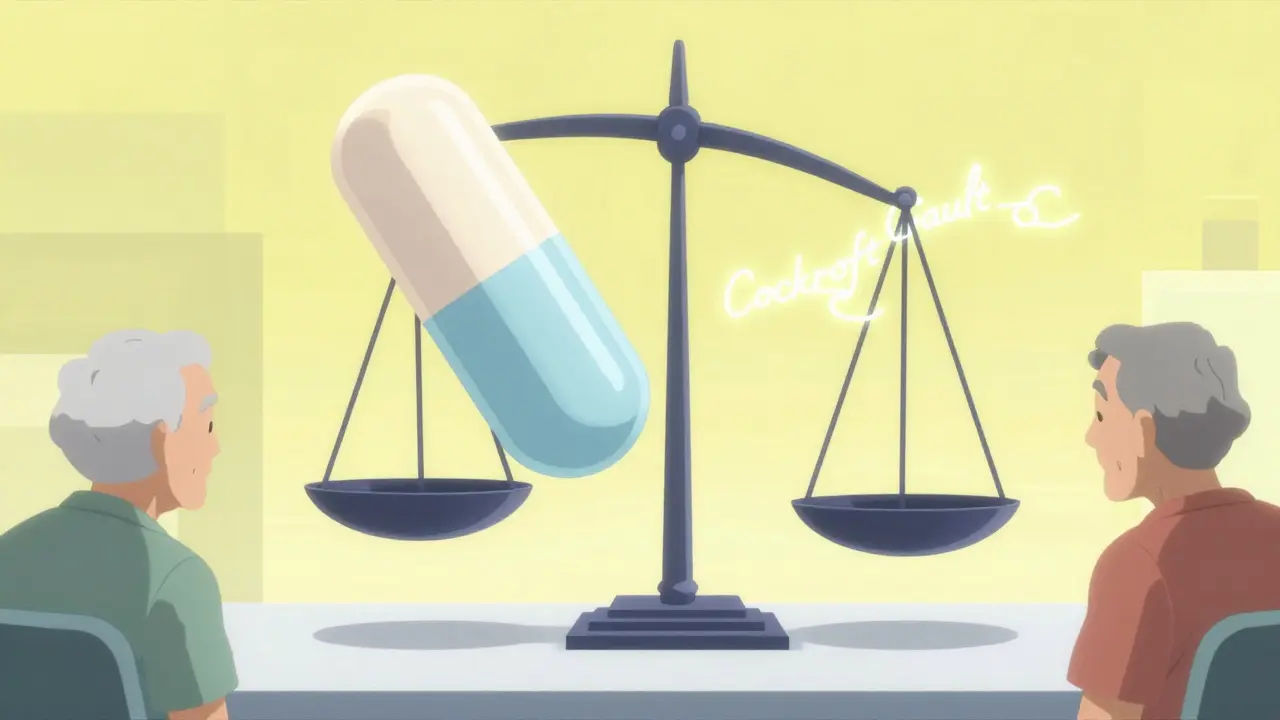
When a pharmacist or doctor sees that kidney function is low, they generally use one of three strategies to keep the patient safe:
- Dose Reduction: Giving a smaller amount of the drug but keeping the same schedule (e.g., 100mg instead of 200mg every 12 hours).
- Interval Extension: Giving the full dose but waiting longer between doses (e.g., moving from every 12 hours to every 24 or 48 hours).
- Combination Approach: Doing both-reducing the dose and extending the time between them.
Some clinicians use the "50% rule": if more than 50% of a drug is cleared by the kidneys and CrCl is below 50 mL/min, they cut the dose in half. While helpful, this is a rough guide. High-risk drugs with non-linear pharmacokinetics, like Vancomycin, require a much more precise approach.
The Danger of Narrow Therapeutic Indices
Some medications have a tiny window between "working" and "poisoning." These are called narrow therapeutic index drugs. For these, guessing isn't an option; you need Therapeutic Drug Monitoring (TDM).
- Digoxin: Used for heart failure. The target range is usually 0.8-2.0 ng/mL. In patients with failing kidneys, the time to check levels must be extended from 7 days to nearly 20 days after the first dose.
- Lithium: Used for bipolar disorder. Levels must be kept strictly between 0.6 and 0.8 mmol/L for chronic maintenance.
- Phenytoin: An anti-seizure med that requires a tight range of 10-20 μg/mL.

Practical Tips for Caregivers and Patients
You don't need to be a pharmacist to help prevent toxicity. Here are a few practical ways to ensure safety:
- Ask about "Renal Dosing": When a new medication is prescribed, ask the doctor, "Has this dose been adjusted for current kidney function?"
- Keep a Current GFR/CrCl Record: Keep a note of the latest lab results. Kidney function can change quickly due to dehydration or other illnesses.
- Watch for "Red Flags": Unusual sleepiness, confusion, or a sudden increase in falls can be early signs of drug toxicity in seniors.
- Review the Beers Criteria: This is a professional list of medications that are potentially inappropriate for older adults. Many are listed specifically because of renal risks.
What is the most common mistake in renal dosing for the elderly?
The most common error is failing to realize that some drugs are broken down by the liver but have "active metabolites" that are removed by the kidneys. If the kidneys fail, these active leftovers build up and cause toxicity, even if the liver is working perfectly. A classic example is the combination of metformin and glibenclamide.
Why do some doctors use the Cockroft-Gault formula instead of GFR?
Most drug manufacturer guidelines and FDA labels were written using the Cockroft-Gault equation. To ensure the drug is used exactly as tested in clinical trials, doctors often stick to the formula the manufacturer used, even if newer GFR methods are available.
Can a healthy diet prevent the need for renal dosing adjustments?
While a healthy diet and hydration support overall kidney health, the age-related decline in GFR is a biological process. Diet cannot "reverse" renal impairment to the point where dosing adjustments are no longer necessary for high-risk medications.
What happens if a dose is not adjusted for renal impairment?
The drug stays in the body longer and reaches higher concentrations than intended. This can lead to adverse drug events (ADEs), which in the elderly often manifest as cognitive impairment, extreme lethargy, or organ failure, potentially leading to hospitalization or death.
Is there a way to automate renal dosing to avoid human error?
Yes, many hospitals now use electronic health record (EHR) alerts and AI-powered platforms like DoseOptima. These tools integrate real-time lab data with dosing guidelines to alert pharmacists and doctors when a dose needs to be lowered.
Next Steps and Troubleshooting
For Patients: If you feel unusually tired or confused after starting a new medication, do not simply "sleep it off." Contact your provider and specifically mention your kidney function status.
For Caregivers: Create a medication list that includes not just the drug name and dose, but the reason for the dose. If you notice a change in the frequency of a dose (e.g., from twice a day to once a day), confirm with the pharmacist that this was a renal adjustment.
For Providers: In borderline cases where eGFR is near a threshold (like 30 mL/min), consider using the Grubb cystatin C-based equation for a more accurate reading, as it is less affected by muscle mass than creatinine-based formulas.