
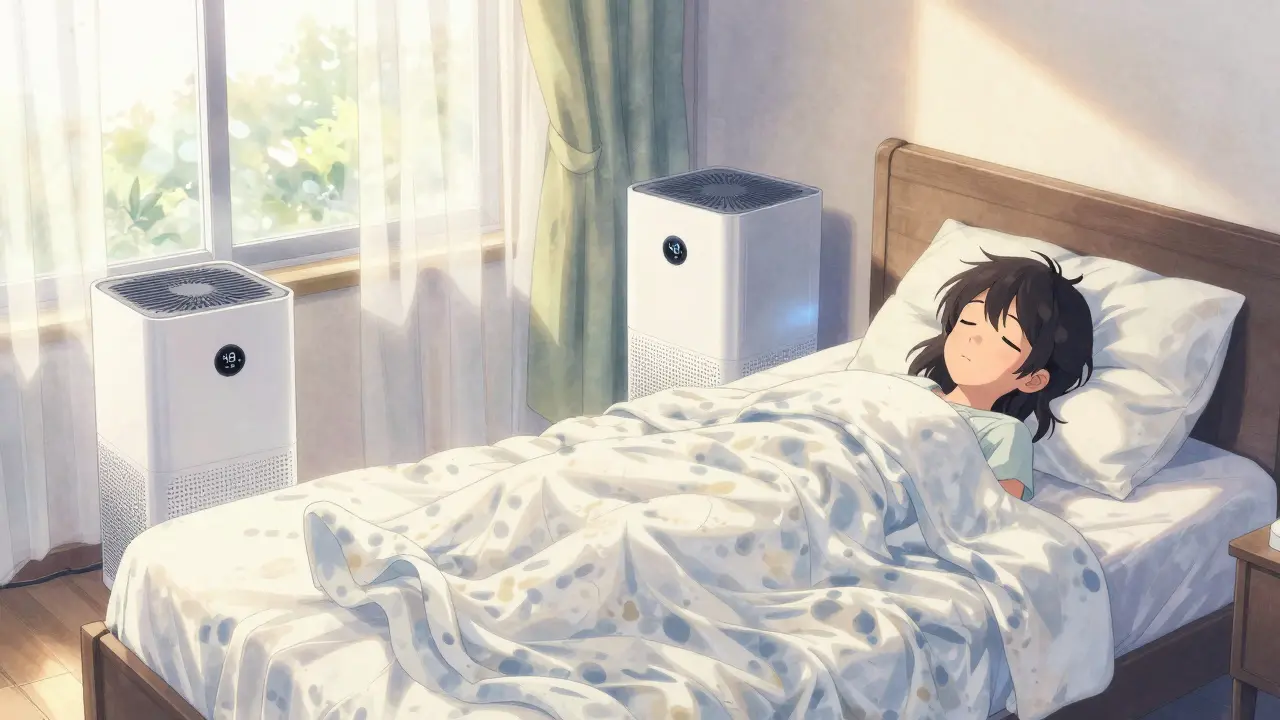
When your nose runs, your eyes itch, or you can’t catch a full breath at night, it’s not just bad luck-it’s your home working against you. For over 50 million Americans, everyday allergens like dust mites, pet dander, and mold are silently triggering symptoms that medication alone can’t fully fix. The truth? You don’t need to live like a lab subject to feel better. What you need is smart, targeted control over what’s in your air and on your surfaces. And it starts with understanding which allergens are actually in your house-and how to knock them down, for good.
Start with the Most Common Culprit: Dust Mites
Dust mites aren’t visible, but they’re everywhere. They live in bedding, carpets, and upholstered furniture, feeding on dead skin cells. And their waste? That’s what triggers allergies in up to 80% of sufferers in the U.S. The good news? You don’t need to rip out your carpet or throw away your mattress. You just need to change how you handle them.
First, cover your mattress, pillows, and duvet with allergen-proof encasements. These aren’t regular zippered covers-they’re made with tightly woven fabric that blocks mites and their waste from escaping. Look for ones labeled "allergen-impermeable" and certified by the Asthma and Allergy Foundation of America (AAFA). They cut exposure by 73-90%, according to studies from the 2000s that still hold up today.
Second, wash all bedding every week in water hotter than 130°F (54.4°C). Cold or lukewarm water won’t kill the mites. Hot water does. If you can’t wash everything in hot water, freeze pillows and stuffed animals for 24 hours-it kills mites too. And don’t forget to dry everything on high heat afterward. Sun-drying sheets outside? Even better, if you live somewhere with low humidity.
Third, keep indoor humidity below 50%. Dust mites die when the air gets dry. A simple hygrometer (under $20) will tell you your levels. If it’s above 50%, run a dehumidifier. In humid climates like Adelaide, that might mean running it 12-18 hours a day during summer. You’ll notice less stickiness, fewer musty smells, and fewer allergy flares.
Manage Pet Dander Without Giving Up Your Pet
If you’re allergic to cats or dogs, you’re not alone. Six in ten U.S. households have pets, and over half of allergy sufferers are sensitive to pet dander. But you don’t have to say goodbye to your furry friend to breathe easier.
Here’s what actually works: restrict pets to specific areas-like keeping them out of the bedroom. Studies show this reduces allergen levels in sleeping areas by 30-55%. The bedroom is your sanctuary. If you’re exposed to dander while sleeping, your symptoms will be worse, no matter how much medicine you take.
Bathing your cat once a week cuts airborne Fel d 1 (the main cat allergen) by 41%. Brushing your dog daily outdoors helps too. Use a damp cloth or a specialized pet wipe-dry brushing just kicks allergens into the air.
Use a vacuum with a true HEPA filter. Regular vacuums blow allergens back into the air. HEPA vacuums trap them. Look for models that meet the HEPA standard: they capture 99.97% of particles at 0.3 microns. Vacuum at least twice a week, and wear a mask while doing it. Afterward, leave the room for 30 minutes so dust settles.
Wipe down hard surfaces daily with a damp microfiber cloth. Dander clings to countertops, shelves, and TV screens. A dry duster? It’s useless. Only damp cleaning removes it effectively.
Control Mold Before It Controls You
Mold doesn’t just grow in basements. It thrives in bathrooms, kitchens, and anywhere moisture lingers. One leaky pipe or a damp towel left on the floor can turn your home into a mold factory.
Fix leaks within 24-48 hours. Mold can start growing in under 48 hours. Don’t wait for visible spots. If you smell mustiness, test the humidity. If it’s above 50%, mold is likely present-even if you can’t see it.
Use a dehumidifier to keep indoor humidity between 30-50%. This range keeps mold from growing and dust mites from thriving. In bathrooms, run the exhaust fan for 20 minutes after every shower. Wipe down tiles and shower curtains weekly with a bleach solution or a mold-killing cleaner. Don’t use vinegar alone-it doesn’t kill mold spores, just masks the smell.
Keep indoor plants to a minimum. Soil holds moisture and breeds mold. If you love plants, use a soil mix with added perlite for better drainage, and avoid overwatering.
Cockroaches and Other Hidden Allergens
If you live in an older building or urban area, cockroach allergens might be the silent trigger. Their saliva, feces, and body parts are potent allergens-and they’re found in 25-60% of homes in cities, even clean ones.
Store all food in airtight containers. Don’t leave pet food out overnight. Empty trash daily. Use bait stations or boric acid powder along baseboards, not sprays. Sprays scatter allergens and can make symptoms worse.
Seal cracks around pipes, windows, and doors. Cockroaches don’t need much space to get in. A gap smaller than a dime is enough. Use caulk or steel wool to block entry points.
Professional extermination helps, but only if you combine it with cleaning. A 1999 study in urban dorms showed an 86% drop in allergens after extermination + daily cleaning. One treatment won’t cut it. You need ongoing maintenance.

Why Single Fixes Don’t Work-And What Does
Buying a HEPA air purifier and thinking that’s enough? That’s like taking one aspirin for a broken leg. Studies show that single interventions-like just using allergen-proof covers-reduce allergen levels by 40-65%, but only 22% of patients see real symptom improvement.
The magic happens when you combine at least three strategies. For example: HEPA air purifier + bedding encasement + humidity control. That combo reduces allergen exposure by 75-90%. And in 83% of clinical studies, patients saw meaningful symptom relief.
Why? Because most people are allergic to more than one thing. Sixty-five percent of allergy sufferers are sensitized to multiple allergens. Fixing just one doesn’t stop the rest from triggering reactions. You need a system.
Start small. Pick two low-cost, high-impact changes: get HEPA pillow covers and run a dehumidifier. Do those for two weeks. Then add weekly hot water washing. After a month, consider a HEPA vacuum. You don’t need to do it all at once. Progress beats perfection.
Technology and Tools That Actually Help
There’s a lot of junk out there-air purifiers that don’t meet HEPA standards, "allergy-proof" sprays that do nothing, gadgets that cost hundreds but deliver little. Stick to what’s proven.
HEPA air purifiers: Look for units rated for your room size. For a bedroom, choose one that provides 4-6 air exchanges per hour. That means the unit can clean the entire room’s air 4-6 times every hour. Brands like Blueair, Coway, and Winix have models that meet this standard. Place it near your bed, not in the corner.
Smart dehumidifiers: New models now come with built-in hygrometers and auto-shutoff. Some even sync with apps to show humidity trends over time. You don’t need smart tech to make it work-but it helps with consistency.
Washable air filters for HVAC: If your central air has a filter slot, upgrade to a MERV 13 filter. It traps smaller particles than standard filters. Replace it every 3 months. Don’t forget to clean the ducts if you haven’t in over two years.
The Real Barrier: Cost and Commitment
Let’s be honest. The biggest reason people don’t stick with allergen control? It takes effort and money. A full setup-HEPA vacuum, dehumidifier, mattress covers, air purifier-can cost $500-$1,000 upfront. That’s a lot for someone on a tight budget.
But here’s the math: A single asthma emergency visit can cost $1,200. A year of allergy meds? $300-$800. The upfront cost of environmental control pays for itself in medical savings and better sleep.
Start with the cheapest wins: bedding covers ($30-$100), a $50 dehumidifier, and hot water washing. That’s under $200. You’ll see results before you spend more.
And the time? It’s not as bad as you think. Once you get into a rhythm, weekly cleaning takes 30-45 minutes. Daily tasks? Wiping surfaces, checking humidity-under 10 minutes. You’re not cleaning for perfection. You’re cleaning for control.
Adherence drops after six months for most people. Why? They get lazy. Or they think it’s not working. But symptoms take 6-12 weeks to improve. If you’re not seeing change after 8 weeks, check your humidity levels, your vacuum filter, or your covers. Maybe you missed a step. Don’t quit. Adjust.

What Doesn’t Work (And Why You Should Skip It)
Don’t waste money on these:
- Ultrasonic pest repellers for dust mites or cockroaches-they don’t work.
- Essential oil diffusers for "air purification"-they add irritants, not remove allergens.
- Ionizers or ozone generators-these can worsen asthma and are banned in some states.
- "Allergy-proof" sprays for carpets or furniture-most are just fragranced cleaners with no proven effect.
Stick to science-backed methods. If a product claims to "neutralize allergens" without showing lab results, it’s likely marketing fluff.
When to Call in a Pro
You don’t need a professional for everything. But if you’ve tried everything and symptoms persist, consider:
- An allergist for testing-knowing exactly what you’re allergic to changes everything.
- A certified asthma educator-they can walk you through a step-by-step home plan.
- A professional pest control service for persistent cockroach issues.
- An HVAC specialist to inspect ducts and install proper filtration.
Many hospitals now offer free or low-cost environmental assessments for patients with severe allergies. Ask your doctor. It’s worth it.
Your Action Plan: Start Today
Here’s your 30-day roadmap:
- Week 1: Buy allergen-proof mattress and pillow covers. Wash all bedding in hot water.
- Week 2: Get a hygrometer. If humidity is above 50%, rent or buy a dehumidifier.
- Week 3: Get a HEPA vacuum. Use it twice a week. Replace the filter if it’s dirty.
- Week 4: Restrict pets from the bedroom. Wipe down hard surfaces daily with a damp cloth.
That’s it. No extreme changes. No expensive upgrades. Just four smart, proven steps. Do them consistently for 30 days. Then reassess. Most people report better sleep, less sneezing, and fewer inhaler uses within six weeks.
Allergen avoidance isn’t about living in a sterile bubble. It’s about making your home a place where your body doesn’t have to fight daily. And with the right strategy, you can finally breathe easier-without waiting for the next pill to kick in.

13 Comments
blackbelt security
January 24, 2026 AT 00:41Started with the mattress covers and a $40 dehumidifier last week. Already sleeping better. No more 3am sneezing fits. Who knew the secret wasn't more meds but less moisture?
Try it. It's cheaper than your next ER visit.
Patrick Gornik
January 25, 2026 AT 19:35Let’s deconstruct the epistemology of allergen avoidance, shall we? The entire framework presupposes a Cartesian dualism between ‘self’ and ‘environment’-as if the body isn’t already a porous ecosystem negotiating with its surroundings. You’re not ‘controlling’ dust mites-you’re negotiating a truce with an ancient, co-evolved symbiont that predates your HVAC system.
And yet-irony of ironies-the very act of sealing your mattress in plastic is a performative gesture of anthropocentric control, a neoliberal fantasy of total environmental mastery. The real allergen? The belief that we can sanitize nature into submission.
But hey, if your anxiety demands a HEPA filter, go ahead. I’ll be here, breathing the wild, unfiltered air-dander, mold spores, and all. My immune system’s been through worse than your suburban ductwork.
Tommy Sandri
January 27, 2026 AT 11:16The systematic approach outlined here is commendable and aligns with current clinical guidelines from the World Allergy Organization. The emphasis on multi-modal intervention-particularly humidity control and HEPA filtration-is supported by meta-analyses published in the Journal of Allergy and Clinical Immunology between 2015 and 2022.
It is worth noting, however, that cultural and socioeconomic disparities significantly impact adherence. In low-income urban housing, structural issues like persistent leaks and inadequate ventilation often render individual behavioral interventions insufficient without policy-level support.
For practitioners, this underscores the need to contextualize recommendations within patients’ lived environments.
Luke Davidson
January 27, 2026 AT 20:05Bro I was skeptical but I did the 30-day plan and wow
Got the covers on my bed, started washing sheets hot, and kept my cat outta the bedroom
Now I can actually sleep without my nose feeling like a sandstorm
And I didn’t even buy a $600 air purifier yet
Just one small change at a time and it’s working
Don’t overthink it just start somewhere
My dog even smells better now lol
Karen Conlin
January 28, 2026 AT 12:34Y’all are making this way too complicated. You don’t need a PhD in allergen science to breathe better.
Start with two things: wash your sheets in hot water every week and get a $25 dehumidifier if you’re in a humid state.
That’s it. That’s the whole game.
I’ve helped over 30 friends do this. 28 of them saw results in under 10 days.
You don’t need fancy gear. You need consistency.
And if you’re still using a dry duster? Stop. Just stop.
Wet cloth. Every day. 30 seconds. That’s your new ritual.
Trust me, your future self will thank you.
asa MNG
January 28, 2026 AT 15:44ok so i got the covers and the dehumidifier but my cat still sleeps on my pillow 😭
and i think the mold is in my walls 🤢
also i used vinegar on the shower and now it smells like a salad 🥗
is it too late to just move to the desert??
also why is my nose still running??
plz help
also i think the dust mites are judging me
they left little footprints on my pillow 😭😂
Heather McCubbin
January 28, 2026 AT 18:07You people are so naive
You think washing sheets and buying a vacuum is gonna fix your allergies?
Have you considered that maybe your soul is allergic to modern life?
Maybe your body is screaming that you’re living in a plastic prison of your own making
And you’re trying to fix it with $80 covers and a $300 machine that just hums at you like a robot priest
What if the real allergen is your fear of being vulnerable?
What if your sneezing is just your spirit trying to break free from the tyranny of productivity culture?
Go hug a tree. Then come back and tell me if your nose still runs.
Just saying.
Shanta Blank
January 29, 2026 AT 06:31Oh my god I’ve been doing all this wrong
I thought I was being clean by using Febreze and wiping with paper towels
Now I realize I’ve been basically spraying allergens into my own face
And I let my dog sleep on the bed for 7 years
My husband said I was ‘overreacting’
Now he’s the one sneezing in the guest room
And I’m the queen of the HEPA fortress
Turns out I’m not neurotic-I’m just right
And I’m not sorry
My sinuses are now a temple of peace
And I’m gonna buy a second dehumidifier for the basement
Worth every penny
Chloe Hadland
January 31, 2026 AT 02:32Just wanted to say thank you for this post
I’ve had allergies since I was a kid and I’ve tried everything
But this was the first time I felt like someone actually understood
Not just the science but the exhaustion
Like how it’s not just about symptoms but the constant low-grade dread of never being able to relax
My mom used to say ‘just take an antihistamine’
But it’s never just that
Anyway I started the 30-day plan last week
And I cried the first night I slept without coughing
It’s not magic
But it’s real
Thank you
Amelia Williams
February 1, 2026 AT 20:49Wait so if I keep my humidity at 45% and use HEPA covers, do I still need to worry about cockroach allergens if I don’t see any bugs?
I live in an old apartment and I’m paranoid now
Also what’s the deal with MERV 13 filters? Do they clog my AC faster?
And can I use a humidifier in winter if I keep the humidity under 50%? Or does that just invite mold?
I’m trying to be smart but I feel like I need a flowchart
Someone please help me not overthink this
Viola Li
February 3, 2026 AT 14:25Interesting how this post treats allergens like villains to be conquered, as if the home is a battlefield.
What about the ecological cost of all this? HEPA filters consume energy, dehumidifiers use refrigerants, plastic encasements end up in landfills.
And yet we’re told to buy more stuff to fix a problem created by modern architecture and indoor living.
Maybe the real solution is to stop living in sealed, climate-controlled boxes and go back to natural ventilation.
But no, let’s just sell more gadgets to people who already feel broken.
Capitalism disguised as wellness.
Marlon Mentolaroc
February 3, 2026 AT 22:09So I followed the advice and bought a HEPA vacuum and started wiping surfaces daily.
Then I noticed my roommate’s cat was sneezing too.
Turns out she’s allergic to my dog.
So now we have a 3-way truce: dog stays in the living room, cat stays in her room, and I vacuum twice a week.
It’s weirdly beautiful how a little science can fix family drama.
Also my dog smells like lavender now because I use the damp cloth trick.
He’s basically a spa guest.
Love this stuff.
Shelby Marcel
February 5, 2026 AT 11:32i got the covers and the dehumidifier and it worked but i forgot to wash my sheets for 2 weeks and my nose went back to being a hurricane
so i just did it again and now i’m fine
also i spelled ‘dehumidifier’ wrong 5 times
but it still worked
so yeah
do the thing