
When antibiotics disappear from hospital shelves, it’s not just a logistics problem-it’s a life-or-death crisis. In 2024, the U.S. hit its highest number of antibiotic shortages in a decade, and the situation is getting worse. Hospitals are running out of basic drugs like penicillin, amoxicillin, and azithromycin. Clinicians are forced to use toxic last-resort drugs for simple infections. Patients in low-income countries are sent home without treatment because there’s nothing left to give them. This isn’t a hypothetical scenario. It’s happening right now, and the consequences are already deadly.
Why Antibiotics Are More Likely to Run Out Than Other Drugs
Antibiotics are 42% more likely to face shortages than any other type of medication. Why? It comes down to money. Unlike cancer drugs or diabetes medications that cost thousands per dose, antibiotics are cheap. Most are generics, sold for pennies. Manufacturers don’t make enough profit to justify the cost of maintaining sterile production lines, which are required to make injectable antibiotics safely. In fact, regulatory compliance costs for these facilities have gone up 34% since 2015, while prices for generic antibiotics have dropped 27% over the same period. The math doesn’t work, so companies shut down production lines-or worse, never build them in the first place.The global antibiotic market was worth $38.7 billion in 2024, but it’s growing at just 1.2% per year. Compare that to the broader pharmaceutical industry, which grows at 5.7%. Investors aren’t interested. Why pour millions into making a drug that earns $0.50 per pill when you could make $50 per pill with a new cancer therapy? The result: fewer factories, fewer workers, fewer backups. When one plant shuts down, global supply crumbles.
The Real Cost: When No Alternative Exists
Most drug shortages can be managed with alternatives. If you run out of a blood pressure pill, there are usually five others that work. Antibiotics? Not so much. When penicillin G benzathine disappears, there’s no substitute for treating syphilis or preventing rheumatic fever in children. When amoxicillin with clavulanate vanishes, doctors have to switch to broader-spectrum drugs like carbapenems. But here’s the problem: overusing those drugs speeds up resistance.By 2023, one in three urinary tract infections worldwide were resistant to first-line antibiotics, according to the WHO. In some regions, like Southeast Asia and the Eastern Mediterranean, that number is even higher. So when doctors can’t use the standard treatment, they’re forced to use drugs meant for emergencies-drugs that are more toxic, harder to administer, and more likely to create superbugs. One California infectious disease specialist told the APHA forum she had to use colistin, a drug that can damage kidneys, to treat a routine UTI. That’s not medicine. That’s triage.
Global Inequality: The Syndemic of Under-Treatment and Resistance
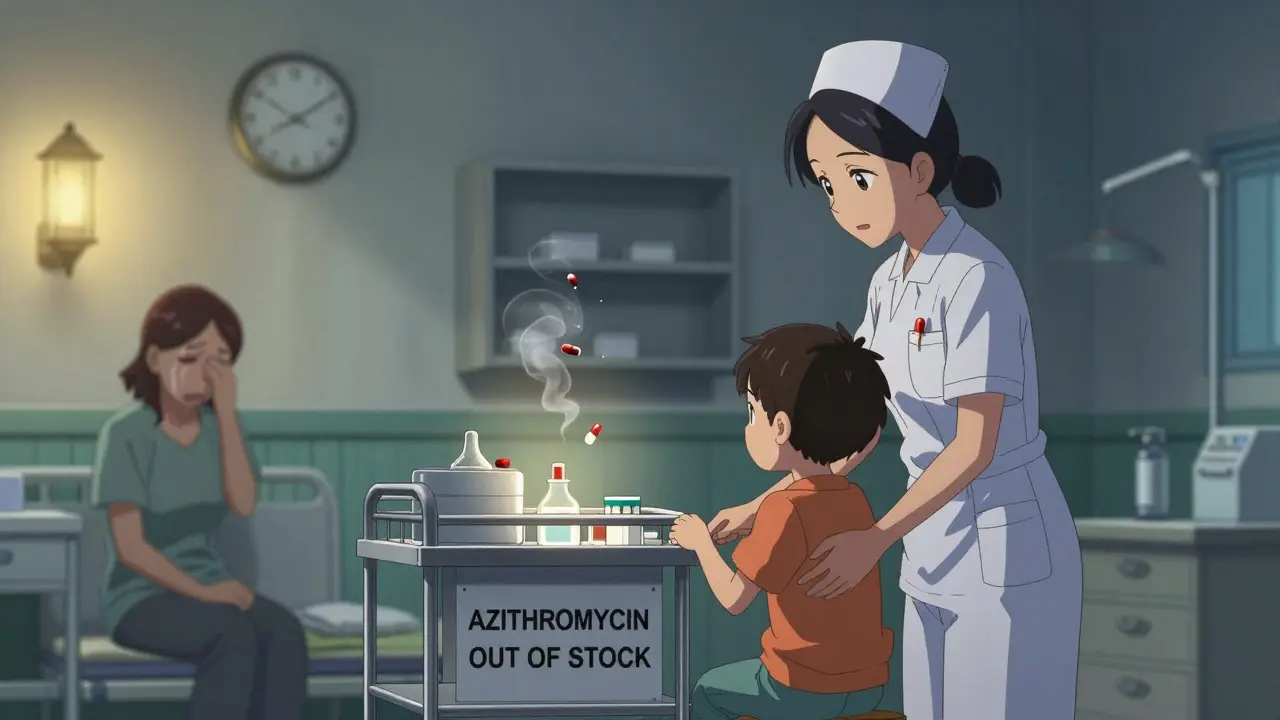
High-income countries can sometimes import antibiotics or shift to more expensive alternatives. But in low- and middle-income countries, 70% of antibiotics are already inaccessible. In rural Kenya, a nurse described sending patients home with pneumonia because penicillin wasn’t available. In Mumbai, a mother waited 72 hours for azithromycin to arrive for her child’s pneumonia. By then, the infection had worsened, and the child needed intensive care.This isn’t just about access. It’s about a deadly feedback loop. Where antibiotics are scarce, people don’t get treated. Untreated infections spread. Resistant strains grow. Then, when antibiotics finally arrive, they don’t work. The WHO calls this a "syndemic"-a perfect storm of under-treatment and rising resistance. And it’s spreading fastest where health systems are weakest.
What Hospitals Are Doing to Cope
Hospitals are scrambling. In the U.S., 78% of hospital pharmacists reported changing treatment protocols in the past year because of shortages. Sixty-two percent saw more patient complications as a result. Some are rationing. Others are using unapproved imports. A few have built regional sharing networks. California’s network, launched in 2024, reduced critical shortages by 43% among participating hospitals by pooling inventory and prioritizing high-risk patients.But these are temporary fixes. The real solution is antimicrobial stewardship programs-systems that track antibiotic use, identify waste, and prevent overuse. Johns Hopkins Hospital cut unnecessary broad-spectrum antibiotic use by 37% during a shortage by using rapid diagnostic tests to confirm infections before prescribing. But only 37% of U.S. hospitals meet all WHO standards for these programs. Most are underfunded, understaffed, or poorly trained. Pharmacists are spending 22% more time managing shortages than they did five years ago. Nurses are making tough calls. Doctors are feeling powerless.
Why Regulations Aren’t Enough
The European Court of Auditors found that regulatory agencies failed to enforce manufacturing standards. They knew the facilities were crumbling. They knew the market was collapsing. But they didn’t act. Why? Because antibiotics aren’t profitable. So no one pushes for reform.The U.S. FDA approved two new manufacturing facilities in January 2025, which should help relieve 15% of current shortages by late 2025. The European Commission is rolling out new rules under its Pharmaceutical Strategy for Europe. The WHO announced a $500 million Global Antibiotic Supply Security Initiative in October 2025. But these efforts are too slow. The Review on Antimicrobial Resistance predicts that without major intervention, global shortages will increase by 40% by 2030-and could cause 1.2 million extra deaths each year from infections we used to treat easily.
The Bottom Line: This Is a Systemic Failure
Antibiotic shortages aren’t caused by a single event. They’re the result of decades of underinvestment, poor policy, and market failure. We treat antibiotics like commodities, not lifesavers. We let manufacturers go bankrupt making them. We let regulators look away. We let patients suffer because the profit margin on a $0.20 pill isn’t worth the cost of keeping it on the shelf.The tools to fix this exist. We need government subsidies to keep production lines open. We need global coordination to prevent stockpiling and hoarding. We need faster diagnostics to stop overprescribing. We need to stop treating antibiotics like cheap goods and start treating them like essential infrastructure-like clean water or electricity.
Because if we don’t, the next time someone gets a simple infection, there might not be a drug left to save them.

9 Comments
Darlene Gomez
March 22, 2026 AT 21:18It’s wild how we treat life-saving drugs like they’re just another commodity. We don’t let water companies shut down because it’s not profitable enough, so why are we okay with this? Antibiotics aren’t luxury goods-they’re infrastructure. We need to treat them like the public utility they are.
Imagine if every time someone got a UTI, they had to beg for the medicine like it was a scarce resource. That’s what we’ve done. And it’s not just about saving lives-it’s about dignity. No one should have to choose between their health and the profit margins of a corporation.
There’s a moral failure here, not just a logistical one. We built this system to maximize returns, not to protect people. Time to flip the script.
Katie Putbrese
March 23, 2026 AT 03:24Let’s be real-this is what happens when you let the left run healthcare. Companies can’t make money on cheap drugs? Good. Let them go bankrupt. We don’t need more government handouts to prop up lazy manufacturers. If you can’t make a profit, you shouldn’t be in business. End of story.
And stop crying about ‘low-income countries.’ We’re not their ATM. If they want antibiotics, they need to build their own economy-not beg us for handouts while they vote for socialist policies at home.
Amber Gray
March 23, 2026 AT 20:26bro honestly this is why we need to defund the fda and let the free market do its thing 🤡
why are we even paying for these drugs anymore? just let people buy them off amazon or something lmao
if u get sick u get sick 🤷♀️
James Moreau
March 24, 2026 AT 16:24There’s a quiet global effort happening right now that doesn’t get enough attention. In Rwanda and parts of Vietnam, community health workers are using AI-assisted diagnostics to triage infections without antibiotics at all. They’re not waiting for supply chains to fix themselves-they’re reimagining care.
It’s not perfect, but it’s proof that innovation doesn’t always come from big pharma. Sometimes it comes from nurses in rural clinics with smartphones and determination.
J. Murphy
March 24, 2026 AT 23:35antibiotics are overrated anyway
people used to live without them
we just got soft
stop whining
also vaccines work better
Jesse Hall
March 25, 2026 AT 21:01I just want to say thank you to every pharmacist, nurse, and doctor who’s been scrambling to keep people alive while the system fails them. You’re not just doing your job-you’re holding the line.
And if you’re reading this and thinking ‘this doesn’t affect me’-it will. One day, it’ll be your kid with an ear infection or your grandpa with pneumonia. And you’ll wish someone had listened when this was still fixable.
Let’s not wait for a crisis to care.
Donna Fogelsong
March 26, 2026 AT 10:35Big Pharma and the WHO are working together to create a false crisis so they can push mandatory vaccinations and biochips under the guise of ‘antibiotic stewardship’
they’ve been shrinking production on purpose to justify centralized control
the $500M initiative? That’s a cover for global surveillance
they want you dependent on the system so they can ration life-saving drugs by algorithm
you think this is about medicine? No-it’s about power
Marissa Staples
March 27, 2026 AT 00:06It’s strange how we’ve normalized the idea that some lives are worth more than others based on geography or income. We wouldn’t accept a world where clean water was rationed by zip code-so why do we accept this for antibiotics?
Maybe the real question isn’t how to fix the supply chain, but how we stopped seeing these drugs as rights, not privileges.
I wonder what our grandchildren will say about us when they look back at this moment.
peter vencken
March 27, 2026 AT 00:08as a former pharma rep, i can tell you the real issue is the FDA’s 5-year approval cycle for generic injectables. it takes longer to get a new production line certified than to build a whole new cancer drug from scratch.
we had a plant in ohio that made penicillin for 40 years. shut down in 2020 because the fda inspection cost $3.2M and the annual profit was $1.8M.
the solution? fast-track generic production with risk-based inspections. not more funding-just smarter rules.
also, stop calling them ‘cheap drugs.’ they’re low-margin. big difference.