

SSRI Hyponatremia Risk Assessment Tool
Assess Your Risk
Enter your specific factors to see if you're at risk for hyponatremia while taking SSRIs. This tool is based on clinical guidelines for older adults.
Every year, more older adults are prescribed SSRIs for depression or anxiety. By 2023, nearly 1 in 5 Americans over 65 were taking one. That’s not surprising-these drugs help. But for many, the hidden dangers are just as real as the benefits. One of the biggest risks? hyponatremia-a drop in blood sodium so low it can cause dizziness, confusion, and falls. And for seniors, a fall isn’t just a stumble. It’s often the start of a hospital stay, a broken hip, or worse.
Why SSRIs Raise the Risk of Low Sodium
SSRIs work by boosting serotonin in the brain. But serotonin doesn’t just affect mood. It also messes with how the kidneys handle water. In older adults, this can trigger something called SIADH-syndrome of inappropriate antidiuretic hormone secretion. Basically, the body starts holding onto too much water. That water dilutes the sodium in your blood. Normal sodium levels are 135-145 mmol/L. When they drop below 135, you have hyponatremia. Below 130? That’s dangerous.Older adults are especially vulnerable. Their bodies naturally have less water. Their kidneys don’t filter as well. Their hormones don’t respond the same way. Even a small change in fluid balance can push sodium levels into the danger zone. And it doesn’t take long. Studies show hyponatremia often shows up within two to four weeks after starting an SSRI-or after a dose increase.
Who’s Most at Risk?
Not everyone on SSRIs gets hyponatremia. But some people are far more likely to. Here’s who needs extra caution:- Those with baseline sodium below 140 mmol/L
- People with a BMI under 25 (especially thin older adults)
- Women-risk is slightly higher than in men
- Anyone taking a thiazide diuretic (like hydrochlorothiazide) at the same time
The combination of SSRIs and thiazides is a red flag. A 2023 Medicare study found that people taking both had a 24-27% higher risk of hyponatremia than those on SSRIs alone. That’s not a small bump. That’s a warning sign.
And not all SSRIs are equal. Fluoxetine carries the highest risk among this class-nearly 3.6 times more likely to cause low sodium than other SSRIs. Venlafaxine, though technically an SNRI, is even riskier. On the flip side, mirtazapine and bupropion have much lower links to hyponatremia. For someone already at risk, switching to one of these might be safer.
The Silent Symptoms That Lead to Falls
Hyponatremia doesn’t always come with nausea or vomiting. In older adults, it often hides. You won’t feel sick. You’ll just feel… off. A little dizzy. A little weak. Your balance feels wrong. Your legs feel heavy. You hesitate before stepping off the curb.These aren’t just signs of aging. They’re signs of low sodium. And they directly increase fall risk. A 2024 review in the Journal of the American Geriatrics Society found that even mild hyponatremia (130-134 mmol/L) was linked to worse gait stability. That’s why so many seniors on SSRIs end up in the ER after a fall-no one realized their balance was failing because of a lab value, not just old age.
And here’s the cruel twist: up to 40% of people with hyponatremia have no symptoms at all. That’s why checking sodium levels isn’t optional. It’s essential.
What Doctors Should Do-And Often Don’t
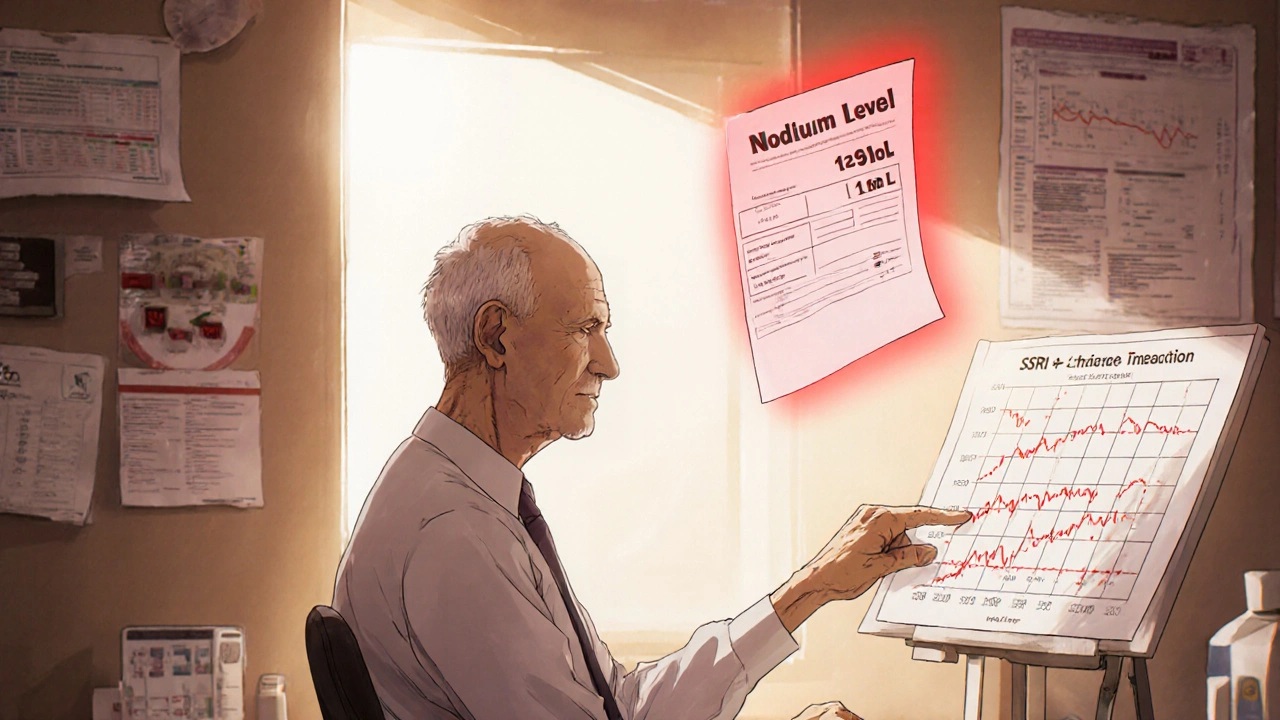
Experts agree: before starting an SSRI, get a baseline blood test for sodium. Then check again two weeks later. That’s the standard advice from the Carlat Report and the American College of Physicians. But here’s the problem: many doctors don’t do it.A 2023 study found that even when hospitals had protocols for sodium monitoring, only about 32% of them actually followed through. Why? Time. Staffing. Lack of reminders. Electronic health records rarely auto-flag high-risk combinations. So unless a doctor remembers to order the test, it doesn’t happen.
And even when it’s caught, it doesn’t always stop bad outcomes. The same study showed that monitoring didn’t reduce hospitalizations for hyponatremia. That doesn’t mean testing is useless. It means we’re missing the next step: what to do after the test.
For mild hyponatremia (125-134 mmol/L), the fix is often simple: stop the SSRI and limit fluids. For severe cases (below 125 mmol/L), hospital care is needed. But correction has to be slow. Rushing sodium back up can cause brain damage from osmotic demyelination. That’s why this isn’t something to handle at home.
Alternatives That Are Safer
If someone’s at high risk for hyponatremia, maybe they shouldn’t start an SSRI at all. There are other options.- Mirtazapine-no strong link to low sodium. Often used when weight gain isn’t a concern.
- Bupropion-doesn’t affect serotonin much. Good for low energy or lack of motivation.
- Psychotherapy-CBT and other talk therapies work well for late-life depression and have zero physical side effects.
The American Geriatrics Society’s 2023 Beers Criteria even lists SSRIs as potentially inappropriate for older adults with a history of low sodium or fall risk. That’s not a minor note. It’s a hard warning.
And while alternatives exist, access is uneven. Therapy requires transportation, time, and insurance coverage. Many seniors can’t get it. That’s why medication choice matters even more.
What Patients and Families Can Do
You don’t have to wait for your doctor to act. Here’s what you can do right now:- Ask: “Has my sodium been checked since I started this medicine?”
- Ask: “Could this drug make me dizzy or unsteady?”
- Track changes: Are you tripping more? Feeling confused after meals? Not wanting to walk? Tell your doctor.
- Review all meds: Are you on a water pill? That combo is risky.
- Don’t cut back fluids unless told to. Dehydration makes things worse.
Many families assume dizziness is just part of getting older. It’s not. It could be a drug. And if it is, fixing it might mean avoiding a broken hip.
What’s Changing in 2025
New tools are coming. In early 2024, the Geriatric Antidepressant Safety Collaborative launched an AI tool that predicts who’s most at risk-based on sodium levels, meds, fall history, and even walking speed from smartwatch data. Hospitals in 127 facilities are already using clinical decision support systems that pop up warnings when SSRIs and diuretics are prescribed together. These tools cut risky prescriptions by nearly 20% in just six months.The FDA updated SSRI labels in 2022 to make hyponatremia warnings bigger and clearer. Patient guides now include specific language about dizziness and falls. That’s progress.
But the biggest change? Awareness. More geriatricians are talking about this. More pharmacists are flagging interactions. More families are asking questions. That’s what saves lives-not just tests, but conversations.
Bottom Line: Don’t Assume It’s Just Aging
SSRIs help millions of older adults feel better. But they’re not harmless. Low sodium doesn’t come with a siren. It comes with a stumble. A pause before walking. A look of confusion that fades after a blood test.If you or someone you love is on an SSRI, don’t wait for a fall to happen. Ask for a sodium test. Review all medications. Know the signs. And if dizziness or imbalance starts after starting the drug-don’t brush it off. It might not be aging. It might be the medicine.
The goal isn’t to avoid SSRIs entirely. It’s to use them wisely. With awareness. With checks. With care.

11 Comments
Sherri Naslund
November 18, 2025 AT 16:49i swear every time someone posts this stuff it's like they're trying to scare grandma off meds. my aunt was on sertraline for 5 years and she's still hiking in the mountains. you think low sodium is bad? try living with untreated depression at 72. i'd rather fall than cry myself to sleep every night.
Ashley Miller
November 20, 2025 AT 08:32so let me get this straight... the pharmaceutical industry wants us to believe that a drug that makes people feel human is secretly plotting to kill them with 'hyponatremia'? next they'll say sunlight causes vitamin D toxicity. wake up. they're not protecting you. they're protecting profits. if you're afraid of side effects, don't take the pill. don't let them make you afraid of feeling better.
Martin Rodrigue
November 21, 2025 AT 14:00The assertion that SSRIs are inherently dangerous in the elderly population is not supported by the totality of clinical evidence. While SIADH is a documented phenomenon, its incidence remains low-approximately 1-2% in controlled studies. The risk-benefit calculus must account for the significant reduction in suicide rates and functional decline associated with adequate treatment of late-life depression. Monitoring protocols, when implemented, reduce adverse outcomes substantially.
Brad Samuels
November 23, 2025 AT 07:40i read this and just thought about my dad. he was on citalopram after mom passed, and he started stumbling around the house. we thought it was his arthritis getting worse. turns out his sodium was at 128. they switched him to mirtazapine and he's been walking better than he has in years. no one told us to check. we just got lucky. please, if you're on one of these, ask for the test. it takes five minutes and could save you from a hospital bed.
Mary Follero
November 25, 2025 AT 02:45this is so important and i'm so glad someone wrote it. i'm a geriatric nurse and i see this all the time. families think dizziness is just 'getting old' but it's often the meds. i always tell my patients: if you start a new pill and your balance feels off, call your doctor before your next appointment. don't wait. and if you're on a water pill too? that's a red flag. also-bupropion is a game changer for older folks who just need a spark back. no water retention, no brain fog. i wish more prescribers knew that.
Arun Mohan
November 25, 2025 AT 05:18you people are so naive. SSRIs are not medicine. they're chemical pacifiers for a society too lazy to confront existential despair. the real issue isn't hyponatremia-it's that we've outsourced emotional resilience to Big Pharma. your sodium levels are low because your soul is dehydrated. no pill fixes that. psychotherapy? sure. but only if you're willing to sit with your pain instead of drowning it in serotonin. i've seen too many elderly people medicated into silence. it's not treatment. it's social control.
Tyrone Luton
November 26, 2025 AT 04:07there's a reason the FDA had to update the labels. because for decades, doctors treated depression in seniors like it was just a mood swing. they didn't think it was 'real' illness. now we know better. but awareness still lags. i'm not anti-medication. i'm pro-awareness. if your grandpa is on fluoxetine and hydrochlorothiazide and hasn't had a sodium test in six months? that's not care. that's negligence. and the fact that only 32% of hospitals follow protocols? that's a system failure, not a patient failure.
Jeff Moeller
November 27, 2025 AT 09:04the real tragedy isn't the hyponatremia it's that we don't talk about the loneliness that makes people need the pills in the first place. my neighbor took sertraline for two years. he got better. but he still sat alone every night. no one visited. no one called. the medicine fixed his mood but not his life. we treat symptoms not causes. that's why we keep seeing falls. because the person is still isolated. the pill didn't fix that. we did.
Herbert Scheffknecht
November 27, 2025 AT 18:14look i get the fear. but let's be real. if you're 70 and you're depressed enough to need an SSRI, you're probably already at higher fall risk. arthritis. poor vision. weak muscles. the drug isn't the villain. the silence around mental health is. we act like depression is something you just 'snap out of.' but it's a disease. and if you're gonna treat a disease, you gotta monitor for side effects. not ignore them. not demonize the treatment. just be smart. check the sodium. know the signs. switch if needed. it's not complicated.
Jessica Engelhardt
November 29, 2025 AT 01:20this is why america is crumbling. we're so obsessed with medicalizing everything we forget how to be human. why not just give them vitamin d and a walk in the park? why do we need a pill to make old people feel okay? the system is broken. they're prescribing drugs like candy and then acting shocked when people get sick. we need less pharma and more community. more church groups. more grandkids calling. not another blood test.
Hannah Machiorlete
November 30, 2025 AT 18:27my grandma died after a fall on citalopram. they never checked her sodium. the hospital said it was 'unfortunate' but didn't change anything for the next 20 patients. this isn't a warning. it's a coverup. and you know who benefits? the drug companies. they make billions while we bury our parents.