
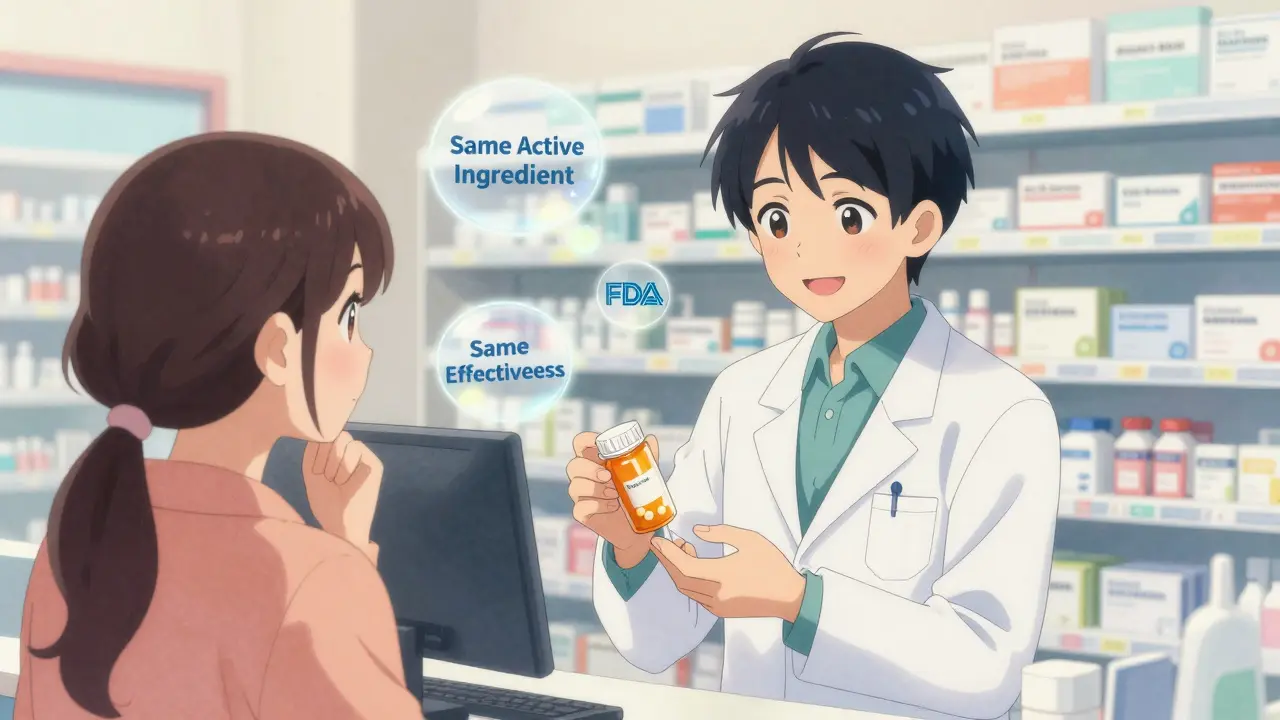
More than 90% of prescriptions filled in the U.S. are for generic drugs. They cost 80% to 85% less than brand-name versions and work just as well. The FDA requires them to meet the same strict standards for safety, strength, and quality. Yet, many patients still hesitate. Some worry they’re getting a weaker version. Others fear unexpected side effects. A 2024 study in PLOS ONE found nearly 40% of Americans still prefer brand-name drugs-even when the generic is cheaper and equally effective.
Why Do Patients Doubt Generics?
The problem isn’t science. It’s perception. Patients aren’t rejecting generics because they’re unsafe. They’re rejecting them because they don’t understand them. A 2023 survey in US Pharmacist showed that patients who believed generics were less effective were more likely to have low health literacy, lower income, or Medicaid coverage. Non-white patients were significantly more likely to distrust generics than white patients. One in five patients said they didn’t want to switch because they were used to their brand. Nearly a third feared new side effects. Reddit threads and pharmacy reviews reveal real stories: one patient reported that their generic Sertraline made them feel “off” compared to the brand. Another said they stopped taking their generic blood pressure pill because the pills looked different. These aren’t failures of the drug-they’re failures of communication.Doctors and Pharmacists Are the Key
Research is clear: the biggest factor in whether a patient accepts a generic is how their provider talks about it. A 2014 NIH study found that 84.7% of patients who received a clear explanation from their pharmacist were comfortable with the switch. Only 63.2% were comfortable if they got no explanation at all. Another study showed that patients who had a 2- to 3-minute conversation with their doctor about generics were far more likely to stick with them. It’s not about saying, “This is cheaper.” It’s about saying, “This is the same medicine, just without the brand name. The FDA makes sure it works exactly like the brand you’ve been taking.” Dr. Sarah Ibrahim from the FDA says it best: “Taking time to talk with patients about switching from brand-name to generic drugs can increase their confidence.” Patients want to be involved. They want to know why the change is happening. They want reassurance that nothing has changed in how the drug works.What Patients Need to Hear
Here’s what works-based on real patient feedback and peer-reviewed studies:- “The FDA requires generics to have the same active ingredient, strength, and dosage form as the brand.” This isn’t marketing. It’s law.
- “The only differences are in the color, shape, or inactive ingredients-like fillers or dyes. These don’t affect how the drug works.” Many patients think a different-looking pill means a different drug. They’re wrong.
- “Generics go through the same testing as brand-name drugs. The FDA checks them in the same labs, with the same standards.” A 2023 FDA report confirmed that generic drugs are held to identical quality controls.
- “If you’ve been taking a brand for years and switch to the generic, you should expect the same results. If you notice anything different, let us know.” This opens the door for feedback without dismissing concerns.
Don’t Assume They Know
Many providers think patients already understand generics. They don’t. A 2024 study found that 50% of patients with low health literacy believed generics were less safe and less effective. That’s not ignorance-it’s a gap in communication. Patients aren’t reading FDA websites. They’re not reading pharmacy pamphlets (only 62% found them “somewhat helpful”). They’re listening to you. Use simple language. Avoid terms like “bioequivalence” or “ANDA.” Say “same medicine, same results.” Ask open-ended questions: “What are your thoughts about switching?” or “Have you heard anything about generics that made you unsure?”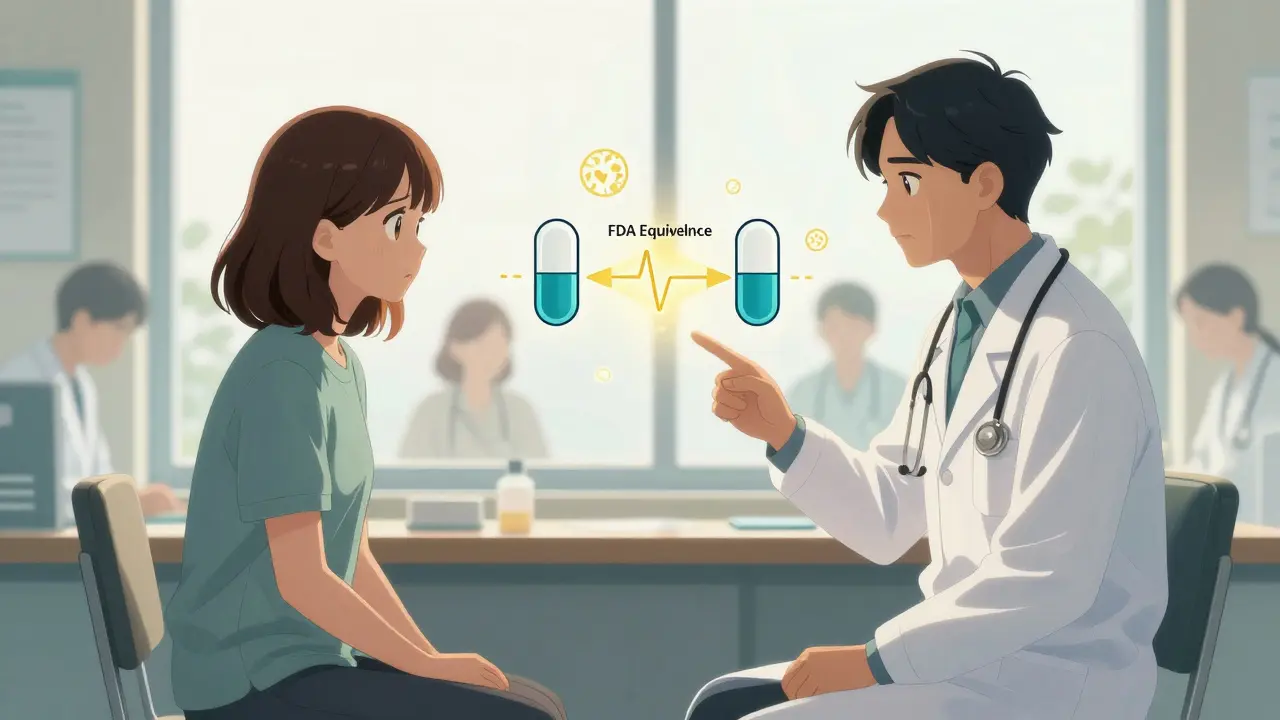
Pharmacists Are the Frontline
When a patient picks up a prescription, the pharmacist is often the last person they talk to before taking the medicine. That’s a critical moment. CVS Health patients praised pharmacists who took time to explain substitutions. Walmart Pharmacy patients complained about rushed consultations. The difference? One minute of genuine conversation. Pharmacists can:- Hand patients a printed one-pager from the FDA’s website (updated October 2023) that answers 50 common questions.
- Point to the FDA’s official statement: “Generic drugs are just as safe and effective as brand-name drugs.”
- Offer to call the prescriber if the patient is hesitant-instead of just swapping the pill.
What About Complex Drugs?
Some patients worry about inhalers, injectables, or patches. These are harder to copy exactly. The FDA has special rules for these, called “complex generics.” The key? Don’t ignore the concern. Say: “Some medicines, like inhalers or patches, are more complicated to match. But the FDA still requires them to work the same way. If your doctor prescribed this generic, it’s because it’s been tested and approved for you.” Patients who were unsure about using a generic inhaler were more likely to stop using it-until their provider explained the process. One patient said, “I thought the generic wouldn’t spray right. My pharmacist showed me how it works the same. I’ve been using it for six months now.”Age, Income, and Trust Matter
Older adults are more likely to accept generics. One study found 71.4% of patients over 60 trusted them. Why? They’ve seen the cost savings firsthand. They’ve had more time to build trust in the system. Younger patients, especially those with private insurance, are more likely to stick with brands-even when generics are available. They don’t feel the financial pressure. But they still need education. Patients with higher income and education are more likely to trust generics. That doesn’t mean lower-income patients shouldn’t get the same information. It means they need it in a way that’s clear, respectful, and repeated.
What Happens When You Don’t Talk About It?
If you don’t explain, patients assume the worst. They think the switch is about cost-cutting-not care. They worry the pharmacy is giving them a “second-rate” product. A 2024 machine learning analysis of patient attitudes found that provider communication was the strongest predictor of acceptance. Not cost. Not brand loyalty. Not age. Communication. When patients feel heard, they’re more likely to try the generic. When they feel ignored, they’re more likely to skip doses, switch back, or stop taking the drug altogether.Small Changes, Big Impact
You don’t need a new program. You don’t need expensive materials. Just do this:- When prescribing or substituting a generic, say: “I’m switching you to this generic version. It’s the same medicine, just less expensive. The FDA makes sure it works exactly like the brand.”
- Ask: “Do you have any concerns about this change?”
- Listen. Don’t interrupt.
- If they’re still unsure, offer to call the pharmacy to schedule a quick chat with the pharmacist.
- Follow up in two weeks: “How’s the generic working for you?”
The Bottom Line
Generics save the U.S. healthcare system $370 billion every year. They’re safe. They’re effective. They’re the standard. But no amount of data will change a patient’s mind if they don’t feel respected. Trust isn’t built by brochures. It’s built by conversation. The next time you prescribe a generic, don’t assume they know. Don’t assume they’re fine. Ask. Explain. Listen. That’s how confidence is built.What If a Patient Still Refuses?
Some patients will still say no. That’s okay. Don’t pressure them. Don’t dismiss them. Say: “I understand. Let’s keep using the brand for now. If you ever want to try the generic later, we can talk again.” Respect builds trust. Trust builds compliance. And compliance saves lives.Are generic drugs really as effective as brand-name drugs?
Yes. The FDA requires generic drugs to have the same active ingredient, strength, dosage form, and route of administration as the brand-name version. They must also prove bioequivalence-meaning they work the same way in the body. Studies show no meaningful difference in effectiveness or safety between generics and brand-name drugs.
Why do some patients feel different side effects with generics?
The active ingredient is identical. But generics can use different inactive ingredients-like dyes, fillers, or coatings-which can sometimes affect how the pill tastes or dissolves. Rarely, these may cause minor differences in how a person feels, especially if they’re sensitive to certain additives. If a patient reports a change, it’s important to listen, document it, and consider whether the issue is the generic or another factor. Switching back or trying a different generic brand may help.
Can pharmacists switch my brand-name drug to a generic without telling me?
In 18 U.S. states, pharmacists can substitute a generic without notifying the prescriber or patient. But best practice is to always inform the patient. Many patients feel misled if they discover the change after the fact. Even if not legally required, explaining the switch builds trust and reduces anxiety.
Do generics cost less because they’re made in lower-quality factories?
No. The FDA inspects all manufacturing facilities-brand and generic-using the same standards. Many generic drugs are made in the same factories as brand-name drugs. The lower cost comes from not spending money on marketing, branding, or patent protection-not from cutting corners on quality.
Why do generics look different from brand-name drugs?
By law, generic drugs can’t look exactly like the brand-name version because of trademark rules. That’s why the color, shape, or size might be different. But the active ingredient, dosage, and how it works in your body are identical. The difference is only cosmetic.
Should I be worried about switching from a brand to a generic for a serious condition like epilepsy or heart disease?
For most conditions, switching is safe and effective. For a small number of drugs with narrow therapeutic windows-like some seizure or blood thinning medications-doctors may choose to stay with the brand for stability. But this is rare and based on clinical judgment, not because generics are inferior. If your doctor recommends a switch, they’ve already weighed the risks. If you’re unsure, ask them to explain why they’re recommending the change.
How long does it take for patients to adjust to a generic drug?
Most patients adjust immediately. Some report minor differences in how they feel during the first few days, often due to psychological expectations or changes in inactive ingredients. These usually resolve within a week. If symptoms persist beyond two weeks, it’s worth discussing with a provider-but it’s rarely because the generic doesn’t work.

11 Comments
Bennett Ryynanen
January 2, 2026 AT 03:56Bro, I work in a pharmacy and people still think generics are 'fake medicine'. I had a guy yell at me because his blood pressure pill changed color. I showed him the FDA sheet, he still said 'but it doesn't look right'. We're not fighting science here-we're fighting fear.
Deepika D
January 2, 2026 AT 17:28Let me tell you something-when I was in Delhi last year, my aunt was on a brand-name antidepressant that cost her 3x more than the generic. She was terrified to switch. Took me three weeks of sitting with her, showing her the FDA labels, explaining how the same labs test both, and even comparing pill photos side by side. She finally tried it. Three months later, she told me, 'Beta, I feel the same. Just with more money in my pocket.' This isn't about science. It's about dignity. People need to feel like they're not being given leftovers. When you treat them like partners, not patients, they listen.
And don't get me started on how pharmacists rush through the explanation. One minute. That's all it takes. One minute of eye contact, one minute of 'I know this feels weird, but here's why it's safe.' That's all. No jargon. No condescension. Just human to human.
Health literacy isn't about IQ. It's about trust. And if your provider looks at you like you're dumb for asking, you'll never believe them-even if they're right.
Also, side note: the inactive ingredients? Yeah, some people are sensitive to dyes. Not often. But when it happens, it's real. That's why we need to say, 'If you feel off, tell us. We'll figure it out.' Not 'It's all in your head.' That's how people stop taking meds. And that's how hospitals fill up.
Generics saved my dad's life. He was on $400/month insulin. Switched to generic-$30. Same results. Same side effects. Same everything. But now he can afford his groceries too. That's not a compromise. That's justice.
Stop treating patients like they're stupid. Start treating them like they're your neighbor. Because they are.
Stewart Smith
January 3, 2026 AT 04:19So let me get this straight… we’ve got a system where the FDA says generics are identical, but patients still think they’re getting the ‘discount version’ of their medicine? And we’re surprised they’re confused? 🤦♂️
Meanwhile, the brand-name companies spend billions on ads telling people ‘this is the real one’ while the generic makers sit quietly. Who do you think wins that battle?
Branden Temew
January 4, 2026 AT 09:12It’s not about the pills. It’s about control. When you’ve been on the same brand for 15 years, the pill is part of your identity. Change the color? Change the shape? Suddenly you’re not taking ‘your’ medicine anymore-you’re taking ‘someone else’s idea’ of your medicine.
And honestly? That’s not irrational. It’s existential.
But here’s the twist: the people who need this explanation the most? They’re the ones least likely to read the FDA pamphlet. They’re the ones who get the prescription, walk out, and forget half of what the doctor said.
So maybe the real problem isn’t the patient. Maybe it’s the system that assumes knowledge is transmitted through paper, not presence.
Darren Pearson
January 5, 2026 AT 13:18It is an undeniable fact that the pharmacoeconomic imperative has, in many instances, supplanted the clinical imperative in contemporary American healthcare delivery. The conflation of cost-efficiency with therapeutic equivalence, while statistically valid, fails to account for the psychosocial dimensions of medication adherence. The patient’s perception of efficacy is not a mere heuristic-it is a phenomenological reality that must be addressed with intellectual rigor, not platitudes.
One cannot simply say ‘it’s the same drug’ and expect epistemic compliance. The hermeneutics of pharmaceutical trust require a nuanced, multidisciplinary approach-ideally involving behavioral economists, clinical psychologists, and communication theorists.
anggit marga
January 6, 2026 AT 10:25why do americans always think their system is the best when other countries have better generics and cheaper meds and no one here complains about it we dont even have brand names here just drugs and everyone takes them and lives longer and healthier what is wrong with you people
Aaron Bales
January 6, 2026 AT 21:35One minute. That’s it. Just one minute to say: ‘Same medicine. FDA says so. Let me know if something feels off.’
That’s all it takes to save lives. Stop overcomplicating it.
Frank SSS
January 8, 2026 AT 05:30Oh wow. Another article about how doctors need to ‘talk more’. Groundbreaking.
Meanwhile, the same people who say ‘just explain it’ are the ones who spend 3 minutes with a patient and then hand them a 12-page PDF they’ll never read.
And let’s not forget the insurance companies that force switches without telling anyone. Then act shocked when patients panic.
It’s not that people don’t understand. It’s that they’ve been burned too many times to trust the system.
So yeah, talk more. But fix the system first. Otherwise, you’re just doing therapy on a sinking ship.
Retha Dungga
January 8, 2026 AT 16:37sometimes i think the real drug is trust not the pill 🤔 the pill is just the container
Chandreson Chandreas
January 9, 2026 AT 07:55Man, I used to think generics were sketchy too… until my dad got on one for his cholesterol. Same pill, same results, but now he can afford his insulin too 😅
Turns out the only thing different was the price tag and the color.
And yeah, I get it-when you’ve been on the same blue pill for 10 years, switching to a white one feels like betrayal. But that’s not the drug’s fault. That’s the system’s failure to say: ‘Hey, this is still your medicine. We just took off the logo.’
Pharmacists: next time you hand someone a new bottle, don’t just say ‘it’s generic.’ Say ‘this is the same medicine your doctor prescribed. The only thing changed is your wallet.’
Small words. Big impact.
Also, side note: if you’re gonna change the pill, at least put a sticker on the bottle saying ‘SAME MEDICINE, DIFFERENT LOOK.’ People aren’t mind readers.
Jenny Salmingo
January 9, 2026 AT 18:33I just tell my grandma: ‘This is the same medicine, just cheaper. Like buying store-brand cereal. Same taste, less money.’ She gets it. No jargon. No stress.